The logistics industry faces pressure from supply chain disruptions.
VnExpress•06/10/2023
The trend towards regionalization, along with demands for cost reduction and greening, poses significant competitive challenges for Vietnamese logistics.
At the "Logistics Conference 2023" held on October 5th in Ho Chi Minh City, many experts pointed out changes in both the breadth and depth of the global supply chain, which are expected to pose numerous competitive challenges for Vietnam's logistics industry.
A prominent trend is the shift from globalization to regionalization. The criterion of cost optimization is now giving way to the requirement of diversification to ensure the supply chain is safer, more reliable, and closer to the consumer market.
This is reflected in the China + 1 policy of some corporations. Along with that, the US and Europe are sourcing goods closer together, revitalizing production. Julien Brun, Director of CEL, said that Mexico has reduced shipping times to almost the same efficiency as China. Meanwhile, India is aggressively attracting FDI to capitalize on the China + 1 initiative.
"We are facing regionalization, so we need to find ways to compete with Mexico in supplying goods to North America, or North Africa to Europe," said Julien Brun.
In this game, from a logistics cost perspective, Vietnam is not yet competitive. Logistics and distribution costs in Vietnam are quite high, ranging from 3-15% depending on the industry, much higher than in Thailand. Solving this problem is essential for Vietnam to gain a foothold in the region, according to Julien Brun. Businesses in Vietnam have complex, unstreamlined production, warehousing, and distribution systems, resulting in low efficiency.
Experts discuss at the "Logistics Conference 2023" on the morning of October 5th. Photo: Dau Tu Newspaper.
Ms. Pham Thi Bich Hue, Founder and CEO of Western Pacific, stated that transportation costs account for over 60% of the company's total logistics costs, while this figure is only 30-40% in other countries in the region. "The infrastructure lacks synchronization and regulation from the highest management agencies; local planning is still largely superficial and not localized to the characteristics of each region and customer needs," Ms. Hue pointed out.
Stating that the trend towards regionalization is the biggest challenge, Alexander Olsen, Vice President of International Transport and Trade at ITL, said that many corporate clients want to use Vietnam as a cargo hub, but customs procedures and regulations are unclear.
"Combining goods imported from China or Cambodia with Vietnamese goods for export is difficult. It is possible, but it is complicated, costly, and inefficient," he said.
Another change in the supply chain is the trend towards greening, which means sustainable development, reducing emissions, and energy consumption. "The entire international supply chain is demanding green, so we must be green, otherwise we will be pushed out," said Mr. Tran Thanh Hai, Deputy Director of the Import-Export Department, Ministry of Industry and Trade .
Governments in Europe, the US, and Asia all have 10, 20, and 50-year targets to reduce emissions. Edwin Chee, COO of SLP Vietnam, noted that many major global companies have shifted their presence in Vietnam. He predicted that in the next 5-10 years, in addition to efficiency, they will also prioritize sustainability.
Alexander Olsen stated that he is installing solar power on warehouses, using trucks that meet Euro 4 emission standards, and is working with authorities to explore ways to import the first batches of electric trucks into Vietnam.
"Building an electric truck fleet in Vietnam is challenging because it requires the development of synchronized infrastructure (charging stations)," he remarked. He also recommended that, for a greener approach, the industry should focus more on exploiting river ports because road transport emits eight times more pollutants than inland waterway transport.
According to the World Bank, Vietnam ranks 64th out of 160 and 4th in ASEAN after Singapore, Malaysia, and Thailand in terms of logistics development. In its 2022 assessment by supply chain management firm Agility, Vietnam ranked 11th in the top 50 emerging logistics markets, with a growth rate of 14-16% and an annual market size of $40-42 billion.
Despite continuous progress, even before the global supply chain underwent significant changes due to the pandemic and geopolitical instability, Vietnamese logistics still faced limitations. According to Deputy Minister of Planning and Investment Pham Duy Dong, these limitations include inconsistencies between policies and infrastructure; a large number of businesses in the industry, but most are small-scale contractors for foreign corporations; and a shortage of skilled personnel, with 93-95% of workers lacking formal training.
Addressing long-standing weaknesses and preparing for new changes requires multi-stakeholder action to improve infrastructure and technology.
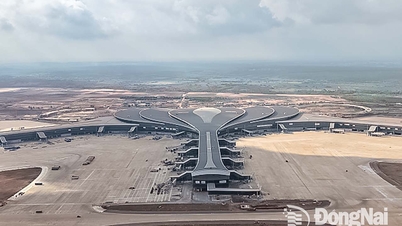
On the government side, Mr. Pham Duy Dong said that over the past two years, many key infrastructure projects and important expressways have been completed. Currently, the country has 1,800 km of expressways, with the goal of having 3,000 km by 2025 and 5,000 km by 2030. In addition, coastal roads, other connecting roads, and other infrastructure such as Long Thanh airport, seaports, and airports are being focused on construction.
According to Mr. Dong, some tasks that need to be continued in the coming period include perfecting policies to regulate logistics services, multimodal transport, and cross-border transport, comprehensively covering all services, and legalizing international commitments.
"We also need to support the development of strong logistics corporations, boost overseas investment and export of logistics services, creating direction and impetus for market development," Mr. Dong said. Regarding human resources, the government needs to develop professional standards for the logistics sector and support schools in investing in teaching facilities.
Meanwhile, experts recommend that businesses accelerate digitalization. This is the key to simultaneously solving the problems of cost, speed, and sustainable development. "Logistics costs are being wasted in many stages, highlighting the importance of digital transformation and having data to optimize," said Ms. Nguyen Thi Bach Yen, Deputy General Director of Smartlog supply chain solutions company.
However, digitalization also requires careful planning. Sam Tan, Director of New Product Introduction at NPI UB Malaysia, said that the country's logistics industry is shifting strongly towards automation, but there are also some painful lessons to be learned.
"Our experience shows that deploying any technology requires a learning journey, from assessing suitability and feasibility, calibration, personnel training, and on-site evaluation, rather than simply saying you'll do it immediately," he stated.
Expert Julien Brun advises businesses not to focus too much on fancy concepts like artificial intelligence (AI) or robotics, but instead to initially focus on fundamentals such as transitioning from using Excel to professional cloud-based software services. "If you haven't adjusted your core platform and are still using Excel, don't even dream about AI," he cautioned.



![[Image] Pleasant weather helps students enter the 10th grade entrance exam with confidence.](https://vphoto.vietnam.vn/thumb/1200x675/vietnam/resource/IMAGE/2026/05/29/1780034401612_ngay-1-thi-lop-10-minh-duy-8-5009-jpg.webp)


![[Photo] Ba Lang An Lighthouse - the "eye of the sea" amidst the "rock museum" of Quang Ngai province.](https://vphoto.vietnam.vn/thumb/1200x675/vietnam/resource/IMAGE/2026/05/29/1780038698840_anh-man-hinh-2026-05-29-luc-14-10-42.png)













































































Comment (0)