

As a passionate and patriotic journalist and media leader, Truong Duc Minh Tu, Editor-in-Chief of Quang Tri Newspaper, has recorded countless memories and expressed his feelings about the places he has traveled through and the people he admires in his memoir "Life is like a novel," published in early October 2024.
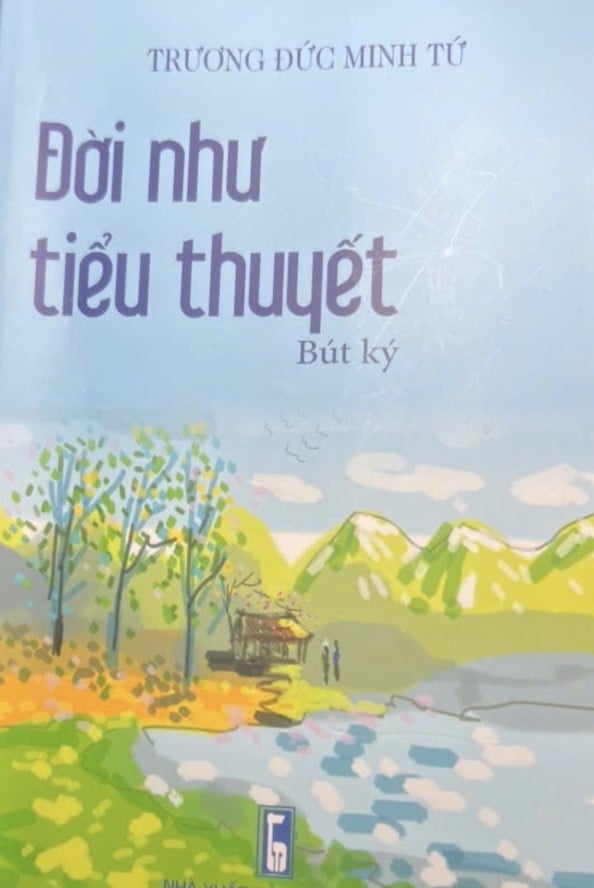
On the afternoon of October 24, 2024, the Dong Da Post Office delivered to me a copy of the memoir "Life is Like a Novel" by journalist and writer Truong Duc Minh Tu, a gift from Quang Tri. The book had an elegant cover and nearly 300 pages printed with easy-to-read fonts. In the seven parts of the book, besides the Foreword and the author's brief introduction, the five main sections contain messages about human relationships and camaraderie; true stories tinged with legend; and the places the author has traveled to both domestically and internationally, which have provided the valuable "ingredient" for his soulful and captivating writing.
As Truong Duc Minh Tu confided, the memoir "Life is like a novel" can be considered a document that helps readers understand and learn more about the talented sons and daughters of the homeland who, for various reasons, left for the ends of the earth, unable to return to their hometown, where every field, village, river, and dock nourished the land with fertile soil, enabling them to contribute magnificent spaces of music and literature to the world, of which I myself am one of those who admire and am grateful. I shared that thought with him when I read the first page of the article "The Reunion of Father and Son, Musician Hoang Thi Tho".
I was moved when I read a passage from a letter by musician Hoang Thi Tho to his son, Chau La Viet: “For thirty-five years, I have always been proud of one thing: my life, including yours and your mother's, is like a novel. And what novel doesn't have many dramatic twists and turns, my son? Well, we, father + mother + son, even though we encounter hardships, obstacles, and sadness, let's consider it the fate of those whose lives are like novels...” (page 21) and “any delay, any late understanding is painful, but every delay is beautiful. That is the delay in a novel, the delay in our novelistic lives” (page 22).
Reading further, even though each character has a different life story and lives in different hidden corners and recesses, each person's fate shines with the color of a novel. Perhaps that's why the author named his creation "Life as a Novel"?
Through her writings, the life and love story of the female artist Tan Nhan with her first husband, the musician Hoang Thi Tho, is full of twists and turns, many of which were unexpected and unpredictable, yet they still fondly remembered each other. If the pinnacle of Tan Nhan's singing style was the song "Far Away at Sea" by Nguyen Tai Tue in the 1960s, there is a line that perfectly captures Tan Nhan's feelings when they went their separate ways, for so many years without seeing each other: "Longing and yearning from afar, oh sea this evening." And "Far away, a flock of birds spreads its wings across the sky – Oh birds, stop so I can send my message to that distant place..." (A folk song by the banks of Hien Luong, music by Hoang Hiep, lyrics by Dang Giao).
This is also the "legendary" voice of singer Tan Nhan that brought tears to the eyes of many during the years when the country was divided by the US-Diem regime, and the Hien Luong River in Quang Tri - Tan Nhan's hometown - became the temporary demarcation line.
Chau La Viet grew up in love with her first father, Hoang Thi Tho; later, she had a second father figure, the talented journalist and writer Le Khanh Can, who was the head of a department at the Nhan Dan newspaper. Both Tan Nhan and Le Khanh Can lived happily together, providing a "foundation" for the success of the Meritorious Artist Tan Nhan's singing career as well as Le Khanh Can's journalistic and literary career.
I was fortunate enough to live with the Chau La Viet family in the cramped and difficult Nam Dong apartment complex at 178 Tay Son Street, Dong Da District, for many years. The renowned journalist and writer Phan Quang also lived there and was a close friend of Tan Nhan and Le Khanh Can from the years of resistance against French colonialism. I admired their harmonious lifestyle and exceptional intellect.
Reading Minh Tu's memoir today, I've come to understand more about the intriguing love story between Tan Nhan and musician Hoang Thi Tho. Due to the difficult circumstances of the time, he was forced to settle abroad until 1993, when he had the opportunity to return to Vietnam and reunite with his child, Chau La Viet, born in a forest during the resistance war in Ha Tinh, by the La River, in 1952.
Later, he adopted the name Châu La Việt to commemorate his birthplace and the hometown of Hoàng Thi Thơ and Tân Nhân, which shared the Cửa Việt River. It turns out that the origin of the name of journalist and writer Châu La Việt is similar to that of a novel. However, what is noteworthy and admirable is that he followed his father Lê Khánh Căn through the Trường Sơn mountains, fulfilling his duty as a soldier, and then graduated from Hanoi Pedagogical University in peacetime, becoming a journalist and writer with remarkable writing abilities in journalism, poetry, and novels.
I've gone into a bit of detail about Hoang Thi Tho, Tan Nhan, Le Khanh Can, and Chau La Viet because Minh Tu's writings have touched the hearts of readers with stories of people who, despite the ups and downs of life, still nurtured love and hope, overcoming all hardships and obstacles to live according to the noble ideals of life – and 35 years later, Chau La Viet met Hoang Thi Tho again with only one wish: "Father, please always use your musical talent to serve the people." And composer Hoang Thi Tho did exactly what his son wished for; among his more than 500 songs, the themes of love for homeland, country, people, and love for peace remain the dominant themes.
With pages overflowing with firsthand information, the author vividly portrays the veteran journalist and writer Phan Quang, a towering figure in Vietnamese journalism—intelligent, elegant, and still prolific even after the age of 90, resulting in a vast body of work unmatched by few other journalists; the journalist and poet Nguyen Hong Vinh, who twice served as a war correspondent in the Truong Son Mountains during the war against the US; and three times in the Truong Sa Islands during the arduous 1980s, resulting in five volumes of political essays titled "Keeping the Flame Alive," totaling over 3,000 pages, and twelve volumes of poetry; and the journalist and writer Pham Quoc Toan, a former soldier, passionate about journalism and literature, a fast and prolific writer who writes in various genres, especially his novel "From the Nhung Riverbank," which vividly depicts the real-life journalist and writer Phan Quang from his youth to his age.
It could be said that Phan Quang's life was like a novel, from a young man born in the rocky land of Quang Tri, where "the hills of sim fruit didn't yield enough to feed the people," he harbored literary dreams in his youth, but when he joined the revolution, the organization assigned him to join the Cuu Quoc (National Salvation) newspaper team in Zone IV along with Che Lan Vien.
With his intelligence and self-taught knowledge, Phan Quang demonstrated his journalistic and literary talent from the very beginning of his career. A prime example is when, in just one night, at the urgent request of Che Lan Vien for an article for the Tet (Lunar New Year) literary supplement, Phan Quang completed the short story "Red Fire," which even the discerning Che Lan Vien exclaimed upon reviewing it: "This story is excellent!"
His journalistic career spanned Zones IV and III, the Viet Bac war zone, and after the liberation of Hanoi (October 10, 1954), he was assigned to work at Nhan Dan newspaper, the largest newspaper of the Communist Party of Vietnam. He primarily focused on agriculture and rural issues for 17 years, producing memorable reports, investigative reports, essays, and memoirs.
Perhaps he was one of the few journalists who had the privilege of accompanying President Ho Chi Minh and other high-ranking leaders, such as Le Duan, Truong Chinh, To Huu, Nguyen Chi Thanh, etc., on numerous trips to the grassroots level. These were excellent opportunities to produce articles that were both insightful and engaging, earning praise from President Ho Chi Minh and other leaders.
If we count from his first work at the age of 20 (1948), then even after turning 90, he remains energetic, continuing to write until today at the age of 96. Over 70 years of writing, he has published 7 collections of short stories, 9 collections of essays, 1 anthology (3 volumes), 6 novels, and 6 translations of foreign literature. Many readers love and remember his works, such as "One Thousand and One Nights," which has been reprinted 30 times; and "One Thousand and One Days," which has been reprinted more than 10 times by 5 reputable publishers (page 127).
In this collection of essays, we cherish the vivid stories accumulated throughout the journalistic life of Truong Duc Minh Tu, such as "Another Love Story by the O Lau River" about security officer Ngo Hoa; "The Story of the Wounded Soldier Teacher Ho Roang," a Van Kieu ethnic minority man passionate about the cause of "nurturing people"; "The Woman with a 30-Year Journey to Seek Justice," demonstrating the civic responsibility and social duty of a writer in the face of the prolonged injustice suffered by Ms. Tran Thi Hien in Pleiku town... (from page 163 to page 204).
The final section of the book contains travelogues about visits and work trips to China, Laos, Cambodia, Thailand, and South Korea, brimming with information about the beauty of the land and people in each country, and about the friendship and peace between Vietnam and these nations (from page 225 to page 281).
It would be a great oversight not to mention the author's talent for "breathing life" into words, his art of note-taking, and his skillful exploitation of valuable details and data – the foundation of this book's appeal. I enjoyed rereading "The Story of the Wish for Peace" (page 223), which records the heartfelt conversation between Mr. Lee Won Hee, Director of Foreign Affairs of the Korean Journalists Association, and the author, the Chairman of the Quang Tri Journalists Association, who was born and raised at the 17th parallel – where the Ben Hai River once served as the temporary demarcation line separating North and South Vietnam for 21 long years.
Mr. Lee shared the hardships of the Vietnamese people during that long war and expressed admiration for the heroic achievements of our country in fighting and building, which aspires to peace, cooperation, and development with South Korea. Mr. Lee mentioned that translator Kyung Hwan, when translating "Dang Thuy Tram's Diary" into Korean, changed the title to "Last Night I Dreamed of Peace" (page 222).
Yes, with a yearning for peace, over the years, Quang Tri, the author's hometown, has regularly organized "Festivals for Peace," because nowhere else is like Quang Tri province—not vast in land, not densely populated, yet possessing 72 martyrs' cemeteries, including two national martyrs' cemeteries: Truong Son and Duong Chin.
Truong Duc Minh Tu used this piece as the epilogue to the book because the lives of the characters in this book create a memoir imbued with profound human emotion, always nurturing the aspiration for peace and faith in a bright future for the country, and is steadily moving into a new era - an era of national resurgence.
Associate Professor, Dr. Nguyen Hong Vinh
Source: https://baoquangtri.vn/nghia-tinh-va-le-song-189294.htm




















































































Comment (0)