

Pilot project for high-tech marine aquaculture.
In a presentation submitted to the 11th National Congress of the Vietnam Fatherland Front (VFF), for the 2026-2031 term, the VFF Committee of Khanh Hoa province stated that the marine and coastal economy currently contributes approximately 80% of the province's GRDP. Fisheries continue to be one of the important economic sectors, with a total output of over 280,000 tons in 2025 and export revenue of approximately 870 million USD.
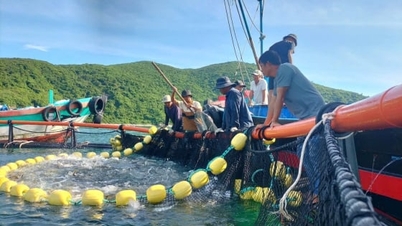
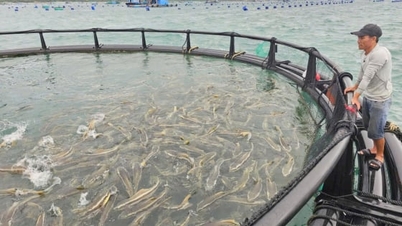
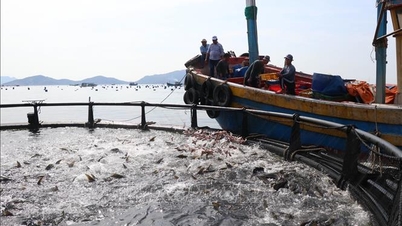
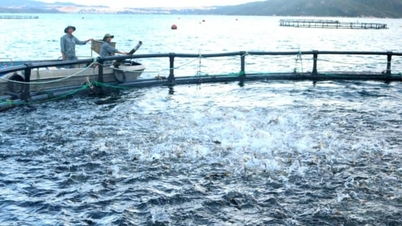
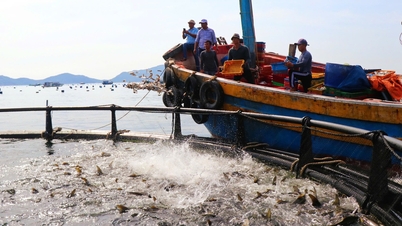
As natural fishery resources decline and the requirements for combating IUU (Illegal, Unreported, and Unregulated) fishing become increasingly stringent, Khanh Hoa province is beginning to shift strongly towards high-tech aquaculture. From 2025, the province has been authorized by the Government to pilot the development of high-tech aquaculture in the Van Phong, Nha Trang, and Cam Ranh aquaculture zones. These models for raising marine fish, lobsters, etc., are equipped with underwater surveillance cameras, positioning systems, and remote monitoring via electronic devices.
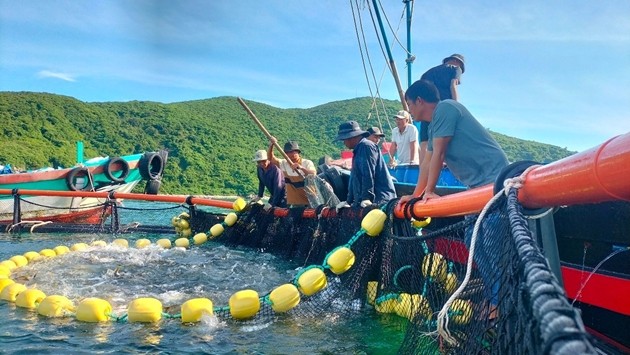 |
| Harvesting farmed fish at a high-tech model farm in Dam Bay, Nha Trang, Khanh Hoa. (Photo: National Agricultural Extension Center) |
According to the Vietnam Fatherland Front Committee of Khanh Hoa province, the application of technology helps control the aquaculture environment, trace origins, ensure food safety, and reduce pressure on coastal fishing. This is also a direction to gradually change production methods at sea, limit risks from natural disasters and diseases, and protect the aquaculture environment.
In the first three months of 2026, Khanh Hoa's seafood production reached approximately 60,000 tons, including about 52,000 tons from fishing and over 8,100 tons from aquaculture.
Fishermen join forces to protect the sea.
Along with livelihood transformation, many marine conservation models in Khanh Hoa also involve the direct participation of fishing communities. At the Hon Mun Marine Reserve in Nha Trang Bay or the Ran Trao Marine Ecosystem Protection Area in Van Hung commune, local people participate in protecting coral reefs and coastal fisheries resources.
Co-management of conservation projects has contributed to the recovery of fisheries resources, the protection of threatened marine species, and the maintenance of stable marine ecosystems. The practice of destructive fishing methods has been eliminated in many areas.
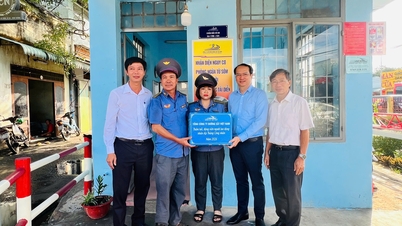
Many programs supporting fishermen in coastal and island areas have been implemented locally in recent years. The "Lighting Up the Sea for Fishermen" program has donated batteries, LED lights, battery packs, first-aid kits, a handbook on "Things to Know About Seafood Fishing," and many other essential items to fishermen.
According to the Vietnam Fatherland Front Committee of Khanh Hoa province, local women's associations have mobilized over 15.7 billion VND through the "Accompanying Women in Border Areas" program; organizing hundreds of awareness campaigns, providing livelihood support, scholarships, and health insurance for women, children, and fishermen in coastal and island areas.
The Provincial Youth Union also implemented many activities focused on the islands and seas, such as "Lighting up distant islands" and "Truong Sa in my heart," while also taking care of the families of officers, soldiers, and young people who have enlisted.
According to the Vietnam Fatherland Front Committee of Khanh Hoa province, in the coming time, the locality will continue to promote propaganda and mobilize people to develop the marine economy associated with protecting maritime sovereignty and islands; at the same time, promote the self-governance role of the community in protecting the marine environment and developing sustainable livelihoods. In the context of the marine industry facing many changes, gradually shifting from exploitation to high-tech aquaculture is considered one of the long-term directions for the locality.
Source: https://thoidai.com.vn/ngu-dan-khanh-hoa-dua-camera-xuong-bien-221500.html
![[Photo] General Secretary and President To Lam presides over a meeting on the implementation of Directive No. 34-CT/TW of the Party Central Committee.](https://vphoto.vietnam.vn/thumb/1200x675/vietnam/resource/IMAGE/2026/05/19/1779187768672_a1-bnd-2350-631-jpg.webp)
![[Photo] Capturing the moment the tide recedes at Yen Binh Son rapids - a million-year-old scenic spot in Quang Ngai.](https://vphoto.vietnam.vn/thumb/1200x675/vietnam/resource/IMAGE/2026/05/19/1779175463885_yen9-1199-jpg.webp)
![[Photo] National Assembly Chairman Tran Thanh Man attends the groundbreaking ceremony for the National Highway 1A spatial axis project.](https://vphoto.vietnam.vn/thumb/1200x675/vietnam/resource/IMAGE/2026/05/19/1779161360398_ndo_br_bnd-1412-jpg.webp)































![[Photo] General Secretary and President To Lam receives Indian Defense Minister Rajnath Singh](https://vphoto.vietnam.vn/thumb/402x226/vietnam/resource/IMAGE/2026/05/19/1779184046302_anh-man-hinh-2026-05-19-luc-16-46-58.png)



















Comment (0)