

On the afternoon of November 14th, the Ho Chi Minh City Department of Transport organized a consultation conference on the pre-feasibility study of 5 investment projects to upgrade and expand existing roads at the city's gateways under the BOT (Build-Operate-Transfer) model, which Resolution 98 allows Ho Chi Minh City to pilot.
The goal is to start construction on the first project by the end of 2025.
Presiding over the meeting, Mr. Tran Quang Lam, Director of the Ho Chi Minh City Department of Transport, stated that Ho Chi Minh City has a mechanism for investing in transportation infrastructure using the BOT (Build-Operate-Transfer) model on existing roads according to Resolution 98. However, because it is still in the pilot phase, its implementation requires close supervision and evaluation to ensure transparency, openness, and effectiveness.
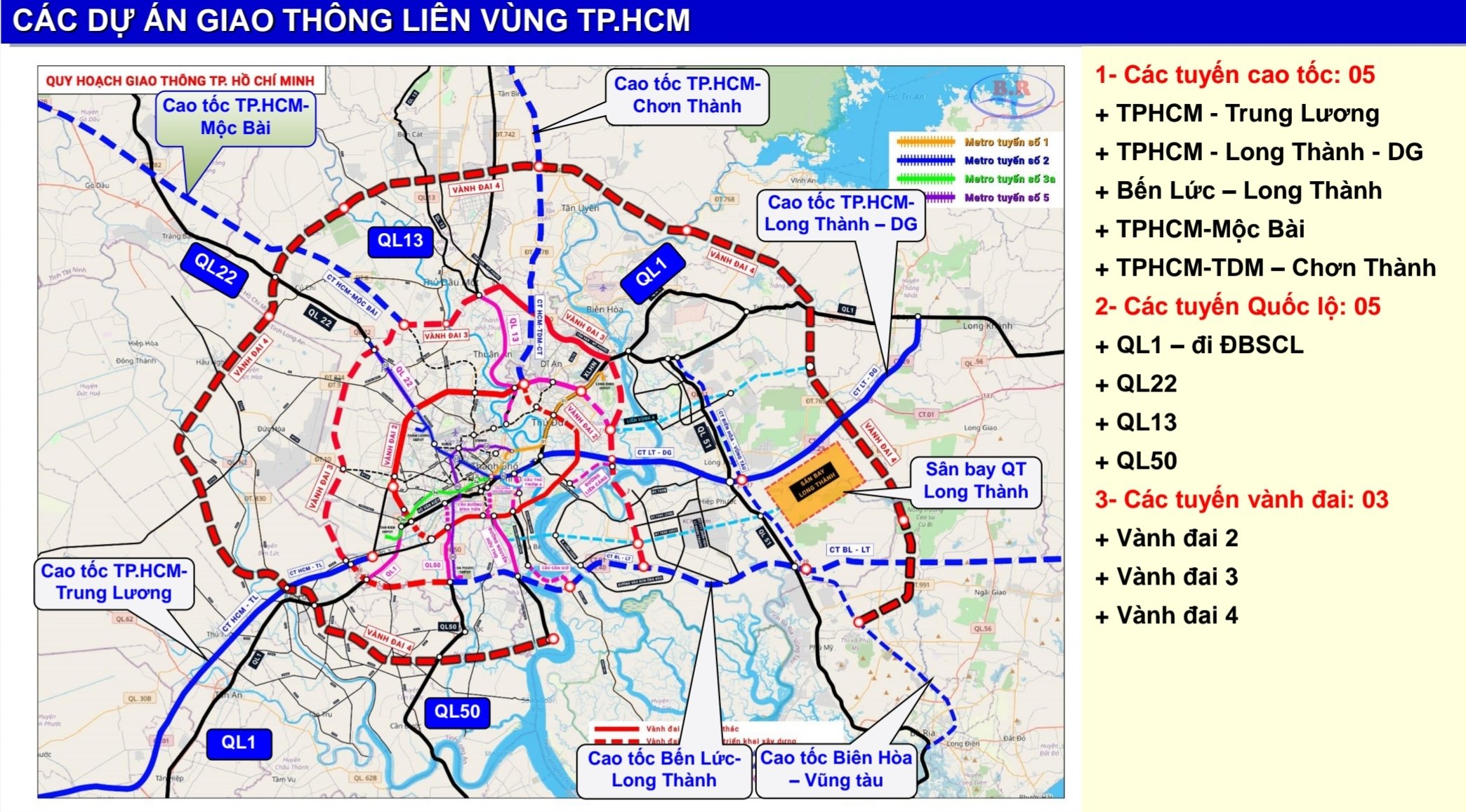
Traffic maps of routes in Ho Chi Minh City and 5 planned BOT projects.
Following a selection process, the Ho Chi Minh City People's Council has approved the study of five roads to be developed under the BOT (Build-Operate-Transfer) model. These roads are funded by the state budget for research, with the Department of Transport acting as the investor and preparing the feasibility study report for submission to the City People's Committee for approval.
Mr. Lam stated that, regarding the implementation roadmap, the pre-feasibility study report will be submitted to the grassroots-level appraisal council in December 2024 (or at the latest by January 2025); the investment policy will be approved in the first quarter of 2025; a contractor will be selected to prepare the feasibility study report; surveys will be conducted, the feasibility study report will be prepared, and investor interest will be assessed; and the feasibility study report will be approved in the third quarter of 2025. The investor will be selected, with the goal of commencing the first project by the end of 2025.
According to Lam, BOT construction on existing roads must harmonize the interests of the people, the State, and investors; have a positive impact on traffic and society; and apply technological solutions during construction to accelerate progress, minimize traffic impact, and quickly put the project into operation. In addition, participating investors should also review and comply with the regulations of Resolution 98.

Mr. Tran Quang Lam, Director of the Ho Chi Minh City Department of Transport.
It is urgent to expand 5 gateway routes.
Five gateway routes to Ho Chi Minh City are being proposed for BOT (Build-Operate-Transfer) projects, including: National Highway 1A (from Kinh Duong Vuong Street to the border of Long An province), National Highway 13 (from Binh Trieu Bridge to the border of Binh Duong province), National Highway 22 (from An Suong intersection to Ring Road 3); the North-South arterial road (from Nguyen Van Linh Street to the Ben Luc - Long Thanh expressway); and the construction of Binh Tien bridge and road (from Pham Van Chi Street to Nguyen Van Linh Street).
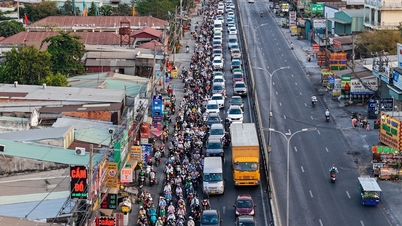
Currently, all five routes experience severe traffic congestion, especially during peak hours or holidays. In addition, traffic accidents occur frequently, resulting in low service capacity on these routes.
Based on that, the consulting units proposed a plan for constructing the roads, suggesting the construction of underground roads, elevated roads, and a combination of other modes of transportation.
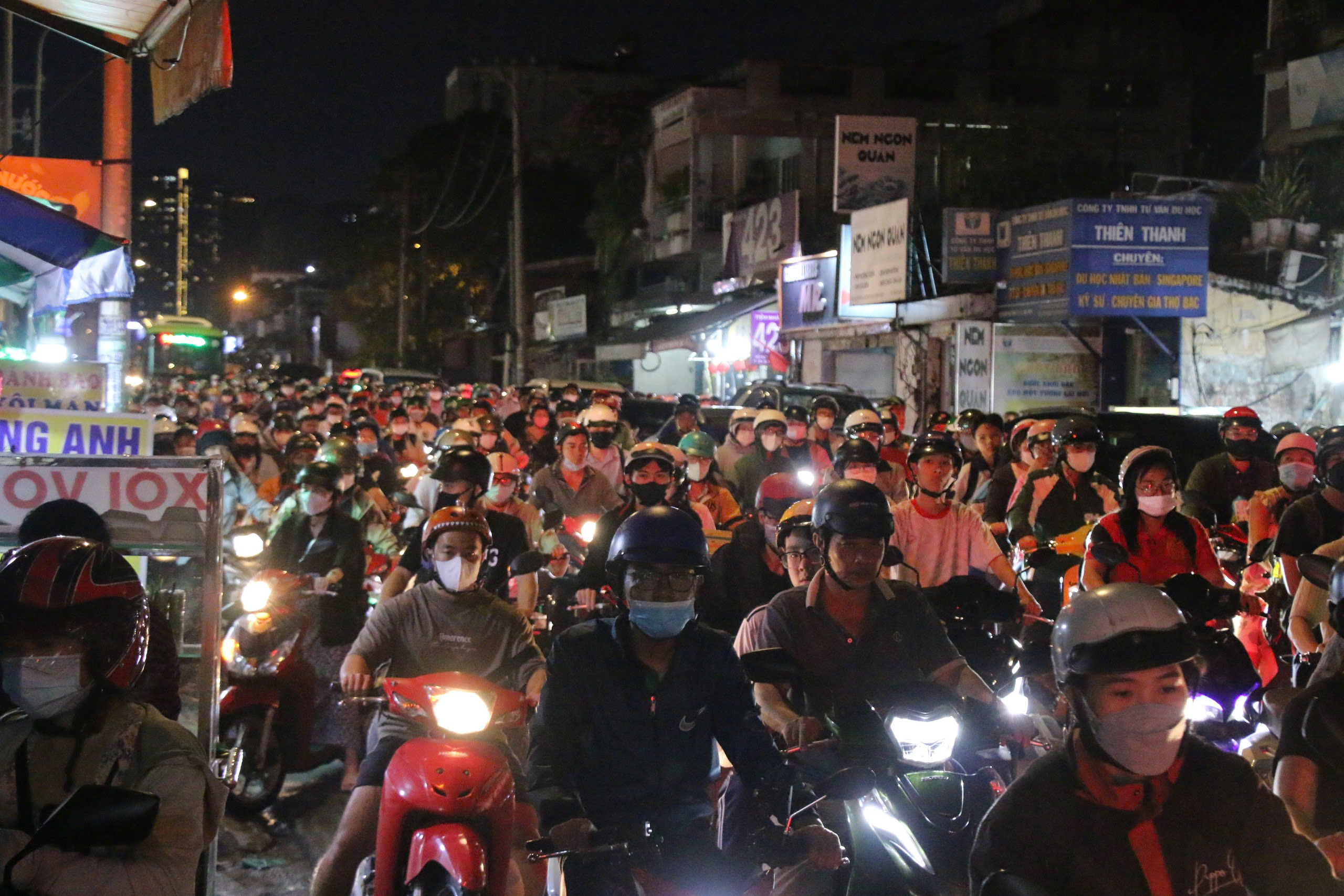
Traffic congestion at the gateways to Ho Chi Minh City is becoming increasingly serious.
On National Highway 13, the current road width from Binh Phuoc intersection to Binh Loi intersection is 19-26.5m, with the carriageway width ranging from 14.5-14m, a 0.5m median strip, and sidewalks ranging from 4-8m. The total length of the route is approximately 5.9km.
The proposed plan involves constructing a road at a lower level and an elevated viaduct; the viaduct connecting the Binh Trieu Bridge to the Binh Phuoc intersection will be 3.7 km long. The route includes two three-level grade-separated interchanges: the Binh Trieu - Pham Van Dong interchange and the final interchange connecting National Highway 1A and National Highway 13.
This road project has a total estimated investment of 19,953 billion VND, affecting approximately 1,150 households and an area of about 18 hectares.
With the Xô Viết Nghệ Tĩnh and Đinh Bộ Lĩnh routes (Bình Thạnh district) already experiencing severe traffic congestion, the consulting unit proposed studying the possibility of adding a section from Bình Triệu bridge to the Hàng Xanh intersection to create a traffic artery connecting the northern gateway to the city center, avoiding "transferring traffic congestion from one place to another".
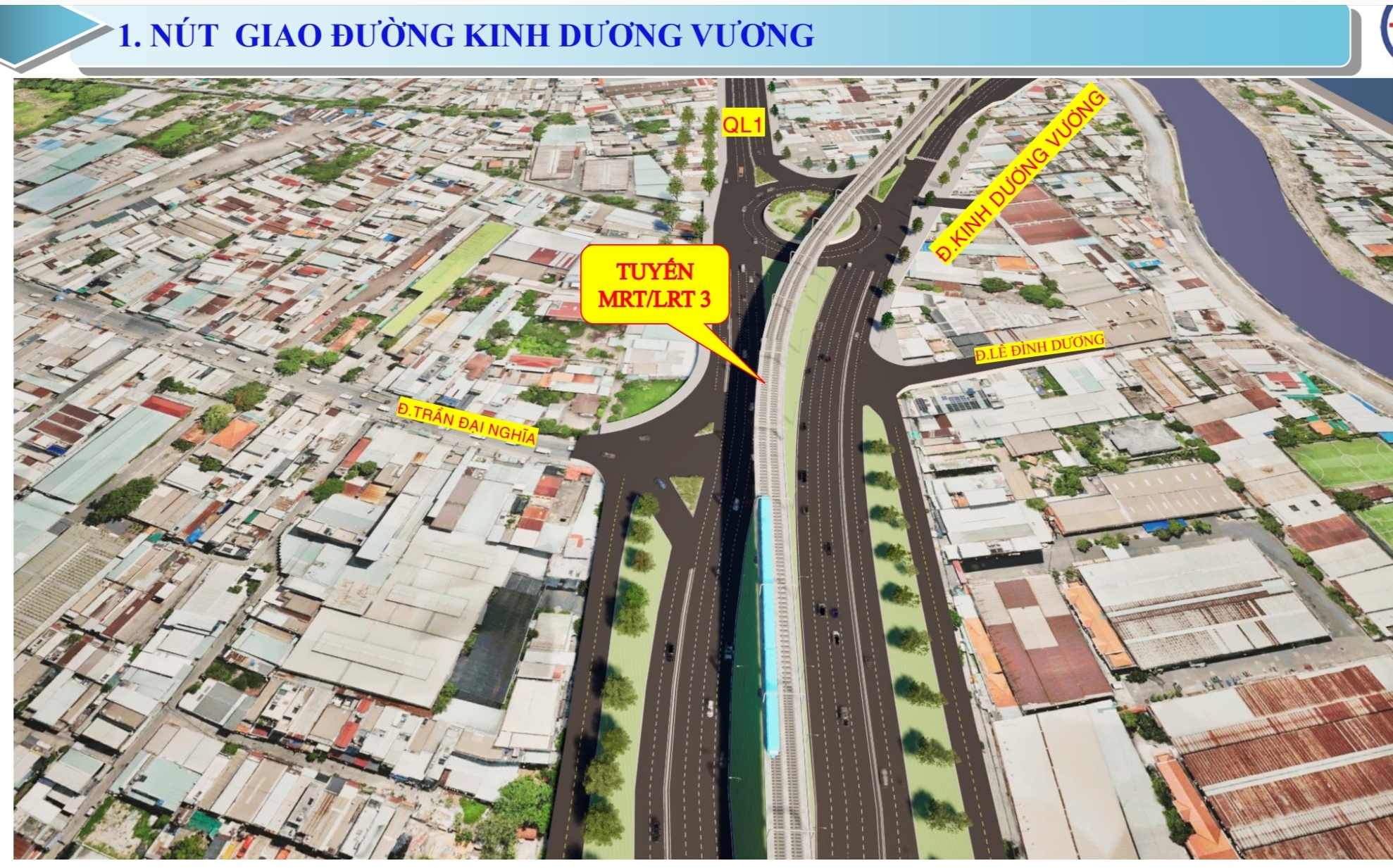
Design of elevated and ground-level lanes on National Highway 1A.
National Highway 1 is located at the western gateway of Ho Chi Minh City, with its starting point connecting to the An Lac - Kinh Duong Vuong intersection and its end point bordering Long An province. The route has 12 intersections, including 3 multi-level interchanges (Tan Kien intersection, Binh Thuan intersection, and Ring Road 3 intersection).
This is a busy route with frequent traffic jams at the An Lac intersection, extending to Tran Dai Nghia Street, Binh Dien Bridge, and the Binh Thuan intersection.
The proposed plan includes constructing both underground and elevated sections of the 9.6km road with a 60m cross-section. It also recommends the complete construction of grade-separated interchanges. The estimated investment is 15,897 billion VND.
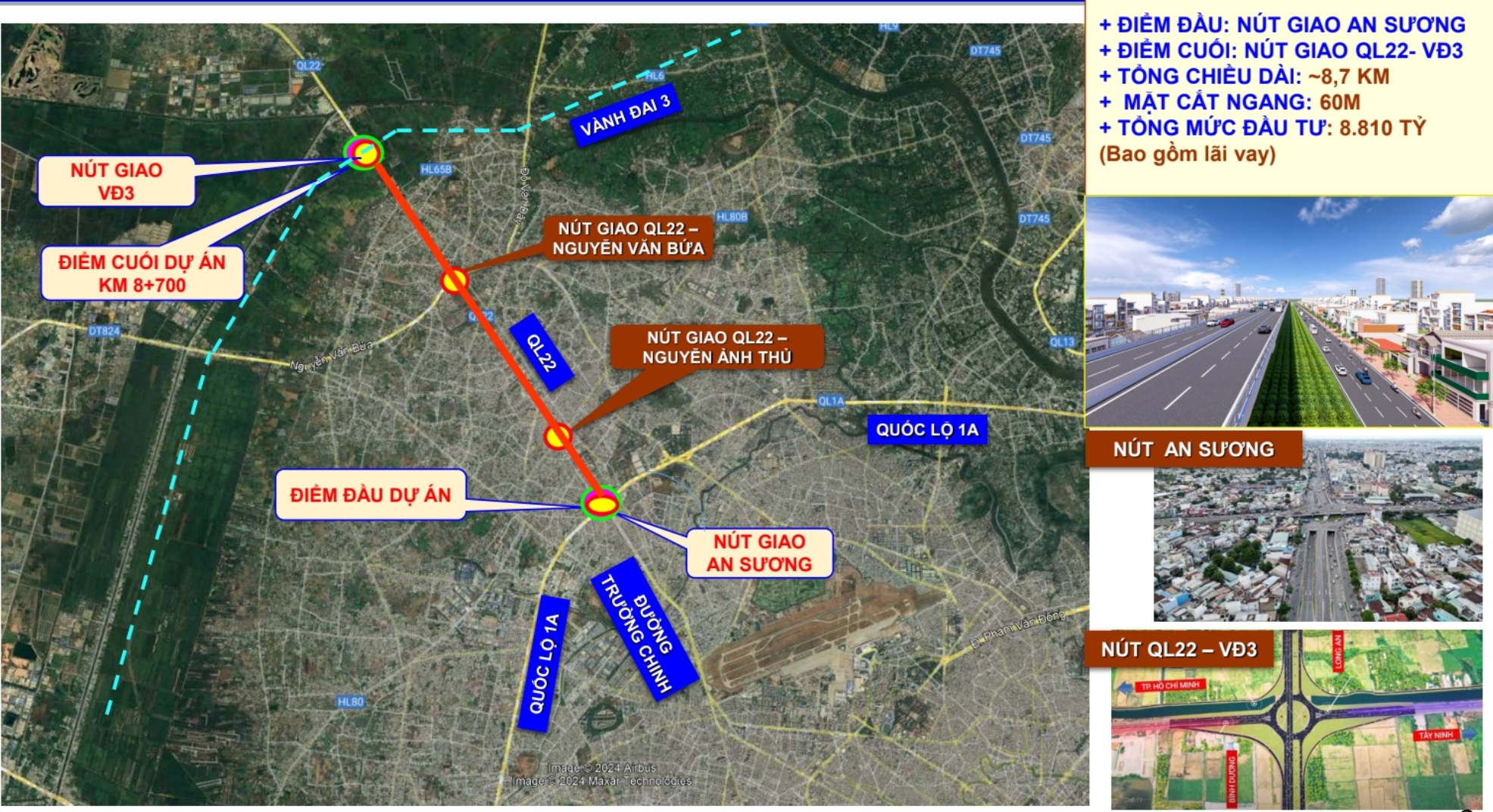
The QL22 section is 8.7km long, with an investment of approximately 8,800 billion VND.
On National Highway 22, starting from the An Suong intersection and ending at the Ring Road 3, the route is 8.7km long. The proposed options include an underground section with overpasses at 7 intersections along the route. An elevated section would serve high-speed traffic connecting Ring Road 3 to An Suong, midway along Metro Line 2. The route will include 3 major intersections and several other grade-separated interchanges. The total investment for the project is estimated at 8,810 billion VND.
Regarding the North-South axis, the section from Nguyen Van Linh Street to the Ben Luc - Long Thanh Expressway currently has two parallel roads, with expansion planned for the middle section. This route is considered advantageous because land acquisition is only required at the intersections, and in the future, Metro Line 4 will run from the city center to Hiep Phuoc (Nha Be District).
However, due to the presence of a large water supply pipeline along the route, the proposed plan is to construct a four-lane elevated bridge, offset from the main axis of the route. The total length of the elevated bridge is 7.2 km, including two interchanges: one with Nguyen Van Linh Street and another with the Ben Luc - Long Thanh Expressway. The estimated total investment is 8,483 billion VND.
Finally, the Binh Tien bridge and road project starts at the intersection with Pham Van Chi Street and ends at the intersection with Nguyen Van Linh Street, approximately 600m from National Highway 50. The project is 3.6km long and has a total investment of approximately 6,863 billion VND.
A combination of underground and elevated roads.
At the conference, experts and investors provided feedback on the design and construction plans for the roads, as well as plans for land acquisition, investment, and return on investment.
Mr. Le Quynh Mai, Vice Chairman of the Board of Directors of Deo Ca Infrastructure Investment Joint Stock Company, suggested that consulting units should consider whether to build elevated or underground roads. According to him, elevated roads should be limited to avoid detracting from the aesthetics. "Instead, underground options should be studied, such as constructing tunnels at major intersections," he said.
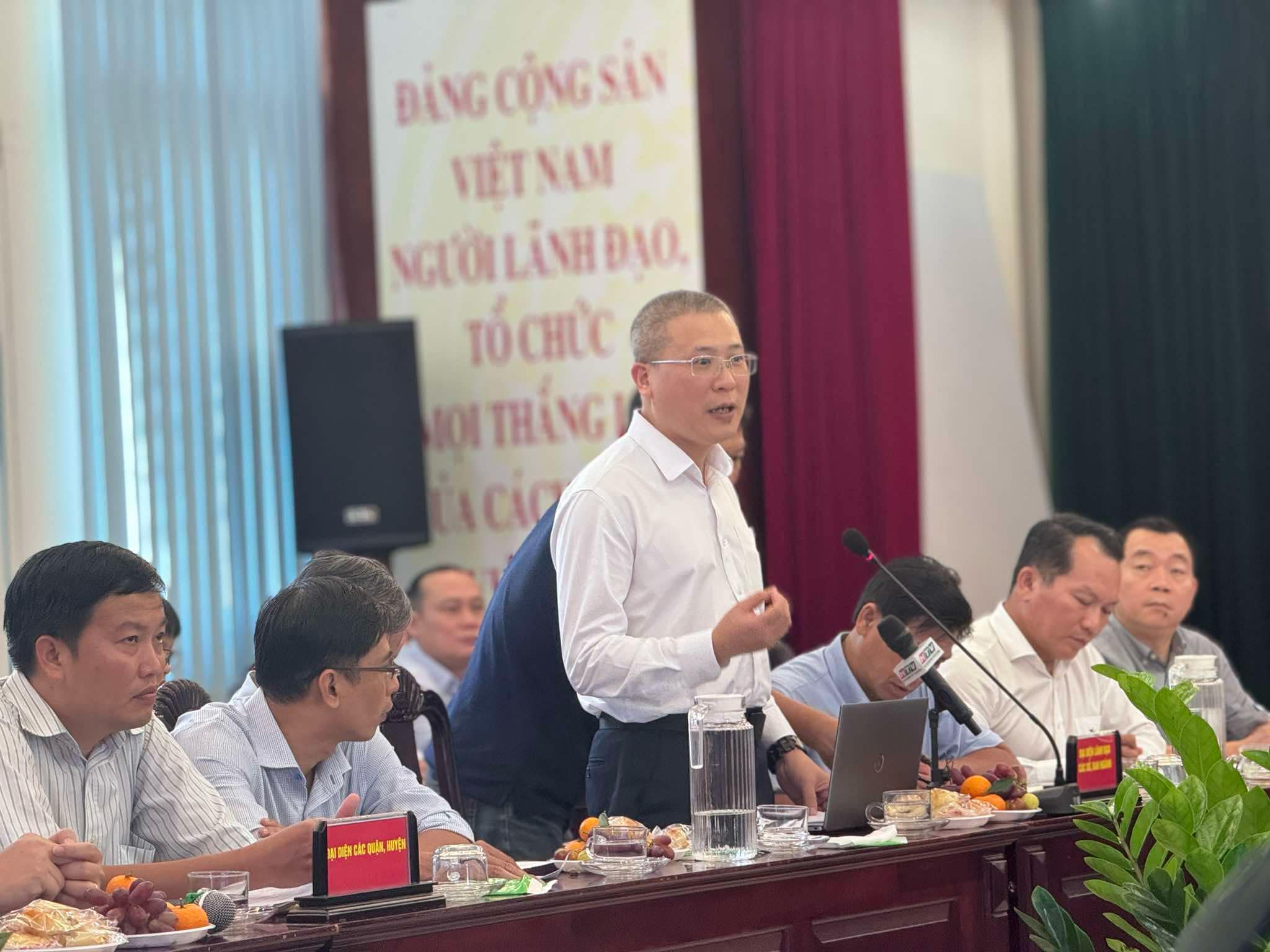
Mr. Le Quynh Mai, Vice Chairman of Deo Ca Infrastructure Investment Joint Stock Company.
Mr. Mai also suggested that there should be flexible criteria regarding the project's financial plan. He proposed that tolls could be collected per segment or per kilometer.
Regarding the financial participation rate, Mr. Mai suggested that a state budget contribution of 50% or 70% would be appropriate to shorten the capital recovery period. The optimal capital recovery period should be around 20 years or less.
"Land clearance is also very challenging. Therefore, the city needs to separate this stage into a separate component project and have it implemented by the local authorities," Mr. Mai suggested.
Mr. Le Quoc Binh, General Director of Ho Chi Minh City Infrastructure Investment Joint Stock Company (CII), also believes that the need for elevated roads in the city is not currently necessary; therefore, it is better to build the ground-level roads first. However, during operation, when traffic volume is high, the investor must implement the construction of elevated roads according to the contract.
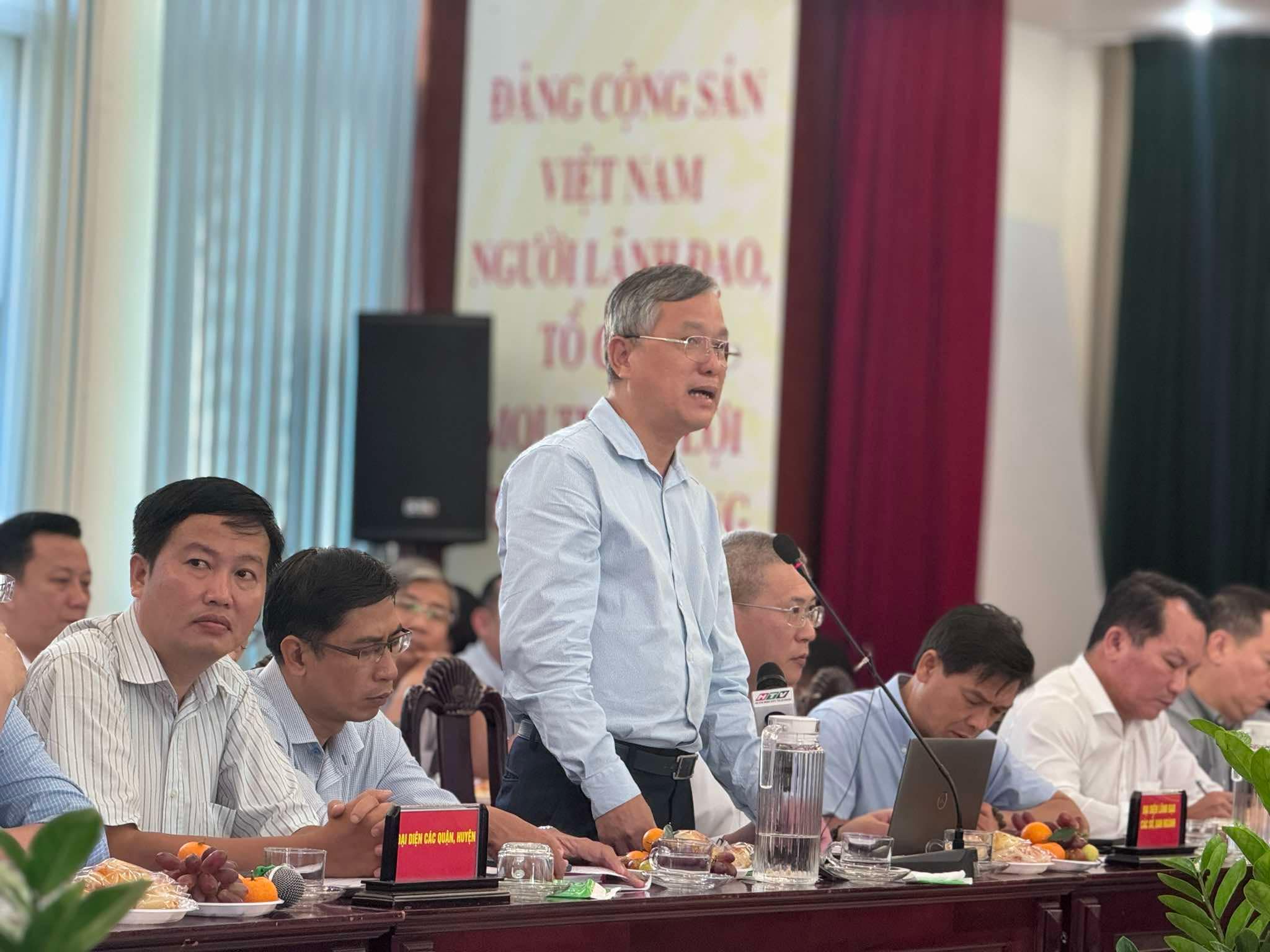
Mr. Le Quoc Binh, General Director of Ho Chi Minh City Infrastructure Investment Joint Stock Company (CII).
According to Mr. Binh, building the elevated road right now would require a very large amount of capital. Therefore, it should be divided into two phases; phase 1 involves building the road at a lower level, and constructing overpasses and underpasses at the intersections below.
Meanwhile, Dr. Tran Du Lich, Chairman of the Advisory Council for the implementation of Resolution 98, offered a different opinion: "For the time being, the road surface should not be widened too much, as it would require extensive land clearance. If necessary, an elevated road should be built to minimize the impact on residents."
Like Mr. Mai, Mr. Binh believes that land clearance is a major issue. "Therefore, projects should only be implemented when 90% of the land clearance work is completed, to avoid situations where contractors are tied up and their capital is tied up in projects," he said.
At the conference, Dr. Tran Du Lich stated: The city needs to quickly and efficiently implement 1-2 projects first, "to avoid a situation where we only start implementing projects when we are reviewing the first 3 years of Resolution 98 in 2026."
Source: https://www.baogiaothong.vn/nha-dau-tu-ban-phuong-an-lam-5-du-an-bot-mo-rong-cac-cua-ngo-tphcm-192241114142952825.htm


![[Photo] Prime Minister Pham Minh Chinh attends the Conference on the Implementation of Tasks for 2026 of the Industry and Trade Sector](/_next/image?url=https%3A%2F%2Fvphoto.vietnam.vn%2Fthumb%2F1200x675%2Fvietnam%2Fresource%2FIMAGE%2F2025%2F12%2F19%2F1766159500458_ndo_br_shared31-jpg.webp&w=3840&q=75)


























































































Comment (0)