

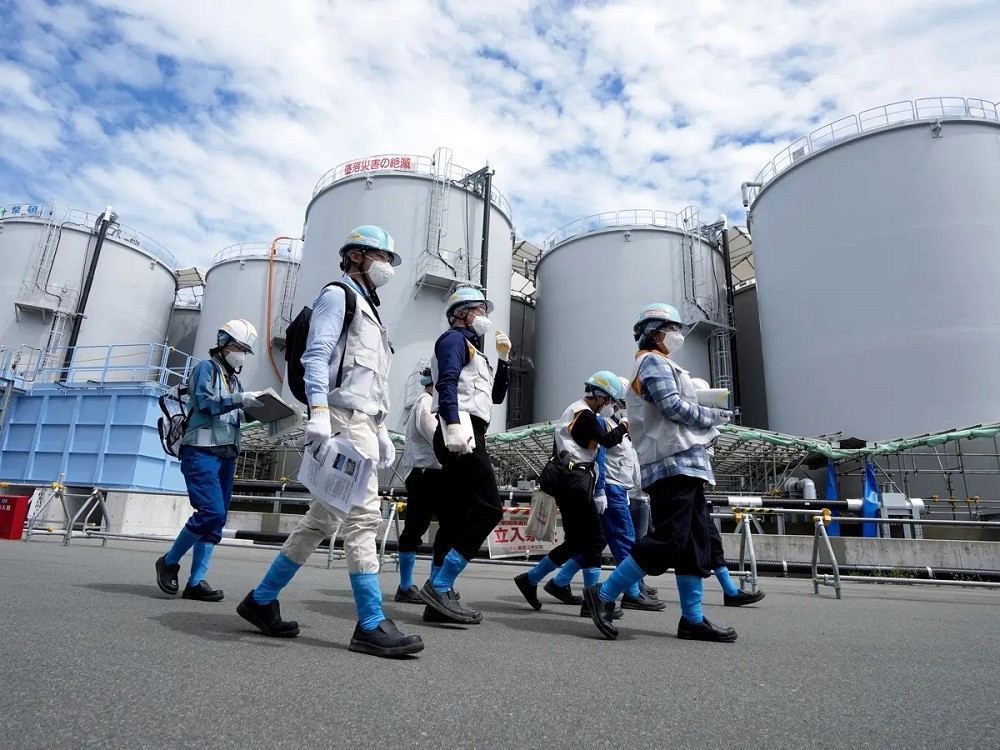
Japan has expressed its stance in response to the reactions of several neighboring and regional countries regarding the emissions from the Fukushima plant.
 |
| Japanese businesses have faced numerous harassing calls in China following the decision to discharge waste from the Fukushima plant. (Source: EPE-EPA) |
On August 28, Japanese Vice Foreign Minister Masataka Okano summoned the Chinese ambassador over numerous instances of harassing phone calls from China related to the discharge of treated radioactive wastewater from the Fukushima nuclear power plant. The statement indicated that the calls were made to Japanese facilities in China and urged Beijing to take prompt and appropriate action to ensure the safety of Japanese citizens.
On the same day, Japanese Chief Cabinet Secretary Hirokazu Matsuno also expressed regret over the calls. Earlier, Tokyo had urged Beijing to “ensure the safety of Japanese citizens in China” following a wave of harassing phone calls targeting Japanese businesses after Japan decided to release wastewater from the Fukushima nuclear power plant.
Japan insists the treated wastewater discharge is safe, and on August 27, it released new data proving that the waters off Fukushima continue to maintain radiation levels within permissible limits. However, the Chinese government vehemently opposes this and has banned the import of all seafood from Japan, claiming the discharge has polluted the ocean.
In related news, Russian scholar Valentin Sergiyenko told reporters that Japan will not allow a scientific vessel from the Russian Academy of Sciences to study the discharge process from the Fukushima plant.
He emphasized: "We carried out these (research) activities immediately after the incident, including exploration, but the Japanese restricted access to their economic zone. They wouldn't allow our ships in or conduct research. That's why we could only work at a distance of 150-300 km from Fukushima; we could only see traces."
According to this scholar, it is important to know how the wastewater is diluted. If it is discharged all at once, the local radiation levels could exceed the limit by many times.
Source
![[Photo] Prime Minister Pham Minh Chinh holds a phone call with the CEO of Russia's Rosatom Corporation.](/_next/image?url=https%3A%2F%2Fvphoto.vietnam.vn%2Fthumb%2F1200x675%2Fvietnam%2Fresource%2FIMAGE%2F2025%2F12%2F11%2F1765464552365_dsc-5295-jpg.webp&w=3840&q=75)

![[Photo] Closing Ceremony of the 10th Session of the 15th National Assembly](/_next/image?url=https%3A%2F%2Fvphoto.vietnam.vn%2Fthumb%2F1200x675%2Fvietnam%2Fresource%2FIMAGE%2F2025%2F12%2F11%2F1765448959967_image-1437-jpg.webp&w=3840&q=75)




































![[OFFICIAL] MISA GROUP ANNOUNCES ITS PIONEERING BRAND POSITIONING IN BUILDING AGENTIC AI FOR BUSINESSES, HOUSEHOLDS, AND THE GOVERNMENT](https://vphoto.vietnam.vn/thumb/402x226/vietnam/resource/IMAGE/2025/12/11/1765444754256_agentic-ai_postfb-scaled.png)



































Comment (0)