

The longest total solar eclipse ever recorded occurred over 2,700 years ago, lasting 7 minutes and 28 seconds, just a few seconds short of the maximum duration.
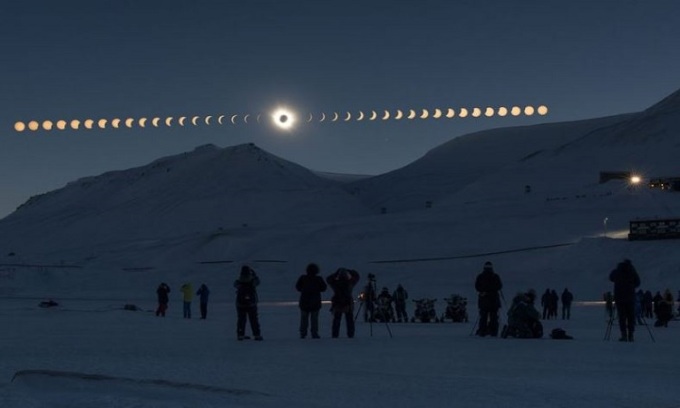
Simulation of the phases of a total solar eclipse. Photo: Earthsky
On April 8, 2024, observers in parts of Mexico, the United States, and Canada will be able to observe a total solar eclipse, while at least a partial eclipse will be visible across all of North America. The maximum duration of the total eclipse – when the Sun is completely obscured by the Moon – will be 4 minutes and 28 seconds, occurring near the village of Nazas in northwestern Mexico. This is relatively long, but still far short of the longest total solar eclipse ever recorded.
The longest total solar eclipse ever recorded lasted 7 minutes and 28 seconds, occurring on June 15, 743 BC, in the Indian Ocean, off the coasts of Kenya and Somalia, Africa, according to NASA.
Mathematically, the longest possible total solar eclipse on Earth is 7 minutes and 31 seconds, according to astronomer Jean Meeus. The event could occur within 5 degrees north of the equator in July, when the Sun is at its farthest point from Earth and appears smaller in the sky, and the Moon is at its closest point to Earth.
No solar eclipses of this duration have been recorded, at least not in the last few thousand years. But in over 150 years, an event nearly reaching this level could occur. Scientists have calculated a total solar eclipse in the distant future. Accordingly, the eclipse in the Atlantic Ocean, off the coast of French Guiana on July 16, 2186, is expected to have a total phase lasting 7 minutes and 29 seconds.
"During the 2186 eclipse, the Moon's shadow will appear directly above the Earth's center. The Moon will appear very large because it's relatively close, and the Sun will appear very small because it's far away. All of these factors combined will make the total phase of the 2186 eclipse exceptionally long," said eclipse expert Dan McGlaun.
Although the longest total solar eclipse in history occurred thousands of years ago and another longer one won't happen for over 100 years, observers could "cheat" if they had a supersonic aircraft. On June 30, 1973, seven scientists aboard the supersonic Concorde 001 flew at Mach 2 (twice the speed of sound) to extend the observation time of the total solar eclipse from 7 minutes and 4 seconds to an astonishing 74 minutes.
Thu Thao (According to Live Science )
Source link

![[Photo] First session of the 14th Congress of the Vietnam Trade Union](https://vphoto.vietnam.vn/thumb/1200x675/vietnam/resource/IMAGE/2026/06/03/1780465947883_ndo_br_img-3852-jpg.webp)



































































































Comment (0)