

According to experts, the screws that attach the screens to the Titan's hull could gradually weaken the carbon fiber shell, causing it to be crushed at sea when it reaches a certain limit.
The tragic incident on June 23rd, when the Titan submersible was crushed at the bottom of the Atlantic Ocean, has sparked intense discussion among both the media and experts. Besides speculations about design flaws, structural defects, or exceeding the Titan's depth limit, the Material Failure hypothesis has also been put forward by experts.
Numerous reports indicate that the manufacturer OceanGate unilaterally modified the Titan spacecraft from its intended purpose of scientific reconnaissance to passenger tourism. Images of the shipbuilding process released by OceanGate show that the company bolted two display screens directly onto the hull, which was originally covered in carbon fiber as CEO Stockton Rush had advertised.
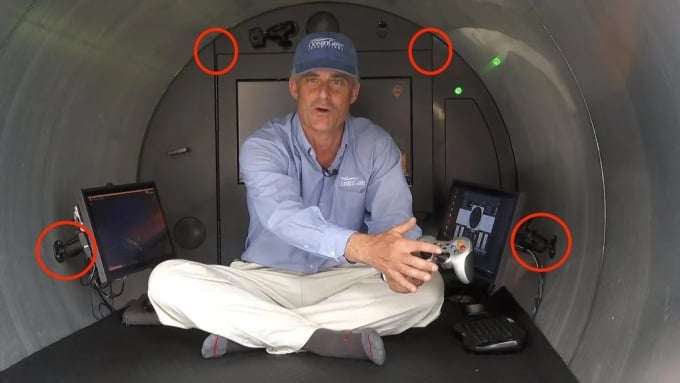
Two monitors are bolted to the hull, and the handcrafted connections (above) in the Titan submersible are shown in the Titan promotional video . Photo: OceanGate
This is a serious mistake because carbon fiber, while five times stronger than steel, is very brittle and is often mixed with resin glue to bond it to the surface of the material being coated. This bonding process is created by layering the material on top of each other, similar to gluing layers of paper with pre-applied adhesive.
The carbon fiber structure will therefore not be in the form of a pure, monolithic sheet, but rather a composite of carbon fiber with resin. OceanGate used the name "carbon fibre composite" for this material in a patent granted in 2021.
Because it's a composite, this carbon fiber structure contains many microscopic voids that the resin cannot fill. OceanGate claims the void ratio is less than 1%, but this figure isn't specifically defined. The difference between a void ratio of 0.99% and 0.0000000000001% can significantly impact the entire structural framework as well as the material's fracture rate.
The method of drilling and screwing the screens onto the hull creates small cracks on the inner composite surface. After numerous dives to explore the Titanic wreck at a depth of 3,800 meters, the Titan's hull was constantly subjected to immense pressure over extended periods, causing cracks to spread as quickly as shattering glass.
This phenomenon can be compared to a glacier with a hole hammered into its surface; the crack is initially small, but gradually, with each sufficiently long and forceful hammer blow, it will split open a section hundreds of meters wide, leading to the entire massive ice mass cracking.
Carbon fiber is known for its strength, but it's not compressive strength, which is crucial for withstanding the pressures of the ocean floor, but rather tensile strength to prevent the frame from breaking under strain.
Carbon fiber composites fracture more slowly than pure carbon fiber, resulting in a gradual cracking process with structural cracks so small that they are undetectable from the outside. The rate of fracture within the same layer of carbon fiber is faster from one layer to the next, so the cracks gradually enlarge until the innermost structure becomes extremely weak.
When the conditions were right, even a slight collision, a gentle nudge with any object on the ocean floor, would be enough to cause the catastrophic collapse of the Titan submersible, claiming the lives of 5 people on board.
In that case, the carbon fiber composite structure would suddenly crumble, even though there had been no unusual occurrences on previous occasions. This explains why the Titan's previous voyages were normal, but its final journey on June 18th was when the ship reached its breaking point.
Even if there is a certain gap between the titanium inner hull and the carbon fiber composite outer shell, preventing the screw holes from cracking, drilling into the titanium hull still creates an opportunity for metal corrosion to occur more quickly.
Titanium is more resistant to rust than iron and copper, but the hull's color isn't pure titanium; it's more like a titanium alloy, as advertised by OceanGate, or a similar hardened steel material used by the US Navy for submarines.
The process of wrapping carbon fiber around the hull of the Titan spacecraft. Source: OceanGate
OceanGate could use an alloy to manufacture the ship's interior instead of pure titanium to reduce production costs, but this also makes it more susceptible to corrosion. In that case, the bolt locations would always be the first to corrode, leading to the risk of the corrosion spreading and weakening the surrounding structure.
OceanGate likely still needs many more screws to be fastened to its hull, as it's being modified to carry tourists and requires the installation of various observation devices. Additionally, the door frames have rather crude welds, lacking any anti-corrosion or anti-wear coating, similar to the design of balcony windows at home.
In materials science, the underside of a weld is the most susceptible to corrosion and structural weakening due to the contact of at least two different materials.
The risks associated with this method are even higher than with bolted connections. Welds can create metallic bonds, leading to rapid rust spread due to electrochemical corrosion in high humidity. To mitigate this risk, manufacturers may apply a thin, wear-resistant, and corrosion-resistant coating to these welds to protect the material and structure from environmental exposure, but there is no evidence that OceanGate has implemented this safety measure.
The design of the Titan submersible from OceanGate's original patent shows that the vessel was built based on the first-generation Alvin DSV deep-sea submersible, which is still in use today. Instead of using the traditional spherical shape to optimize resistance to pressure from all directions, Rush modified the Titan submersible into a tubular shape to carry more passengers.
The two ends of the jar on either side are made of titanium, while the central cylindrical frame is wrapped in multiple layers of carbon fiber approximately 13 cm thick. This central cylinder, as designed, becomes the main load-bearing element, and this is precisely the area that has been altered through bolting and welding.
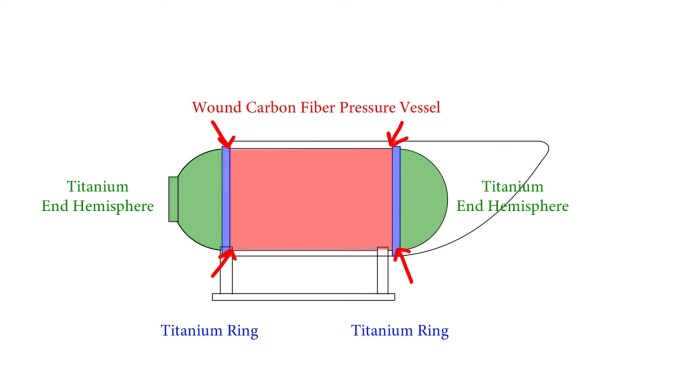
OceanGate's submersible design features a double-ended dome and ring, reinforcing the connection point, made of titanium. Graphic: Oceanliner Designs
The 13 cm thick carbon coating may help the ship withstand external pressure, but it also inadvertently increases its brittiness and makes it more difficult to observe very small cracks within the layer structure.
The joints between the main body of the tube and the titanium ends are not 3D-printed from a single batch but are joined together by a sealing welding mechanism, creating a risk of weakening the mechanical framework. The overall structure will be very weak due to the use of multiple different materials combined from carbon fiber, titanium, and acrylic glass. Each material has different tensile strength, expansion properties, and brittleness in the same environment.
This is also why 3D printing technology is favored for manufacturing spacecraft hulls, even though it is many times more expensive than assembly methods. With this technology, manufacturers only need to 3D print once to get a complete product, no matter how complex the design, without any welding or screwing, reducing the risk to the overall structure.
In its patent, OceanGate mentions that it had safely tested the Titan submersible under pressure conditions of 5,000-6,000 psi (400 times greater than atmospheric pressure). This test pressure is equivalent to the pressure the submersible would face at a depth of 4,000 meters.
But from a safety assessment perspective, this is an extremely serious error. The manufacturer is responsible for ensuring the product can withstand conditions far more extreme than those of normal use. OceanGate should have ensured the Titan could withstand at least 8,000-10,000 psi before allowing it to operate regularly at 6,000 psi, instead of letting it carry tourists at its maximum capacity as concluded in the test.
OceanGate's marketing tactics for the Titan spacecraft and its adventure tour package also raised doubts about whether safety inspections had been carried out in accordance with international standards.

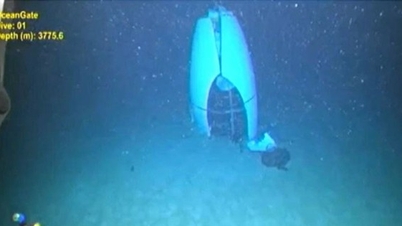
Debris from the Titan submersible was brought ashore at Saint John harbor, Canada, on June 28. Photo: AP
OceanGate previously claimed that their submersible product was so novel that it exceeded conventional safety standards and was beyond the reach of any regulatory body. Furthermore, OceanGate used the unproven concept of "titanium-carbon fiber alloy" in its patent, instead of clearly identifying the material as a "titanium alloy" rather than pure titanium and a carbon fiber composite rather than pure carbon fiber.
In reality, manufacturers can use newer, stronger, more durable, and harder materials, but they must always ensure safety standards are above the minimum. Self-modification and setting their own safety standards always carry the risk of accidents.
This article reflects the views of the author, Dang Nhat Minh, currently a PhD candidate at the Centre for Advanced Materials Surface Design (ARC SEAM) of the Australian Research Council, based at Swinburne University of Technology in Melbourne.
Dang Nhat Minh
Source link


![[Photo] Admire the coral "masterpiece" amidst the million-year-old heritage of Dak Lak province.](https://vphoto.vietnam.vn/thumb/1200x675/vietnam/resource/IMAGE/2026/05/30/1780107638639_y25-jpg.webp)






































































































Comment (0)