

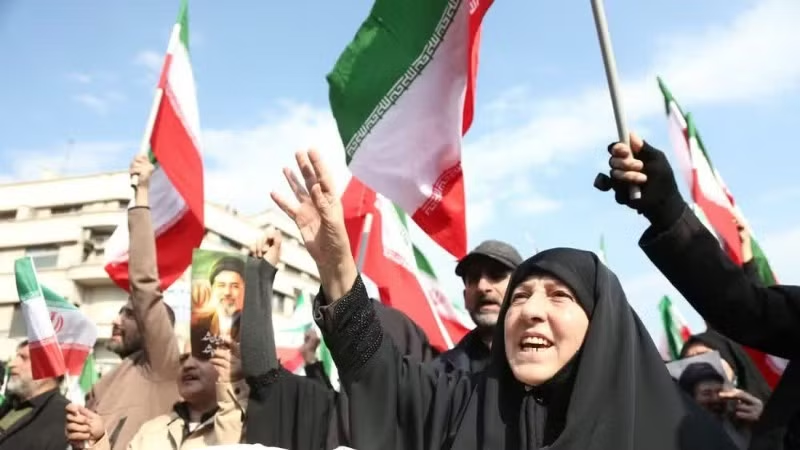
According to diplomatic sources in the Middle East, US and Iranian negotiators are still continuing talks and have not yet finalized the contents. Meanwhile, there is conflicting information suggesting that US and Iranian negotiators have reached a final agreement on the Memorandum of Understanding (MOU).
Specifically, Axios, citing sources, reported that US and Iranian negotiators have essentially finalized the content of the MOU, which will take effect in 60 days, and are only awaiting final approval from US President Donald Trump.
The US-Iran negotiations are entering a crucial phase as mediators continue to push for regional de-escalation efforts. Several regional sources indicate that discussions are focusing on key issues such as restoring maritime traffic through the Strait of Hormuz, lifting the freeze on Iranian assets, establishing a mechanism to reduce the US military presence in the region, and outlining a roadmap for further negotiations on Iran's nuclear program.
On the ground, tensions have not completely subsided. The US recently resumed airstrikes in southern Iran under the pretext of "defense," and has been accused by Iran of violating the ceasefire agreement.
Tehran has vowed a strong response if the attacks recur. In its latest message on May 28, the Iranian Islamic Revolutionary Guard Corps (IRGC) emphasized that it will respond decisively if the US continues to carry out attacks against the country.
Meanwhile, US Treasury Secretary Scott Bessent announced that Washington would block Iranian airlines from accessing landing, refueling, and ticketing services as negotiations remain deadlocked. The US Treasury Department imposed sanctions on Iran's Persian Gulf Strait Authority (PGSA), an organization established by Tehran on May 5 to collect transit fees from ships passing through the Strait of Hormuz.
Source: https://nhandan.vn/thong-tin-trai-chieu-ve-ket-qua-dam-phan-my-iran-post965784.html




![[Photo] Admire the coral "masterpiece" amidst the million-year-old heritage of Dak Lak province.](https://vphoto.vietnam.vn/thumb/1200x675/vietnam/resource/IMAGE/2026/05/30/1780107638639_y25-jpg.webp)
















































































Comment (0)