

In recent years, Dongxing's agriculture has seen significant improvements as the movement to consolidate land for cultivating one or two rice varieties has been widely adopted, and mechanization has been strongly implemented. This spring, farmers who boldly "embraced" land for commercial rice production continued to reap a bountiful harvest.
Farmers who "hold onto" their land are always bold in investing in machinery to support production, resulting in increased productivity and income per unit of cultivated land.
Accumulated rice cultivation covers nearly 15 hectares.
The scorching summer sun has made the rice paddies of Mr. Pham Van Doan's family in Dong Dong commune ripen faster, turning the entire field golden. This spring, Mr. Doan planted nearly 15 hectares with two high-quality rice varieties, BC15 and TBR225, both for seed production and for commercial rice sales. This is the 10th year he has implemented land consolidation for commercial rice cultivation. In the early seasons, he only planted 6-7 acres, but later, regretting that the fertile land was not being cultivated by his neighbors, he took it on to cultivate. With additional financial support from the province, he boldly borrowed hundreds of millions of dong to invest in rice transplanters, plows, harrows, and fertilizer spreaders... to serve his family's production and provide services to his neighbors.
Mr. Doan shared: "Before, small-scale, fragmented production was arduous and inefficient. Natural disasters, rats, and pests meant no income. Now, I've consolidated my fields into larger plots of several acres each, mechanizing almost all stages. As a result, rice cultivation is much easier, costs are lower, labor is reduced, productivity is higher, and the efficiency is clearly visible. I always focus on selecting high-quality seeds according to the needs of traders, and ensuring proper planting and care techniques. Therefore, my family's rice fields are always beautiful and more productive than those of small-scale farmers. Traders buy the harvested rice immediately at a price of 8,000 VND/kg, so I don't have to spend time drying it. Each year, my family harvests nearly 200 tons of rice, earning a profit of 500-600 million VND after deducting expenses. In addition, I also provide plowing, planting, and harvesting services for other farmers, covering about 20 acres each season, to increase my family's income." More and more farmers are losing interest in farming and are willing to rent or lend their land to me for rice cultivation. However, when I suggest extending the rental period instead of the current seasonal limit, they disagree. The short rental period prevents me from investing in additional machinery or building sturdy embankments to expand production. I hope the Party committee and government will promote and encourage farmers to extend the rental period for their land.
Getting rich by renting land.
Since renting or borrowing land from households that don't cultivate rice for large-scale production, Pham Thi Thuy and her husband in Dong Dong commune no longer have to struggle to make a living working as laborers. Instead, they have become "landlords," earning hundreds of millions of dong each year from commercial rice cultivation.
Ms. Thuy said: "Currently, I am renting or borrowing land from 40 households, covering an area of 13 hectares, to cultivate BC15 and TBR225 rice varieties. To make farming more convenient, I proactively exchanged good land for poor land to create larger plots of 3-5 acres, all planted with the same variety. Previously, these 13 hectares required 40 landowners to hire or exchange labor with many people, taking many days and incurring significant costs to complete planting and harvesting. Now, with the help of modern machinery, my husband and I handle everything from land preparation, sowing seedlings, transplanting, fertilizing, and spraying pesticides. Most importantly, harvesting is completed in just a few days."
Because she cultivates a large area, Ms. Thuy spends most of her time in the fields checking, tending, and spraying pesticides to prevent and control pests and diseases. With this professional approach, her family's rice paddies are full of plump, round grains, with almost no empty grains, and yields are usually 20-30 kg/sao higher than other households. While still diligently cultivating on the same plots of land, by shifting their production mindset from small-scale, fragmented, and manual methods to large-scale, borderless fields, Ms. Thuy and her husband have also mastered modern agricultural machinery, cultivating commercial rice and transforming low-yield fields into bountiful harvests.
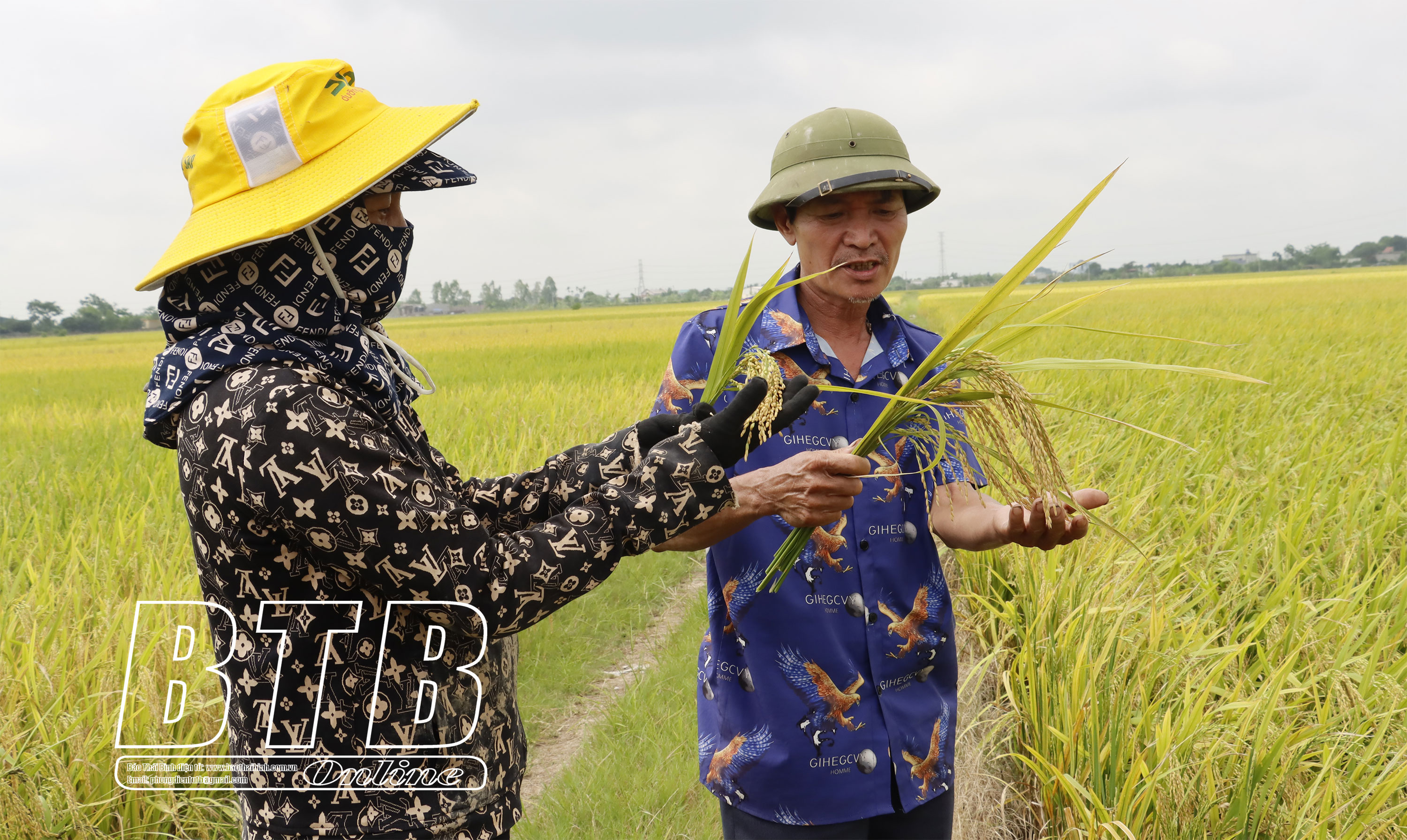
Thanks to consolidating their rice fields to cultivate 1-2 rice varieties, Pham Thi Thuy's family's rice yield is usually 20-30 kg/sao higher than that of households cultivating on a smaller scale.
Ms. Thuy affirmed: Thanks to land consolidation and implementing production according to the "three together" principle - same variety, same planting season, same farming method - many costs have been reduced in all stages, and productivity and efficiency are significantly higher than before. However, the difficulty that I and other households involved in land consolidation face is that many fields are interspersed with fields already being cultivated by other households, making it impossible to consolidate them into large, contiguous plots of 5 hectares or more. Farmers rent or borrow land on a per-season basis, through verbal agreements, without formal contracts. Although we have consolidated a large amount of land, we have not yet met the conditions to receive support as stipulated by the province and district. We request that the province narrow the required consolidation area and the contiguous plot size so that those who consolidate land can benefit from the support mechanisms and policies, contributing to reducing abandoned land and increasing the value of agricultural production.
Income from rice farming is 600-800 million VND per year.
Standing amidst the vast expanse of golden rice paddies laden with grain, Mr. Pham Van Thanh from Phu Chau commune enthusiastically shared: "Having worked in agriculture for so many years, I never thought that one day my wife and I could cultivate 10 hectares, increasing productivity by 8-10% compared to traditional rice planting methods. Before, every season, even with just a few acres of land, I had to struggle to find and hire people to plant, spray pesticides, harvest, and thresh the rice. Everything had to be hired, so production was less profitable, and in some seasons, due to storms and rat damage, we even lost money."
Seeing the benefits of large-scale farming, Mr. Thanh didn't hesitate to go from house to house, persuading people to rent or borrow their land so he could consolidate it into one large plot, becoming the first person in the district to own a large plot of land over 6 hectares. He also boldly invested nearly 1 billion VND to buy 3 rice transplanters, 1 plow, 1 harvester, and built his own tray seedling machine to serve production; he also rented drones to spray pesticides. This spring, thanks to good care, the rice yielded a high productivity of 2.2 - 2.4 quintals per sao (approximately 1000 square meters). He sold 50% of the harvested rice fresh to traders, and dried the other 50% to sell later when the price increased. Each year, he earns 600 - 800 million VND from rice cultivation, an amount that he and his wife never imagined they could achieve with their hard work in farming before. His main concern is that although he cultivates a lot of rice, he lacks land to build a rice storage facility and a rice drying kiln. He hopes the government will facilitate the process and help him complete the necessary procedures for constructing such a facility.
Mr. La Quy Thang, Head of the Agriculture and Rural Development Department of Dong Hung District, said: "In the district, there are many models of land consolidation for rice production that have brought practical results, among which Mr. Pham Van Doan and Ms. Pham Thi Thuy from Dong Dong commune, and Mr. Pham Van Thanh from Phu Chau commune are pioneers. Thanks to land consolidation, concentrated production areas have been formed, creating favorable conditions for synchronized mechanization in the fields; resolving difficulties related to labor shortages in localities; reducing agricultural input costs; and raising people's awareness of applying scientific and technical advancements to production. From small, fragmented areas that were difficult to cultivate and had low economic efficiency... thanks to consolidation, productivity and economic efficiency have increased. This confirms that land consolidation for commercial rice cultivation is an inevitable trend in agricultural production. However, households borrowing land are still in the form of spontaneous agreements without contracts on the duration of the lease or borrowing." In the coming period, to create more effective models for rice consolidation and concentration, the District Department of Agriculture and Rural Development will coordinate with local authorities to disseminate information, mobilize support, and persuade households to agree to consolidate their land; review, guide, and complete procedures so that consolidated households can benefit from the support mechanisms of the province and district in accordance with regulations.
| In Dong Hung district, nearly 2,000 households and individuals have transferred, contributed capital, leased land use rights, and participated in production linkages to accumulate and concentrate land, totaling 2,200 hectares. Of these, 500-600 areas are less than 5 hectares; 20 areas are between 5 and less than 10 hectares; and 3-5 areas are between 20 and less than 50 hectares. While young people are no longer interested in farming, farmers like Mr. Doan, Ms. Thuy, and Mr. Thanh are passionate about it, boldly accumulating dozens of hectares per household to cultivate commercial rice, transforming small, unproductive, abandoned rice fields into large, thriving rice paddies yielding hundreds of tons of rice per harvest, opening up a new, effective, and sustainable direction in agricultural production. However, authorities at all levels need to promptly address difficulties and obstacles so that support mechanisms and policies can reach households and individuals who accumulate and concentrate land, further motivating them to expand their acreage and invest in machinery to promote agricultural production development. |
Thu Hien
Source
![[Image] Checking the security conditions at the exam site, ready for the 10th grade exam.](https://vphoto.vietnam.vn/thumb/1200x675/vietnam/resource/IMAGE/2026/05/28/1779943458889_z7872507660648-d764421a26e8cd7b61d70d142a48a685-jpg.webp)

![[Photo] Life on both banks of the river returns to its bustling pace on the day the Long Bien Bridge opens to traffic.](https://vphoto.vietnam.vn/thumb/1200x675/vietnam/resource/IMAGE/2026/05/28/1779949763708_cau-long-bien-minh-duy-7-3610-jpg.webp)
![[Photo] The heat at the fireworks display site on the opening night of the Da Nang International Fireworks Festival 2026](https://vphoto.vietnam.vn/thumb/1200x675/vietnam/resource/IMAGE/2026/05/27/1779889741485_ndo_br_z7872039145157-fecaba5112f39e8352544099d7ef4738-5140-jpg.webp)





























































Comment (0)