

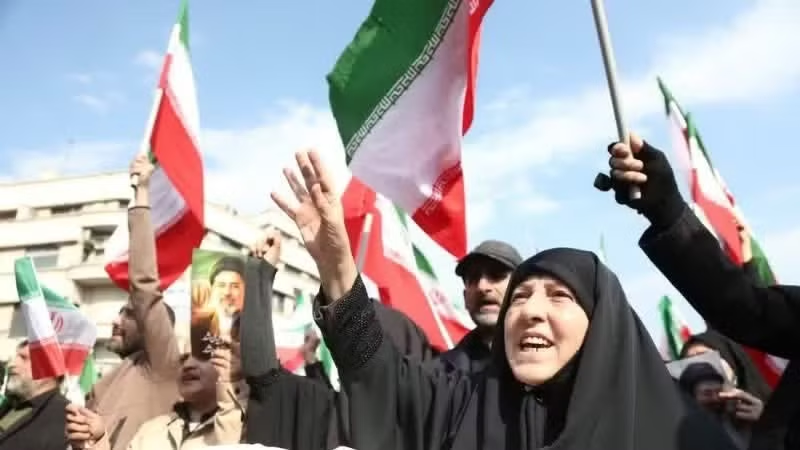
With their mission as mediators, they quietly promote the negotiation process, creating opportunities for parties to find common ground. In an increasingly fragmented international environment, more than ever, the world needs persistent "messengers" to mend rifts and preserve peace.
Amidst the escalating conflict in the Middle East, Pakistan and Qatar have been frequently mentioned recently as potential intermediaries between the US and Iran. While Pakistan has held the official mediating role since the conflict erupted, Qatar has only recently joined the process. Though late, as a US ally in the region and a reliable channel of communication between Washington and Tehran, Qatar has contributed to the negotiation process. The frequent appearances of US and Iranian negotiators in Qatar in recent days, along with Pakistan's continuous shuttle diplomacy , are vivid evidence of the crucial role these "ambassadors" play in ensuring regional security and stability.
Qatar is no stranger to the role of conflict mediator. Building a balanced and harmonious foreign policy, along with the ability to maintain trust among all parties, the Gulf nation has left a deep mark on the international stage by contributing to easing many tense relationships in the region and around the world. Qatar has supported the US and the Taliban in Afghanistan to achieve the historic Doha Agreement in 2020, setting a deadline for the US withdrawal from Afghanistan; restoring diplomatic relations between Kenya and Somalia in 2021. In 2023, Qatar helped achieve a temporary ceasefire in the Gaza Strip; and supported the family reunification and prisoner exchange agreement between Russia and Ukraine for the period 2023-2024… With its tireless efforts over the years, Qatar's diplomatic mediation imprint extends across conflict hotspots worldwide.
While not possessing the same extensive experience as Qatar, Pakistan has attracted particular attention for its early involvement in mediating tensions between the US and Iran. Leveraging its relatively balanced relationship with both Washington and Tehran, Pakistan has engaged in extensive shuttle diplomacy to build trust between the two sides. Experts believe that its flexible and tactful approach has been key to Pakistan's successful role as a mediator in the US-Iran dialogue.
Despite some differences, Qatar and Pakistan share a common goal in supporting the resolution of tensions in the Middle East. While Qatar is located in the Gulf, directly affected by the US-Iran conflict, Pakistan shares a long border with Iran. For both sides, any escalation of tensions between Washington and Tehran poses direct threats, negatively impacting vital shipping lanes, trade, and national security. Therefore, mediating disagreements is the only way to limit the risk of contagion, maintain economic safety, and ensure social stability.
Furthermore, being entrusted with the responsibility of mediating the US-Iran tensions – one of the world's most complex conflicts in recent times – has also contributed to strengthening the voices of Qatar and Pakistan in the Middle East and on the international stage. This is also clear evidence that, in today's multipolar world, expanding influence regionally and globally is no longer the privilege of a few countries. Middle-sized nations are not just "pawns" on the political chessboard of great powers, but play a role in balancing relationships and reducing antagonism between major powers.
In reality, many countries have succeeded in their role as mediators, thereby strengthening their "soft power," asserting their position through efforts to contribute to peace, de-escalate hotspots, and address global challenges. In the context of ongoing tensions in many conflicts, an increasingly divided world, and heightened strategic competition, the role of mediating countries is predicted to become increasingly important, not only in opening channels for dialogue but also in shaping the security structure and balance of power in the future.
For many international relations today, simply maintaining dialogue is a significant challenge. "Peace envoys" will continue to be indispensable, helping parties gradually resolve differences, rebuild trust, and prevent conflict escalation.
Source: https://nhandan.vn/nhung-su-gia-hoa-binh-post965982.html

![[Photo] Admire the coral "masterpiece" amidst the million-year-old heritage of Dak Lak province.](https://vphoto.vietnam.vn/thumb/1200x675/vietnam/resource/IMAGE/2026/05/31/1780221235105_anh-man-hinh-2026-05-31-luc-16-53-27.png)
![[Photo] The General Secretary, President and his wife begin their state visit to the Philippines.](https://vphoto.vietnam.vn/thumb/1200x675/vietnam/resource/IMAGE/2026/05/31/1780230559452_anh-man-hinh-2026-05-31-luc-19-28-11.png)
![[Photo] Solemn bathing ceremony and Buddha procession in Hue](https://vphoto.vietnam.vn/thumb/1200x675/vietnam/resource/IMAGE/2026/05/31/1780228263543_1-jpg.webp)

![[Image] Hanoi Police officially crowned champions of V-League 2025/2026](https://vphoto.vietnam.vn/thumb/1200x675/vietnam/resource/IMAGE/2026/05/31/1780244769054_ndo_br_039d561b692be875b13a-jpg.webp)









![[Video] Sunset at Lap An Lagoon – Where the sun sets over the fishing nets](https://vphoto.vietnam.vn/thumb/340x192/vietnam/resource/IMAGE/2026/05/31/1780192137701_beach-landscape-sea-water-nature-grass-745871-pxhere-com.jpeg)
![[Image] Hanoi Police officially crowned champions of V-League 2025/2026](https://vphoto.vietnam.vn/thumb/402x226/vietnam/resource/IMAGE/2026/05/31/1780244769054_ndo_br_039d561b692be875b13a-jpg.webp)
![[Video] Mass fish deaths in the retention pond in Cau Giay cause serious environmental pollution.](https://vphoto.vietnam.vn/thumb/402x226/vietnam/resource/IMAGE/2026/05/30/1780155056587_dung01-10-30-33896still010-png.webp)

























![[Photo] Admire the coral "masterpiece" amidst the million-year-old heritage of Dak Lak province.](https://vphoto.vietnam.vn/thumb/402x226/vietnam/resource/IMAGE/2026/05/31/1780221235105_anh-man-hinh-2026-05-31-luc-16-53-27.png)






















Comment (0)