

Borders serve two functions: they act as a "barrier" protecting national territorial sovereignty and as a gateway for economic and cultural exchange with neighboring countries. A significant achievement that Vietnam has made since the Doi Moi (Renovation) period is the basic demarcation of its borders with neighboring countries, especially with China.
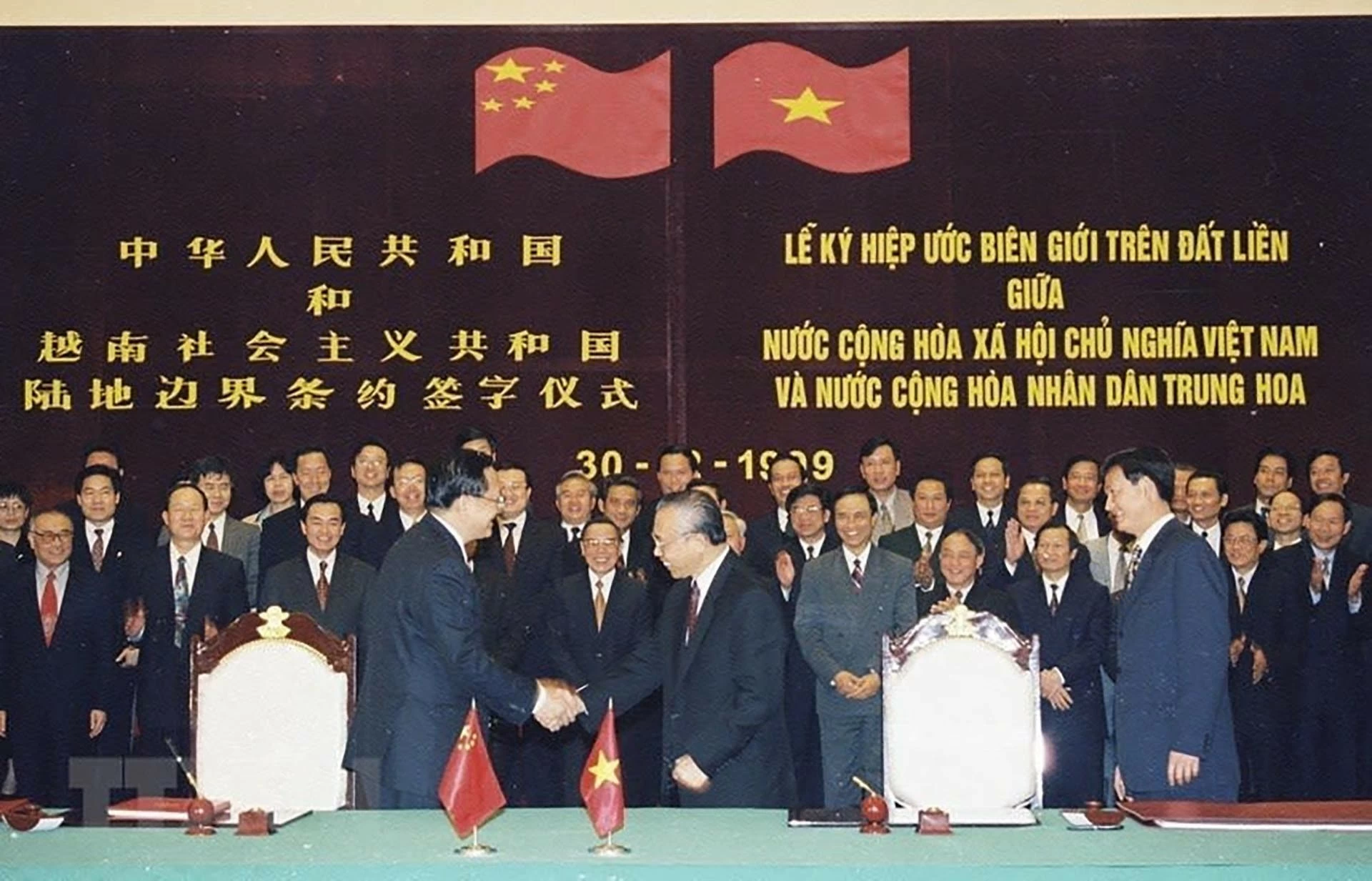 |
| Deputy Prime Minister and Minister of Foreign Affairs Nguyen Manh Cam and Chinese Minister of Foreign Affairs Tang Jiaxuan signed the land border treaty between the two countries in Hanoi on December 30, 1999. (Source: VNA) |
Immediately after the normalization of Vietnam-China relations in 1991, the two countries proceeded with negotiations and reached the Land Border Treaty between the Socialist Republic of Vietnam and the People's Republic of China on December 30, 1999, which served as the basis for both sides to carry out demarcation and placement of border markers on the ground along the entire 1,449.566 km border between the two countries.
Despite numerous difficulties and hardships, on December 31, 2008, both sides declared the completion of the demarcation and placement of border markers on the land border. Nearly a year later, on November 18, 2009, the two countries signed three documents: the Protocol on the Demarcation and Placement of Border Markers on the Land Border, the Agreement on the Management Regime of the Land Border, and the Agreement on Border Crossings and the Management Regime of Border Crossings on the Land Border between Vietnam and China.
The completion of border demarcation between the two sides marks a significant turning point in the history of Vietnam-China border construction and opens a new chapter in peaceful relations and cooperation between the two countries. The three fundamental documents on border demarcation, border management, and border gate management are of paramount importance not only for protecting the territorial border but also for creating a favorable basis for economic and cultural exchanges between Vietnam and China.
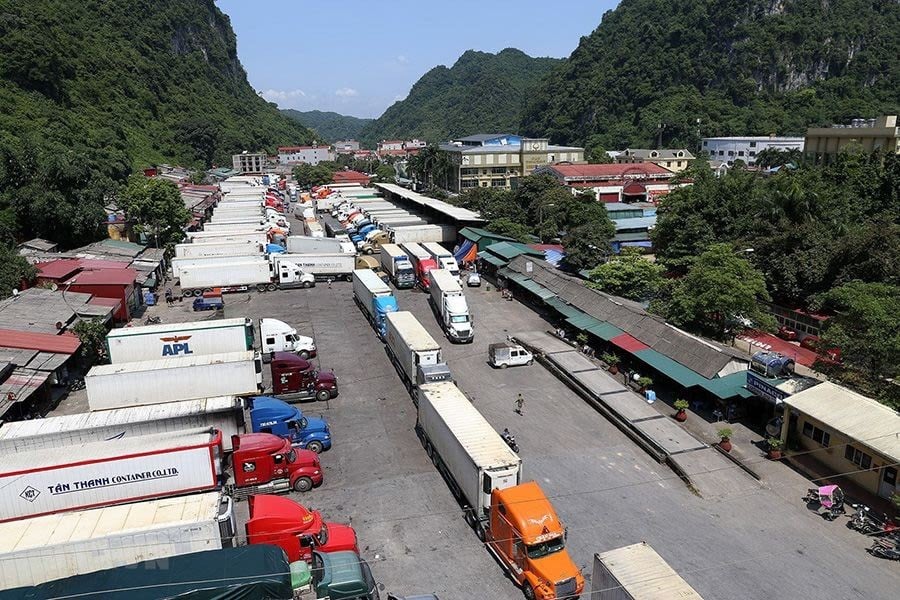 |
| Trucks carrying export goods at Tan Thanh border gate. (Photo: VNA) |
Over the past 25 years since the border was clearly demarcated, not only has the border system and markers been maintained and territorial sovereignty ensured, but both sides have also opened and upgraded dozens of border gates, including five international border gates, creating favorable conditions for increasingly bustling cross-border economic and trade exchanges, making a significant contribution to economic development, and consolidating and strengthening peaceful and friendly relations.
Cross-border trade between the two countries reaches a significant figure, approximately 40 billion USD per year. Through border gates, Vietnam exports many key agricultural products to China, such as rice, fruits and vegetables, seafood, and spices, while importing various raw materials, machinery, components, electronic equipment, and chemicals from China to serve domestic production.
Along with the development of border trade, problems are inevitable, but overall, border trade, especially trade between Vietnam and China, has made and continues to make a significant contribution to the economic development of both sides, creating many job opportunities and developing the border region's economy. Conversely, economic relations between the two countries and between localities of the two countries also contribute to border stability, creating a strategic advantage to maintain long-term security and stability of the national border.
The face of the border in general, and especially the Vietnam-China border, has completely changed after 25 years since the signing of the three agreements. It now enjoys both peace and stability, as well as vibrant trade and commerce. This is a tremendous achievement, one that not every country in the world can accomplish, especially given the complex economic, political, and security situations in many parts of the world.
Source: https://baoquocte.vn/nhung-van-kien-mo-duong-cho-thuong-mai-bien-mau-282802.html

![[Photo] Ba Lang An Lighthouse - the "eye of the sea" amidst the "rock museum" of Quang Ngai province.](https://vphoto.vietnam.vn/thumb/1200x675/vietnam/resource/IMAGE/2026/05/29/1780038698840_anh-man-hinh-2026-05-29-luc-14-10-42.png)
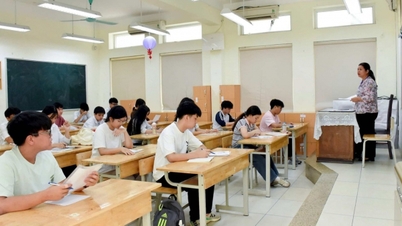
![[Image] Pleasant weather helps students enter the 10th grade entrance exam with confidence.](https://vphoto.vietnam.vn/thumb/1200x675/vietnam/resource/IMAGE/2026/05/29/1780034401612_ngay-1-thi-lop-10-minh-duy-8-5009-jpg.webp)



















































































Comment (0)