

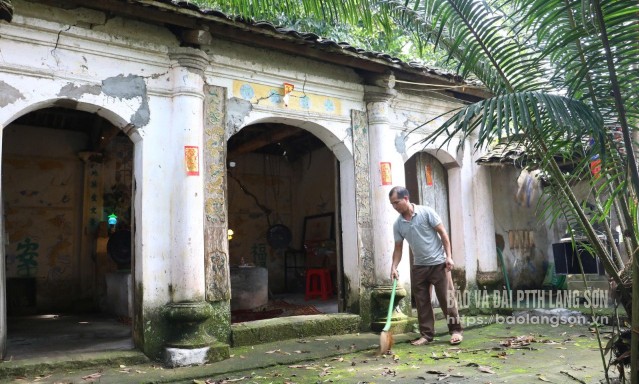
Khau Ngoa Temple was built around the beginning of the 18th century. It is dedicated to the Mountain God and the tutelary deity of the village, and is associated with the legend of Mr. and Mrs. Dinh who raised Mr. Cut (Mr. Coc), who is worshipped at Vang Khac Temple. Therefore, in the folk consciousness and among the local people, Khau Ngoa Temple is called the father temple, and Vang Khac Temple is called the son temple.
According to local elders, the temple was originally just a small thatched-roofed room. Later, it was rebuilt with wood, consisting of three bays and two wings, with a yin-yang tiled roof, large round wooden columns resting on stone bases, and open spaces without wooden panels. Over time, the temple collapsed and suffered severe damage. Around the early 20th century, the villagers contributed labor and resources to rebuild the temple as it stands today.
Located on a hilltop, the temple's main entrance faces southeast and is built in the "Công" (Chinese character for "work") architectural style, comprising two main sections: the front hall and the rear hall. The roof system is designed with four tiled gables, featuring raised eaves running from the apex down the sides. The entire beam and truss system is made of natural wood, connected by mortise and tenon joints. The front hall is connected to the rear hall by two rows of side wings. The temple currently preserves 28 ancient artifacts, including many valuable couplets and horizontal plaques inscribed with Han Nom characters. During the period of 1947-1948, the temple also served as a military base for local troops. Every year, the Khau Ngoa Temple festival is held on the 16th and 17th of the 4th lunar month, featuring many traditional rituals and unique folk games.
Through the ups and downs of time and the impact of history, the temple is now severely dilapidated, with many parts leaking and crumbling. The wooden structures have been damaged by termites, especially the beams and purlins, seriously affecting the safety of the monument and the religious needs of the people. In addition, because it was repaired a long time ago, and the local area lacks the economic resources to reinforce it, most of the details built with cement, bricks, and mortar have peeled, cracked, and are covered with moss.
Mr. Hoang Van Tien, Party Secretary and Head of Ban Moi village, who is in charge of looking after the temple, said: "The temple has been deteriorating for decades, but it has not been repaired. We, the temple caretakers and local people, have long hoped that the authorities at all levels would consider and study the possibility of repairing and protecting the Khau Ngoa temple to promote its historical value."
Over the past period, the People's Committee of Thong Nhat commune has made efforts to preserve and promote the value of the communal house. Accordingly, the People's Committee has directed the specialized departments to actively introduce the relic on the commune's electronic information website; promote propaganda and mobilize people to raise awareness of maintaining environmental hygiene and proactively protect the relic from the risk of deterioration. Every year, the commune government and the management board of the communal house mobilize people to contribute financially, however, only minor renovations and restoration of severely dilapidated items and the organization of the traditional festival of the communal house can be carried out.
In 2023, Khau Ngoa communal house was classified as a provincial-level historical site by the Chairman of the Provincial People's Committee according to Decision No. 2214/QD-UBND. At the end of 2023, the former Department of Culture and Information (formerly under the People's Committee of Loc Binh district) researched and developed restoration plans, which were submitted to the People's Committee of Loc Binh district for consideration and approval by the competent authorities. The aim was to mobilize social resources for the restoration and renovation of the communal house. However, due to objective reasons and the policy of ending district-level operations and establishing a two-tiered local government system, the restoration has not yet been implemented.
Mr. La Van Thuan, a specialist from the Culture and Social Affairs Department of Thong Nhat commune, said: "Along with Vang Khac communal house, Khau Ngoa communal house is an architectural and artistic relic with historical and cultural value. If restored and closely connected, the two temples will contribute to the development of religious tourism in the commune. Therefore, in the coming time, we will advise the People's Committee of the commune to conduct a survey and assess the level of deterioration. Based on that, we will develop restoration plans to submit to the competent authorities for approval, and then call for social resources to gradually restore, repair, and rebuild if necessary to promote the value of the relic."
Khau Ngoa communal house is an ancient structure, containing many meaningful and unique values; therefore, preserving and promoting this relic is a necessary and ongoing task. In the coming time, together with the Thong Nhat commune government, the restoration of Khau Ngoa communal house requires the attention and cooperation of all levels and sectors, as well as philanthropists, so that the relic can be renovated, contributing to preserving traditional values for future generations.
Source: https://baolangson.vn/noi-niem-dinh-khau-ngoa-5054714.html

















![[Photo] Urgently help people soon have a place to live and stabilize their lives](/_next/image?url=https%3A%2F%2Fvphoto.vietnam.vn%2Fthumb%2F1200x675%2Fvietnam%2Fresource%2FIMAGE%2F2025%2F12%2F09%2F1765248230297_c-jpg.webp&w=3840&q=75)












































Comment (0)