


1. The other day, my friend – a famous artist in Hue – created a small sensation on social media when he posted two photos on his personal Facebook page depicting a woman named "O Hoa" – a soy milk vendor on the sidewalk of Chi Lang Street, Hue City – sitting with her feet up on a chair reading a book while there were no customers.
The reason it caused a sensation is that, even now, many people are still unaccustomed to seeing an elderly woman selling soy milk on the sidewalk reading a book. Moreover, the book that "Aunt Hoa" was reading was a "tough book," difficult for many to digest – "The Old Path, White Clouds" by Zen Master Thich Nhat Hanh.
The image of "Ms. Hoa" reminds me of another image, also on a different sidewalk in Hue from the 1980s. Back then, I was an 8th-grade student, spending my days reading books borrowed from Uncle Son, who rented out comic books on the side of what is now the Morin Hotel.
Back then, in front of my apartment complex, on Truong Dinh Street, there were many large, shady flame trees where cyclo drivers would park to rest during their lunch break. Even now, I still vividly remember my surprise at seeing those cyclo drivers lying on their bikes reading books instead of taking a nap every lunchtime.
And I still remember one of them specializing in tackling a more challenging book by "Ms. Hoa" now, Suzuki's "Zen Essays," which later became my bedside book during my university years.

2. In fact, there aren't many "O Hoa" or cyclo drivers like that in Hue, but there aren't few either. They're enough to create a symbol of their fleeting, somewhat mysterious and captivating nature, much like the libraries – sometimes containing thousands of precious books, but more often heard about than seen firsthand.
In Hue, besides the state library system, there are also many family bookshelves considered "treasure troves," containing numerous invaluable specialized books preserved and passed down as family heirlooms. The most prominent examples are the bookshelves of famous Hue researchers such as Nguyen Huu Chau Phan, Ho Tan Phan, Phan Thuan An, Nguyen Dac Xuan, and others.
In addition, many temples and monasteries in Hue possess numerous bookshelves containing valuable religious texts, protected in a "library" style, much like what is often seen in martial arts films.
But it is from this point that a paradox emerges: the more valuable a book is, the more its owner hides it; the rarer it is, the more carefully it is stored. And when it is stored carefully, it also means that fewer people get to read it. These "treasures," if only preserved, can easily become "dead" repositories of knowledge, existing more as a source of pride than as a real lifeblood nourishing the spiritual life of the community.
Looking at Ms. Hoa, one can see a very simple truth: books only truly come alive when they are opened. Not in formal settings, but right in the midst of everyday life, where people read not out of obligation but out of a genuine need. Ms. Hoa doesn't need anyone to promote her, she doesn't need a movement, and she doesn't need any appeals. She reads simply because she wants to read. And that is the root of reading culture.
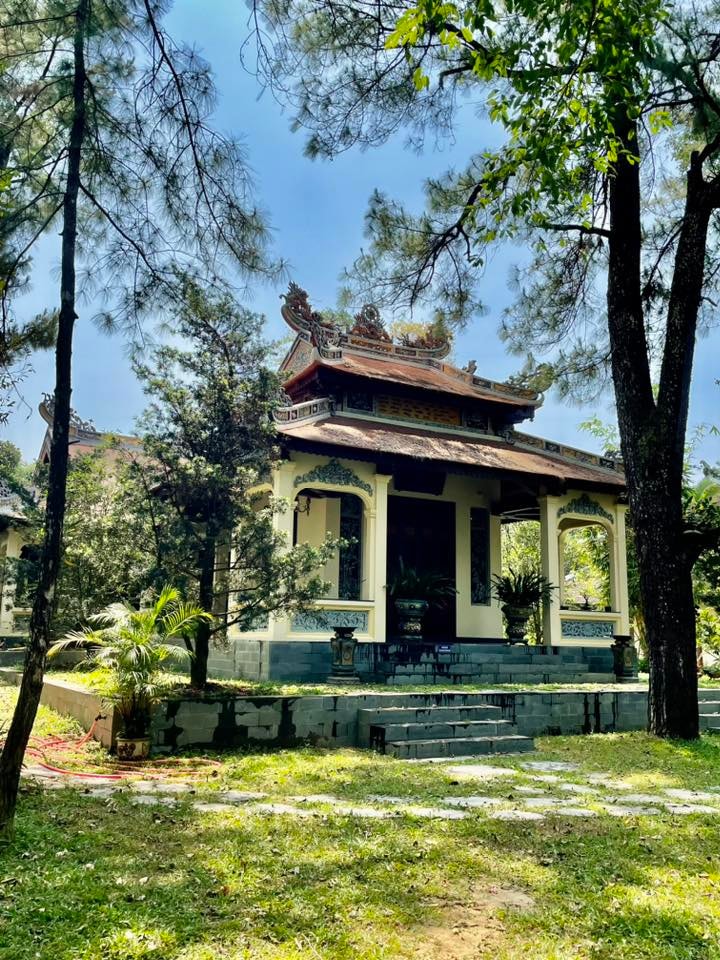
3. The image of Ms. Hoa reading a book prompted me and many others to question which is more important: the fact that Hue and many other localities possess many valuable books that are "hidden" in "libraries" and rarely read, or the fact that everyone reads books daily?
And the answer, perhaps, is that books need to be placed in places where people actually live, such as a corner of a coffee shop, a porch, a workers' dormitory, a public space, or even a sidewalk. Not everyone has the habit of going to a library, but many people will readily pick up a book if it's right in front of them, in a familiar space. When reading is no longer a special act but becomes a natural part of life, then a reading culture has a chance to take root.
More importantly, local communities, and most importantly families and schools, need to create reading communities, instead of relying solely on individual readers. A single person reading is a beautiful image, but many people reading together will create a social habit. Then, reading will no longer be a private matter but will become a part of shared life.
Ultimately, the value of a book lies not in its quantity or rarity, but in whether it is opened, read, contemplated, and integrated into people's lives...
Source: https://baodanang.vn/o-hoa-doc-sach-3335045.html
![[Photo] National Assembly Chairman Tran Thanh Man attends the groundbreaking ceremony for the National Highway 1A spatial axis project.](https://vphoto.vietnam.vn/thumb/1200x675/vietnam/resource/IMAGE/2026/05/19/1779161360398_ndo_br_bnd-1412-jpg.webp)
![[Photo] Capturing the moment the tide recedes at Yen Binh Son rapids - a million-year-old scenic spot in Quang Ngai.](https://vphoto.vietnam.vn/thumb/1200x675/vietnam/resource/IMAGE/2026/05/19/1779175463885_yen9-1199-jpg.webp)


















































![[Photo] General Secretary and President To Lam receives Indian Defense Minister Rajnath Singh](https://vphoto.vietnam.vn/thumb/402x226/vietnam/resource/IMAGE/2026/05/19/1779184046302_anh-man-hinh-2026-05-19-luc-16-46-58.png)























Comment (0)