

Fields and hills are "laboratories".
Professor Tran Dinh Long was born in 1941 in Phu Tho province. His family were farmers, and from a young age, Tran Dinh Long deeply understood the hardships and struggles of farmers. In 1962, he was sent to the Soviet Union for study, determined to "bring something truly useful to Vietnamese farmers and agriculture ." In the land of the white birch, after thoroughly researching tropical crops suitable for Vietnamese farming conditions, he focused his research on legumes, as these plants were both beneficial as food sources and capable of improving agricultural soil.
 |
| Comrade Trinh Van Quyet, Member of the Political Bureau, Secretary of the Central Committee of the Party, Head of the Central Propaganda and Mass Mobilization Department, visited and extended New Year greetings to the family of Professor Tran Dinh Long during the Lunar New Year of the Horse 2026. Photo provided by the subject. |
In 1967, Tran Dinh Long became the first Vietnamese student to graduate with honors in Biology from Kishinev State University. Upon returning to Vietnam, he taught at the Agricultural University I. Throughout his teaching and scientific research, he always considered the fields and hills of farmers as the largest "laboratory"—the most honest testing ground for the value and effectiveness of each scientific work on agriculture. In 1983, he successfully defended his doctoral dissertation; ten years later, he was awarded the title of Academician of the Vietnam Academy of Agricultural Sciences. In 2002, he was appointed Professor of Agriculture, specializing in genetics and plant breeding.
Throughout the various stages of Vietnam's agricultural development, Professor Tran Dinh Long consistently adjusted his research direction to suit practical needs. When the country faced food shortages, he focused on high-yield crop varieties. As production stabilized, he shifted to improving the quality of agricultural products. When the market demanded high standards of safety and value, he researched and developed crop varieties that were both high-yielding and high-quality, environmentally friendly, and adaptable to climate change.
 |
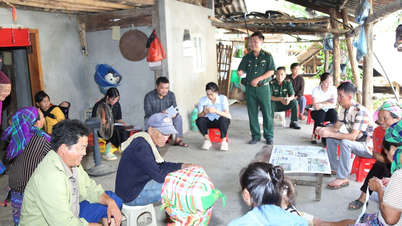
| Professor Tran Dinh Long shares his farming experience with people in the Northwest highlands. Photo provided by the interviewee. |
During his research, Professor Tran Dinh Long always dedicated significant time to on-site visits (some lasting up to two months) to meet and exchange ideas with farmers, monitoring the effectiveness of new crop varieties under real-world conditions. For him, the results of scientific research cannot stop at reports or conferences; they must be present on every field, in the income and livelihoods of the people. The scientific research projects he leads are not only groundbreaking and innovative but also highly practical and applicable. He confided: "In science, the most valuable thing is not titles, but when my products are accepted by the people; helping them reduce their hardship and increase their income is what makes me happiest."
Accompanying farmers on their journey of innovation.
Professor Tran Dinh Long is considered the "pioneer of modern plant genetics and breeding in Vietnam." He has led numerous state-level scientific projects, creating many high-yield and high-value varieties of rice, soybeans, mung beans, peanuts, and vegetables. He is the author of 27 new plant varieties (including 9 soybean varieties, 6 peanut varieties, 4 mung bean varieties, VX83 rice variety, sunflower, V6 sesame, VX37 sweet potato, and stevia). These varieties are now widely cultivated in various ecological regions of Vietnam, helping to increase farmers' income by 15-20% compared to older varieties, contributing to improving the lives of tens of thousands of farming households. In particular, the L23 peanut and DT26 soybean varieties have been granted patent protection, a proud achievement for Vietnamese agricultural science.
 |
| Professor Tran Dinh Long (seated) at a model of growing cantaloupe in a greenhouse at the Ha Nam High-Tech Park (Vina Seed Group). Photo provided by the subject. |
Continuing our conversation, Professor Tran Dinh Long recounted a profound memory: “In 1988, General Vo Nguyen Giap returned from a trip to Cuba, bringing with him a stevia plant and entrusting it to the Ministry of Agriculture and Food Industry (specifically me) for research. At that time, laboratory conditions were rudimentary, and there was only one plant as a sample. But I persevered in isolating, tissue-cultured, and propagating it. After 5 years, the ST88 stevia variety was created; subsequently, the ST77 and ST99 varieties were developed. This stevia variety is used as a raw material in the food and medicine industries, bringing high income to farmers.”
Professor Phan Xuan Dung, President of the Vietnam Union of Science and Technology Associations, stated: “Professor Tran Dinh Long is the author of many prestigious scientific works both domestically and internationally. Having dedicated his entire life to agriculture, the research projects he led were closely linked to plant breeding, contributing to the sustainable development of Vietnamese agriculture.”
Having lived in Hanoi since his youth, Professor Tran Dinh Long proudly shared: "Hanoi is not only my place of residence but also the place where I dedicate my passion and knowledge to serving the people." From 2009 to 2021, he served as the Head of the Science and Technology Program for Agricultural Development in Hanoi. During this period, he and his colleagues carried out many practical projects, such as: preserving and developing the genetic resources of Lang mint; developing Hanoi's specialty vegetables; transferring high-quality rice varieties (BT09, HDT10, VAAS16) to farmers; and advising on the development of late-ripening longan varieties, Yen Tu apricot blossoms, and phalaenopsis orchids in suburban areas. The results of this program have contributed to shaping a green, safe, and sustainable agricultural production model for Hanoi.
Having dedicated his life to agriculture, farmers, and rural areas, Professor Tran Dinh Long has conducted hundreds of training sessions for technical staff and farmers, imparting knowledge about plant varieties and cultivation techniques. He shared: “I am happiest when I see the eyes of farmers light up when they understand something new. Science is only valuable when it helps people's lives.” Professor Tran Dinh Long is both a great scientist and a close friend of farmers. He always accompanies them on their journey of innovation to build a sustainable Vietnamese agriculture with a strong position in the world.
"Passing the torch" to the next generation
At the age of 85, Professor Tran Dinh Long continues to diligently research, write books, and pass on valuable knowledge to future generations. He has published 25 scientific books, many of which are included in the curriculum of universities and colleges, and numerous monographs. In addition, he participates in many scientific councils, evaluates research projects, and advises on agricultural programs.
 |
| Professor Tran Dinh Long's joy on a stevia field in Ninh Binh province, where he created the plant. Photo provided by the subject. |
For over 60 years, Professor Tran Dinh Long has dedicated himself to science, training and guiding thousands of agricultural engineers, masters, and doctoral students to successfully defend their dissertations. He wants to "inspire" future generations with his simple yet profound philosophy: "To achieve success and happiness, one must know how to stand on the shoulders of giants, constantly learning to continuously innovate. The most valuable assets of humankind are intellect and compassion."
What makes Professor Tran Dinh Long's name live on in the scientific and agricultural communities are his works closely connected to the realities of the countryside. For intellectuals, he is a prime example of perseverance, dedication, and scientific integrity. For generations of students, he is a great teacher. His students are now making significant contributions to agricultural development, with many becoming high-ranking officials in the Party and State.
Professor Tran Dinh Long's greatest legacy is the knowledge he sowed, which has now taken root in the fields, thrived in the livelihoods of farmers, and spread to subsequent generations. The image of "Academy of the Farmers" is not only a noble title but also a vivid symbol of patriotic emulation, dedicated work, relentless creativity, and the quiet dissemination of simple yet profoundly meaningful values.
Professor Tran Dinh Long has been awarded many prestigious honors, such as: the Second and Third Class Labor Orders; the Commemorative Medal for the Vietnamese Peasant Class; 6 Creative Labor Awards; and numerous domestic and international awards... In 2024, he was selected as one of the 25 outstanding national role models in "Studying and following the thoughts, ethics, and style of Ho Chi Minh". In 2025, he was honored as an "Outstanding Citizen of Hanoi". |
Source: https://www.qdnd.vn/phong-su-dieu-tra/cuoc-thi-nhung-tam-guong-binh-di-ma-cao-quy-lan-thu-17/ong-giao-su-de-ra-co-1028545
![[Image] Hanoi Police officially crowned champions of V-League 2025/2026](https://vphoto.vietnam.vn/thumb/1200x675/vietnam/resource/IMAGE/2026/05/31/1780244769054_ndo_br_039d561b692be875b13a-jpg.webp)


![[Photo] Solemn bathing ceremony and Buddha procession in Hue](https://vphoto.vietnam.vn/thumb/1200x675/vietnam/resource/IMAGE/2026/05/31/1780228263543_1-jpg.webp)
![[Photo] Admire the coral "masterpiece" amidst the million-year-old heritage of Dak Lak province.](https://vphoto.vietnam.vn/thumb/1200x675/vietnam/resource/IMAGE/2026/05/31/1780221235105_anh-man-hinh-2026-05-31-luc-16-53-27.png)
![[Photo] The General Secretary, President and his wife begin their state visit to the Philippines.](https://vphoto.vietnam.vn/thumb/1200x675/vietnam/resource/IMAGE/2026/05/31/1780230559452_anh-man-hinh-2026-05-31-luc-19-28-11.png)










![[Video] Sunset at Lap An Lagoon – Where the sun sets over the fishing nets](https://vphoto.vietnam.vn/thumb/340x192/vietnam/resource/IMAGE/2026/05/31/1780192137701_beach-landscape-sea-water-nature-grass-745871-pxhere-com.jpeg)
























![[Photo] Admire the coral "masterpiece" amidst the million-year-old heritage of Dak Lak province.](https://vphoto.vietnam.vn/thumb/402x226/vietnam/resource/IMAGE/2026/05/31/1780221235105_anh-man-hinh-2026-05-31-luc-16-53-27.png)






























Comment (0)