

After enduring countless hard days under the scorching sun, Phan Van Phuc (Vinh Thinh commune, Hoa Binh district), once a poor salt farmer, has now, after 40 years, become one of the people with the largest salt production area in the region.
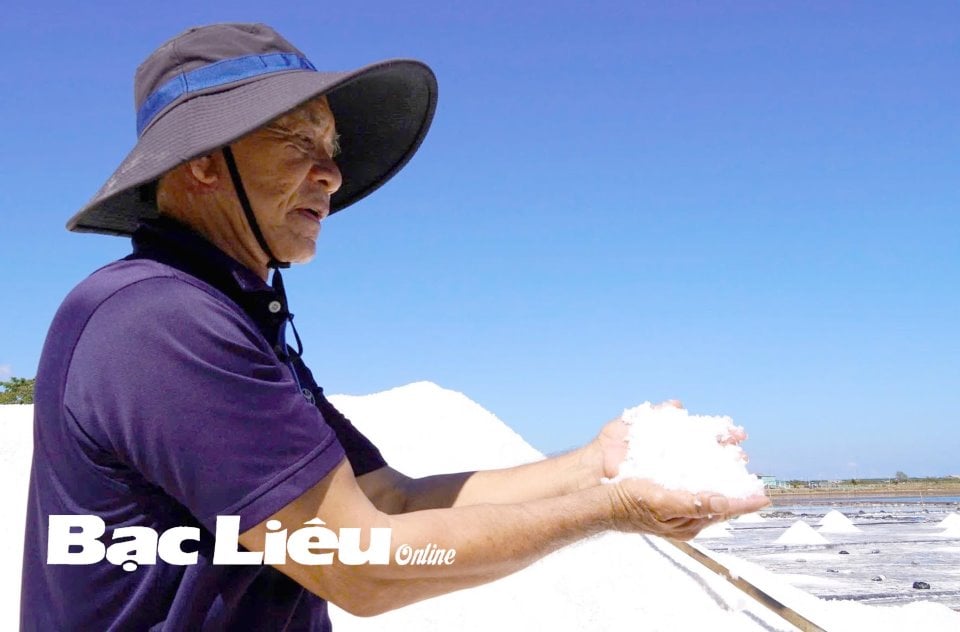
Salt billionaire Phan Van Phuc (Vinh Thinh commune, Hoa Binh district). Photo: M.D.
Phuc's parents were among the first salt farmers to reclaim the barren land in Vinh Thinh commune. Following in the family tradition, in 1979, after serving in the army, Phuc was discharged and returned to his hometown to start a family and begin his career in salt production.
In the early days, on a barren, saline plot of land nearly 6 hectares in size, Mr. Phuc and his wife worked hard to level the ground and build embankments to make salt. Due to unfavorable land and weather conditions, and a lack of experience in production, the salt yield was very low for many consecutive seasons. Mr. Phuc recalled: “At that time, I invested about 50 million VND in salt production, but I suffered losses for the first two years. It wasn't until the third year that the yield began to stabilize. Finally, in the fourth year, my perseverance and patience paid off; the salt yield started to improve, production became profitable, and my family could make a living from this profession.”
Not stopping there, Mr. Phuc continued to expand his salt production area, and by 2000, he and his wife owned more than 45 hectares of land for salt farming. Their annual salt production reached over 75,000 bushels, providing his family with a stable income and steadily improving their economic situation .
According to Mr. Phuc, the paradox of salt production is that in years with high yields, prices plummet, while in years with unfavorable weather and low yields, prices soar. This instability in both production and price has led to very precarious incomes for salt farmers. Many households with limited capital and insufficient storage facilities easily fall into poverty and have to abandon the profession. Therefore, Mr. Phuc invested in building three storage warehouses with a capacity of approximately 30,000 bushels to store salt, selling it only when prices are favorable. To date, Mr. Phuc has the largest salt production area in the region. Each salt harvest brings him nearly 1 billion VND – a considerable sum for salt producers in the area.
According to Mr. Phuc, producing high-quality salt requires not only perseverance but also meticulous preparation, from leveling and cleaning the salt fields to ensuring a consistently clean seawater source. All steps must follow a strict process to achieve the desired salt quality. "Bac Lieu salt has a unique flavor; although salty, it has a sweet aftertaste without bitterness or a fishy smell. That's why Bac Lieu salt is so popular in the market," Mr. Phuc shared.
Mr. Phuc not only preserved the craft but also passed it on to his children and grandchildren. Thanks to this, his family not only escaped poverty but also became wealthy from the traditional salt-making profession, contributing to the preservation and development of the salt-making industry in Bac Lieu province.
In 2020, Bac Lieu salt-making was recognized as a National Intangible Cultural Heritage, a great honor for the salt producers there, including salt billionaire Phan Van Phuc.
Nhat Minh
Source: https://baocamau.vn/ong-phan-van-phuc-ty-phu-muoi-bac-lieu-a41742.html
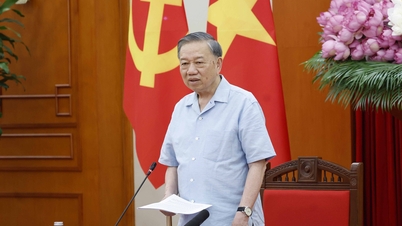
![[Photo] General Secretary and President To Lam presides over a meeting on preparations for the review of one year of operation of the three-tiered government system.](https://vphoto.vietnam.vn/thumb/1200x675/vietnam/resource/IMAGE/2026/06/02/1780391821195_a1-bnd-4595-9717-jpg.webp)








![Transforming from Resolution 57: [Part 2] Businesses Lead the Way](https://vphoto.vietnam.vn/thumb/402x226/vietnam/resource/IMAGE/2026/06/02/1780399668663_5332-dsc09931-2-235637_295-235639.jpeg)



























































Comment (0)