

Her childhood was an unfinished melody. Those notes echoed from the old teacher's piano at the end of the village – a gentle sound, like a breeze from the fields, weaving into her innocent soul, stirring within her a vague longing: to sit before the piano, wearing a pristine white dress, bowing under the stage lights. But her life, like a parched rice field during the lean season, never had room for dreams. Born into a poor family in the central countryside, the seasons of famine taught her from a young age how to endure and sacrifice. Every afternoon after school, she would linger on the teacher's porch. Through the leaves, she would secretly watch the thin fingers gliding across the piano keys. Once, catching her gaze, the teacher smiled: "Do you want to learn?" She nodded softly: "Yes!" The teacher said: "Clean the classroom, polish the piano, and I will teach you."
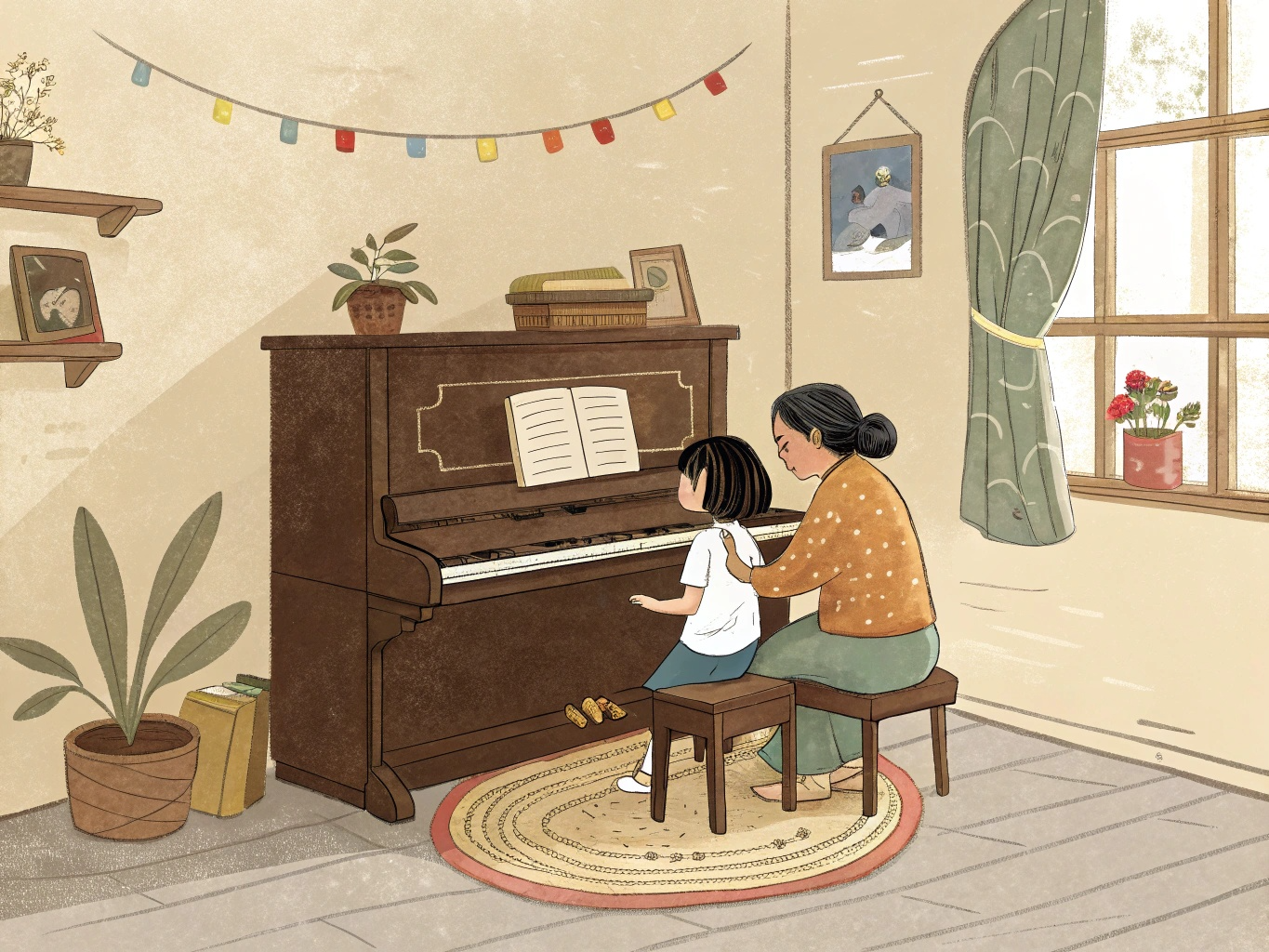 |
| Illustrative image. |
From then on, she diligently went to the teacher's house every day. Four months passed, four months she lived in a gentle dream. But then the teacher passed away. The piano came to an end. The dream ended with it.
Then she grew up quickly, shouldering the role of the eldest sister in a large family, dropping out of school, working as a hired rice planter and water carrier, toiling from dawn till dusk. Her fingers, once gliding over the piano keys, were now calloused and stained with the smell of mud. Then she married – a kind man who loved her but knew nothing about music . They lived in poverty. He died young from lung disease, leaving her with two young children. She became the whole world for her children, not daring to think of anything for herself anymore.
But those old dreams, like seeds silently sprouting in the barren soil, quietly continued to grow through the two daughters. The older sister—careful and quiet—soon noticed the sadness in her mother's eyes whenever she heard the singing emanating from the old radio. She began to practice singing. Her voice was as clear as morning dew on leaves. One day, she looked at her mother and said, "Mom... I want to learn to play the piano."
Ms. Hoa paused. The piano – a luxury she had once touched and then lost. But before her child's pleading eyes, she only nodded slightly: "I'll try."
She took on extra evening jobs, saving every penny. When her child was fifteen, she bought a used electric piano. She placed it in the middle of the house, dusting it every day, cherishing it like a treasure.
"Listening to you play the piano, my childhood comes alive again," she whispered, her eyes welling up with tears. Her younger daughter – lively and dreamy – had danced to the music since she was little, even composing her own lyrics for the songs she heard. Hoa watched, her gaze gentle like the morning sun. Her heart ached when she saw her daughter sitting on the floor, swaying to the faint melody. On some late afternoons, she would just sit silently, watching her two children and listening… as if listening to herself from a bygone era.
That summer, the older sister was preparing for her entrance exam to the Conservatory, while the younger sister turned ten. The two sisters were chosen to perform at the end-of-year school ceremony: the older sister sang and played the piano, while the younger sister danced as a backup. Ms. Hoa sat in the front row, wearing the white ao dai she had cherished for decades – the dress she had always dreamed of wearing on stage. Watching her daughters perform, she burst into tears, not out of regret, but out of happiness. Her once unfulfilled dream had blossomed on her daughters' small shoulders.
That evening, the mother and her two children sat by the small fire. On the table was a plate of fragrant baked sweet potato cakes. The night breeze blew through the cracks in the door, carrying the faint scent of jasmine.
"When I was little, I had a dream," she said slowly, "I wished to have a piano, to learn music, to perform… But my grandmother was sick, we were poor, and then your father passed away, so I put it all aside. Sometimes I thought, 'Well, a dream is just a dream.' But then… she turned to her daughter, 'when I saw you sing, I believed that if the dream was real enough, someone would continue writing it.'" The older sister sobbed. The younger sister hugged her mother and whispered, "Mom, we'll continue writing… we'll write for you too."
That night, laughter and conversation echoed by the firelight. Outside, the moon rose silently. In Hoa's heart, an old melody gently began to play, no longer unfinished, but tender and complete, like a summer piano piece – rewritten by the hands of children who knew how to dream.
TA
Source: https://baokhanhhoa.vn/van-hoa/sang-tac/202507/truyen-ngan-phim-dan-gac-lai-ae350eb/


















![[Photo] Prime Minister Pham Minh Chinh receives the Director of RMIT University Melbourne (Australia)](https://vphoto.vietnam.vn/thumb/1200x675/vietnam/resource/IMAGE/2026/04/02/1775142120087_thiet-ke-chua-co-ten-2026-04-02t214220784-png.webp)



























































Comment (0)