

(QBĐT) - I first heard the name Dong Hoi in 1955, when I was only 7 years old. The photo my father gave to my mother, sent to Thanh Hoa , was taken in Dong Hoi and read: Dong Hoi, Spring of the Year of the Goat 1955. At that time, my father was in the army and stationed in Dong Hoi town.
Therefore, I have loved the song "Quang Binh, My Homeland" ever since it was created (in 1964) and sung by Meritorious Artist Kim Oanh (in 1966), and since then, I have loved Quang Binh as the frontline outpost of the North. That's all. In the old days of 1955, there was no monument to Mother Suốt, not even the poem "Mother Suốt" by Tố Hữu. It was only later, when the poem "Mother Suốt" was written, that I kept humming: "Listening to Mother tell stories of the old days / The vast sand dunes under the midday sun of Quang Binh ." Back then, there wasn't even the novel "The Sorrow of War" by Bảo Ninh. I didn't even know where General Võ Nguyên Giáp was from.
Until I learned more about Quang Binh, it was already towering over Central Vietnam with its unique and impressive features. Writers and poets like Lam Thi My Da, Do Hoang, Ngo Minh, and Hoang Vu Thuat... I always thought they were portraits of Hue . It turns out they were from Quang Binh.
 |
But since 2014, when I returned to Quang Binh and sang with her on the white sand dunes in autumn, I fell in love with Quang Binh, with writer Huu Phuong, with the sincerity of a grain of Quang Binh sand on the banks of Nhat Le River. And so, my appearance in Nhat Le Magazine with a small, charming collection of poems was inevitable. But without writer Huu Phuong, how could I have appeared in Nhat Le Magazine, despite its distance?
"Quang Binh, My Homeland" —I've loved that song for a long time, it's associated with the youth of our generation's war against the US in the 20th century. But back then, during the war, my friends went to the front lines, while I went to university. My class had 40 students when we enrolled, but when I graduated, I was the class president, and only 10 were left; the rest went to war, and many never returned. My friend, from Quang Binh, said goodbye before going to the battlefield. He sang "Quang Binh, My Homeland ," but he ended up in Quang Tri, taking with him a song he would never sing again.
But I didn't know that Quang Binh also had a composer whose name I can't remember, only vaguely hearing "...Goodbye my love, farewell to the beloved seaside city..." , I thought he was from Hai Phong but he wasn't, he was from Quang Binh, back then, he had to remain anonymous. He was truly admirable, and at that time, Vietnamese literature was one-sided, people only wrote about war literature without considering that the diversity of literature is the foundation for a brilliant literary development. And I, with my level of literary theory at that time, wasn't mature enough to judge right from wrong.
Is that Hoàng Vũ Thuật? No, it's not. The song based on the poem "The Sailor's Feelings" is by Hoàng Vân, but the author of the poem is Hà Nhật (real name Lương Duy Cán). The poem was initially published in the newspaper under the pseudonym Mai Liêm (Hà Nhật didn't dare sign his own name and had to use the names of his two younger siblings, Mai and Liêm). Unfortunately, for a time, because of his love poems, Hà Nhật was accused of having bourgeois ideas. Even when Quý Dương sang the song, he wasn't invited to the Provincial Party Committee's meeting hall to watch.
Quang Binh is a small province (ranked 47th in population nationwide), but it was the birthplace of Vo Nguyen Giap, one of the ten greatest generals in the world...
Quang Binh province is tiny, like the palm of your hand, but it has the world's largest cave complex. Similarly, Poland, though small in comparison to the rest of the world, has six Nobel Prize winners, the oldest being in Chemistry and the most recent in Literature.
Oh, my homeland Quang Binh … It’s been more than 10 years since that day, 2014, when I returned to Dong Hoi. On a moonlit night at Nhat Le… the white sand was hazy and ethereal, the sky, land, and sea were like poetry. My understanding of Quang Binh back then was very vague.
Today I returned, and I saw towering buildings rising along the oceanfront, five-star villas, and luxurious restaurants lining the white sandy beaches. Bao Ninh, Mother Suot's hometown, is different now. I only just realized how beautiful Bao Ninh is now, more tourist-oriented, and wealthier, even though the coconut trees and sand remain. The tall buildings stand out against the shimmering starry night sky. The green coconut trees and white sand are also different from before, having endured more sun, rain, and storms, but also possessing a more rugged charm. The Mother Suot monument stands majestically against the backdrop of Nhat Le, bathed in the autumn sun.
Even though the festival is still crowded and there's plenty of fresh fish, the fish is different now. Fresher, tastier. The bell tower of Tam Toa Church remains the same, ancient and moss-covered... Dong Hoi now, upon my return, Quang Binh Quan is also different from before... History has added another page, the mountains and rivers have changed, but even though I return now, the name remains the same: Quang Binh Quan.
I only now realize that in Quang Binh, even though the floods cause losses, next year there will be more alluvial soil, leading to a more bountiful harvest. I only now understand that there is a benefit in every loss...
In November 2024, I returned to Quang Binh. The new Secretary of the Quang Binh Provincial Party Committee, Le Ngoc Quang, former Director General of Vietnam Television, received me warmly, even though he had just taken office and had a mountain of work to attend to. I shared my concerns about the difficulties caused by Typhoon No. 3, the impoverished households, etc. He immediately said: "Thank you, that's our job. Writer, please talk about Quang Binh's advantages, its world-renowned tourist destination, so that more international investors and tourists will come, and what solutions are there to help them come faster."
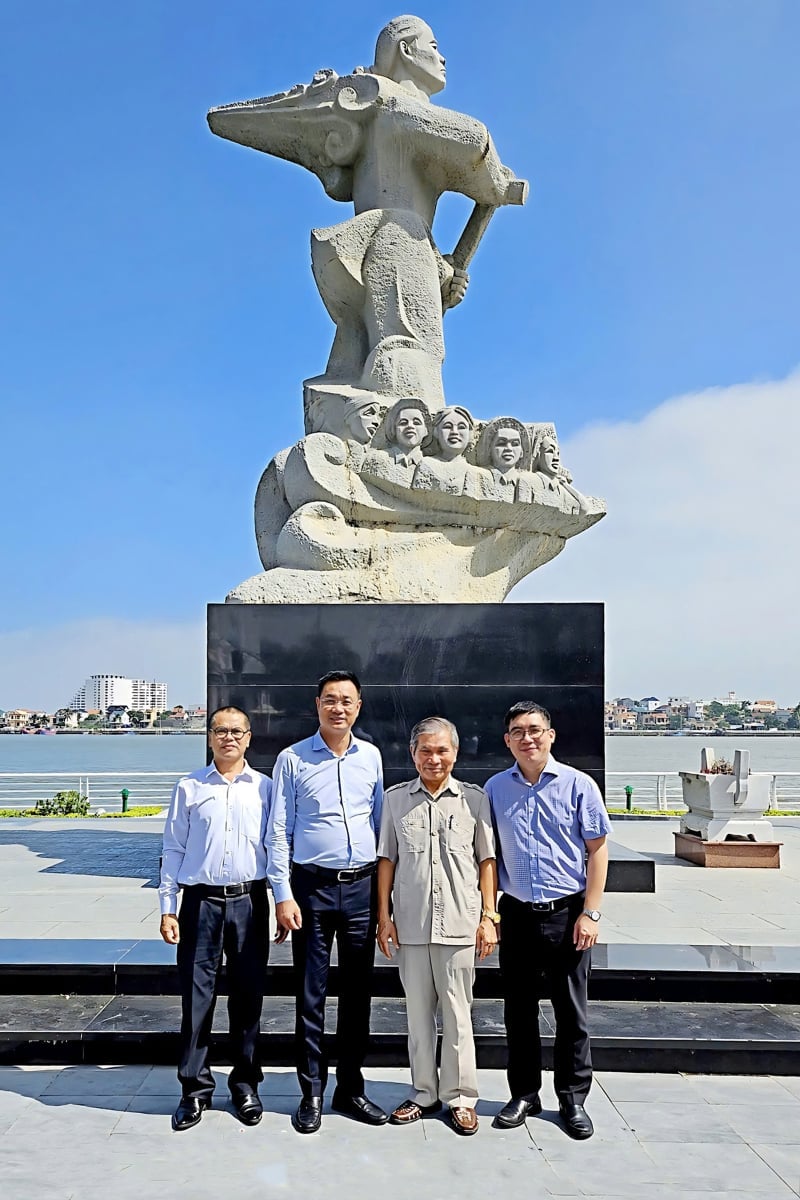
The Chairman of the Quang Binh Literature and Arts Association, Phan Dinh Tien, happily invited the new Provincial Party Secretary, Le Ngoc Quang, and me to the banks of the Nhat Le River to take photos at the foot of the Mother Suot monument. I asked Phan Dinh Tien: "Who is the sculptor of the Mother Suot monument?" Phan Dinh Tien proudly pointed to his chest: "I am." Le Ngoc Quang, surprised, said: "That's great! Let's go to the banks of the Nhat Le River and take photos next to the Mother Suot monument with the sculptor himself." And those impressive and unique photos were taken just 30 minutes later.
Oh, my homeland Quang Binh, spring is coming! Nhat Le Beach shines with new projects unfolding in Quang Binh, tourists are arriving to welcome spring with festivals. Party congresses at all levels are being urgently prepared for the new year 2025... Everything is in springtime!
Le Tuan Loc
Source: https://www.baoquangbinh.vn/dat-va-nguoi-quang-binh/202501/quang-binh-que-ta-oi-2223992/


![[Photo] Commemorating the unwavering friendship between Vietnam and Laos](/_next/image?url=https%3A%2F%2Fvphoto.vietnam.vn%2Fthumb%2F1200x675%2Fvietnam%2Fresource%2FIMAGE%2F2026%2F01%2F27%2F1769518372051_ndo_br_1-jpg.webp&w=3840&q=75)

![[Photo] Announcement Ceremony of the Art Program “Light Concert – Welcoming the New Year 2026”](/_next/image?url=https%3A%2F%2Fvphoto.vietnam.vn%2Fthumb%2F1200x675%2Fvietnam%2Fresource%2FIMAGE%2F2026%2F01%2F27%2F1769514762857_le-cong-bo-ct-hoa-nhac-anh-sang-1772-9042-jpg.webp&w=3840&q=75)


![[Hightling] Conference on the Implementation of Tasks for 2026](/_next/image?url=https%3A%2F%2Fvphoto.vietnam.vn%2Fthumb%2F402x226%2Fvietnam%2Fresource%2FIMAGE%2F2026%2F01%2F27%2F1769477856197_dsc01637.jpeg&w=3840&q=75)


![OCOP during Tet season: [Part 2] Hoa Thanh incense village glows red.](/_next/image?url=https%3A%2F%2Fvphoto.vietnam.vn%2Fthumb%2F402x226%2Fvietnam%2Fresource%2FIMAGE%2F2026%2F01%2F27%2F1769480573807_505139049_683408031333867_2820052735775418136_n-180643_808-092229.jpeg&w=3840&q=75)
![OCOP during Tet season: [Part 1] Ba Den custard apples in their 'golden season'](/_next/image?url=https%3A%2F%2Fvphoto.vietnam.vn%2Fthumb%2F402x226%2Fvietnam%2Fresource%2FIMAGE%2F2026%2F01%2F26%2F1769417540049_03-174213_554-154843.jpeg&w=3840&q=75)




Comment (0)