

The AI craze and Pi Network's promise of "life-changing" success.
In a cryptocurrency market constantly hungry for groundbreaking stories, Pi Network, a project that once caused a sensation with its model allowing users to mine tokens via a mobile app, is once again stirring up the community with an ambitious declaration: to conquer the artificial intelligence (AI) market. This is no longer just about free Pi tokens, but a strategic gamble that could completely reshape the project's future.
The focus of attention came from the analysis of Mr. Spock, a prominent industry commentator, who painted a spectacular growth picture.
This vision is based on a simple yet incredibly bold premise: if Pi Network can capture even a small slice of the enormous global AI market, which giants like PwC and McKinsey predict will reach a value of $16 trillion by 2030, the value of Pi will explode.
Specifically, three scenarios were presented.
Scenario 1 (realistic): If Pi Network captures 1% of the AI market share, the project's capitalization could skyrocket from its current level of approximately $3.53 billion to $160 billion. This is equivalent to the price of each Pi coin exceeding $21, resulting in a 46-fold increase (equivalent to a 4,500% return).
Scenario 2 (optimistic): If Pi Network successfully captures 5% of the market, its market capitalization will reach $800 billion, and the value of each Pi coin could reach or exceed $100 – an incredible growth rate, 200 times its current value.
These figures, though only projections, immediately sparked hope for millions of Pioneers (Pi users) worldwide. But the biggest question is: How will Pi Network achieve this?
The foundation for an AI empire, or just a promise?
The foundation for Pi Network's ambitions lies in its recently announced strategic moves, particularly at the Pi2Day event. The development team (Pi Core Team) officially launched Pi App Studio and integrated GenAI technology, affirming their determination to make Pi Network the first blockchain fully optimized for the artificial intelligence era.
In theory, this move is incredibly smart. Pi Network's biggest advantage is its massive community of tens of millions of active users. In the world of AI, data is gold. A decentralized network with such a large user base could become a data "gold mine" for training AI models, and a potential market for deploying personalized AI applications.
According to analyst Mr. Spock, by encouraging developers to build AI utilities on its platform, Pi Network is not only creating value for the Pi coin but is also building a decentralized, user-centric digital infrastructure. The long-term vision is to create a digital economy where users and developers alike benefit from AI services operating directly on the blockchain.
However, there is a significant gap between ambition and reality. An ecosystem cannot survive on promises and potential that remain only on paper.
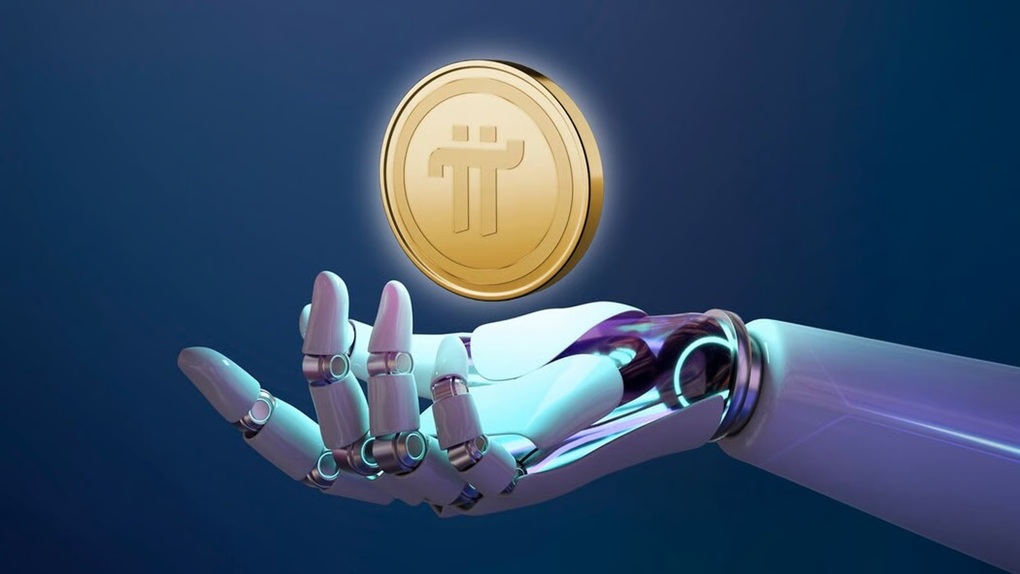
Pi has a significant advantage in building a decentralized infrastructure ready for AI, and it also possesses a huge user community – a factor that not all blockchains have (Illustration: CoinCodex).
Short-term pressures and long-term challenges
While the prospect of reaching $100 is being spread, investors need to face a less rosy reality. The price of Pi is still fluctuating below $0.50, a modest figure compared to the project's ambitions. More worryingly, a short-term "storm" is looming.
According to data, approximately 272 million Pi tokens are expected to be unlocked and returned to user wallets this July. Theoretically, a large supply released into the market could create significant selling pressure, potentially pushing the price of Pi back to its April lows of around $0.40. This tangible risk is something any short-term investor must consider.
But Pi Network's biggest challenge isn't a token unlocking campaign, but execution. The core question is whether the Pi Core Team can transform the massive community into a vibrant ecosystem with practical applications.
The $100 million Pi Ventures fund, established to promote this development, has yet to attract significant investment. Many analysts believe that, to succeed, the Pi team needs to be more proactive in supporting developers, offering attractive reward mechanisms, and creating a truly favorable environment for AI applications to emerge and thrive. Otherwise, Pi Network will remain a "giant" in terms of user numbers but a "tiny" entity in terms of practical value.
The AI gamble: Opportunity or trap?
The story of Pi Network and AI is a classic example of the contrast between potential and risk in the world of cryptocurrencies.
On the positive side, Pi Network possesses two invaluable assets: a massive community and a strategic vision that capitalizes on the biggest technology trends of the decade. If successfully implemented, transforming this network into a decentralized AI platform could create a true revolution, and predictions of a price of $21 or $100 would no longer be far-fetched.
On the downside, the project is facing short-term downward price pressure, fierce competition, and a huge challenge in transitioning from "promise" to "product." The success of this AI gamble depends entirely on the execution capabilities of the Pi Core Team and the responsiveness of the developer community.
Despite its ambition to redefine the entire blockchain ecosystem in the AI era, Pi Network still stands on the line between revolution and illusion. Its weight no longer lies in promises or inflated prices, but in its ability to realize each line of code into real value, each application into a practical need.
If it fails to surpass itself – to escape the shadow of a past filled with skepticism and prove its viability in the real world – the once most anticipated cryptocurrency project could become another prime example of a technological dream that crumbled before it even hit the ground.
Source: https://dantri.com.vn/kinh-doanh/pi-network-dat-cuoc-vao-ai-gia-tang-200-lan-hay-cu-lua-the-ky-20250710161610919.htm

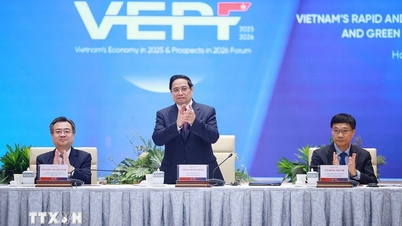
![[Photo] Prime Minister Pham Minh Chinh attends the Vietnam Economic Forum 2025](/_next/image?url=https%3A%2F%2Fvphoto.vietnam.vn%2Fthumb%2F1200x675%2Fvietnam%2Fresource%2FIMAGE%2F2025%2F12%2F16%2F1765893035503_ndo_br_dsc-8043-jpg.webp&w=3840&q=75)
![[Photo] Prime Minister Pham Minh Chinh receives the Governor of Tochigi Province (Japan)](/_next/image?url=https%3A%2F%2Fvphoto.vietnam.vn%2Fthumb%2F1200x675%2Fvietnam%2Fresource%2FIMAGE%2F2025%2F12%2F16%2F1765892133176_dsc-8082-6425-jpg.webp&w=3840&q=75)

![[Photo] Prime Minister Pham Minh Chinh receives Lao Minister of Education and Sports Thongsalith Mangnormek](/_next/image?url=https%3A%2F%2Fvphoto.vietnam.vn%2Fthumb%2F1200x675%2Fvietnam%2Fresource%2FIMAGE%2F2025%2F12%2F16%2F1765876834721_dsc-7519-jpg.webp&w=3840&q=75)
![[Image] Leaked images ahead of the 2025 Community Action Awards gala.](/_next/image?url=https%3A%2F%2Fvphoto.vietnam.vn%2Fthumb%2F1200x675%2Fvietnam%2Fresource%2FIMAGE%2F2025%2F12%2F16%2F1765882828720_ndo_br_thiet-ke-chua-co-ten-45-png.webp&w=3840&q=75)












































































Comment (0)