

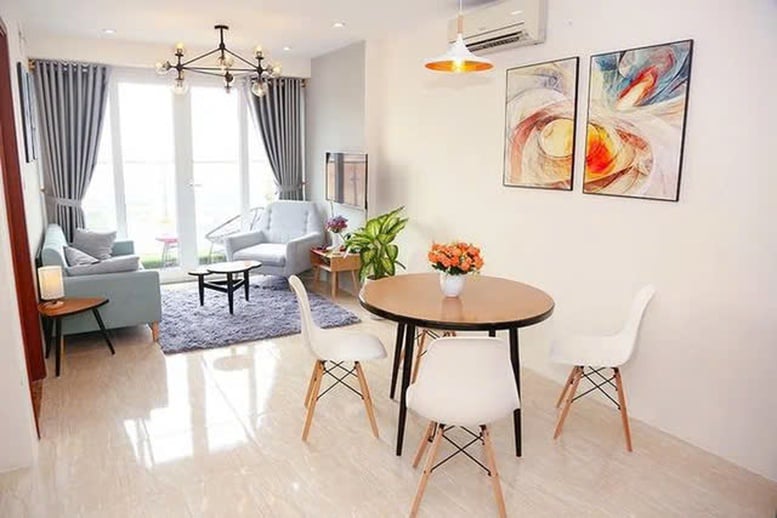
Currently, it is illogical that while long-term apartment rentals (under 30 days) are not prohibited, short-term rentals are banned – Illustration image.
Regarding the Ho Chi Minh City People's Committee's Decision 26 issued on February 27th, which regulates the management and use of apartment buildings, the decision stipulates that renting apartments in apartment buildings must ensure they are used solely for residential purposes and absolutely prohibit short-term stays, whether by day or hour. The Department of Document Inspection and Administrative Violation Management ( Ministry of Justice ) has compiled a report on the difficulties and shortcomings related to the aforementioned regulation and submitted it to the Ministry of Construction.
According to the Department of Document Inspection and Administrative Violation Management, current regulations prohibit the following acts: using apartment units for purposes other than residential use; arbitrarily changing the function or purpose of common areas of the apartment building; altering or damaging the load-bearing structure; and dividing or separating apartments without permission from the competent state authority.
The implementing guidelines and Circular 4757 of the Ministry of Construction have also stipulated that using apartment units for purposes other than residential use is strictly prohibited.
The regulations are unreasonable.
However, in essence, the Ministry of Justice argues that: Airbnb-style rental services (a model connecting people who need to rent houses or rooms with those who have rooms for rent) are still essentially about renters using the apartment for residential purposes. Current laws do not specify how many days constitute a short-term rental or prohibit owners from renting out their apartments.
In fact, the current situation where long-term apartment rentals are not prohibited, but short-term rentals (under 30 days) are, is illogical. Therefore, prohibiting apartment rentals through Airbnb is unreasonable and lacks legal soundness.
If the apartment owner does not live in it, they have the right to rent it out; this is one of the property rights of the owner as stipulated in the Civil Code.
In reality, this model may affect other residents, but instead of a complete ban, appropriate management solutions should be implemented. For example, homeowners should be required to register their businesses, meet security and fire safety requirements, and ensure that their activities do not negatively impact the community within the apartment building.
In this summary, the proposed solutions aim to thoroughly address the situation. Authorities need to implement comprehensive measures, such as enacting specific legal regulations regarding short-term accommodation businesses in apartment buildings.
If the ban on short-term accommodation businesses in apartment projects continues, state management agencies may also consider imposing deterrent sanctions for violations.
Regulations will be amended in the near future.
In response to the above issue, the Department of Housing and Real Estate Market Management stated that it will take note of, research, and review the matter in order to report to the competent authority for amendment and supplementation in the near future.
At the same time, the Department of Housing and Real Estate Market Management emphasized that the management and use of apartment buildings are carried out in accordance with the provisions of the Housing Law of 2023 and its implementing guidelines.
The Ho Chi Minh City Real Estate Association (HoREA) has submitted a document to the Ho Chi Minh City People's Committee. HoREA argues that instead of banning it, the city should consider this model as a conditional investment and business sector. Short-term accommodation businesses in apartment buildings need to be regulated by law, requiring business owners to register, pay taxes, and comply with housing and service standards.
According to HoREA statistics, there are currently 24 apartment buildings and complexes in the city offering short-term rentals through the Airbnb platform, totaling approximately 8,740 apartments. In addition, many other short-term rentals are conducted directly or through intermediaries.
Short-term rentals generate an average monthly revenue of 15-60 million VND for homeowners and can significantly contribute to the city's budget.
In many countries around the world , short-term accommodation services operate, and homeowners can rate guests; violations can result in future service suspension.
Phan Trang
Source: https://baochinhphu.vn/ra-soat-quy-dinh-cam-cho-thue-can-ho-ngan-ngay-102250519134300771.htm




![[Image] Nearly 125,000 Hanoi students completed the Literature exam for the 10th grade entrance exam.](https://vphoto.vietnam.vn/thumb/1200x675/vietnam/resource/IMAGE/2026/05/30/1780117233041_ndo_br_thiet-ke-chua-co-ten-2-png.webp)














![[Photo] Admire the coral "masterpiece" amidst the million-year-old heritage of Dak Lak province.](https://vphoto.vietnam.vn/thumb/1200x675/vietnam/resource/IMAGE/2026/05/30/1780107638639_y25-jpg.webp)






































































Comment (0)