The fields were destroyed after the flood, but the people did not leave the land.
In mid-December, while the scars of the historic November 20th flood were still visible on many vegetable fields in Lam Dong province, the atmosphere of production gradually returned. Plots of land that had been swept away by the flood were now plowed, mud cleared, and greenhouses rebuilt. On the still-dirty soil, farmers began planting the new crop.

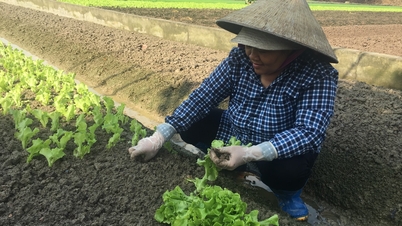
Ms. Nguyen Thi Hoa in Ka Do commune is tending to her family's cabbage garden, which was planted after the historic flood: Photo: Pham Hoai.
In Ka Đô commune, the area specializing in vegetable cultivation suffered the most severe damage. Many areas along rivers and streams still show signs of erosion, with the topsoil worn away and depleted. However, amidst the still chaotic landscape, the vibrant green of newly sown vegetables has appeared, signaling that production is gradually recovering.
Ms. Nguyen Thi Hoa, a resident of Ka Do commune, still remembers the heartbreaking loss of over 3 acres of cabbage, almost ready for harvest, completely swept away by the flood. “When the water receded, I went to the field hoping to salvage something, but all the vegetables were gone, and the soil, soaked for days, was completely barren,” Ms. Hoa recalled.
After the initial days of near exhaustion, in early December, Mrs. Hoa returned to her fields. With limited capital, she only dared to plant in stages, carefully planning as she went along. "The losses are significant, but if I don't replant, I don't know how I'll make a living. As long as I have land, I have a way to make a living," she said.
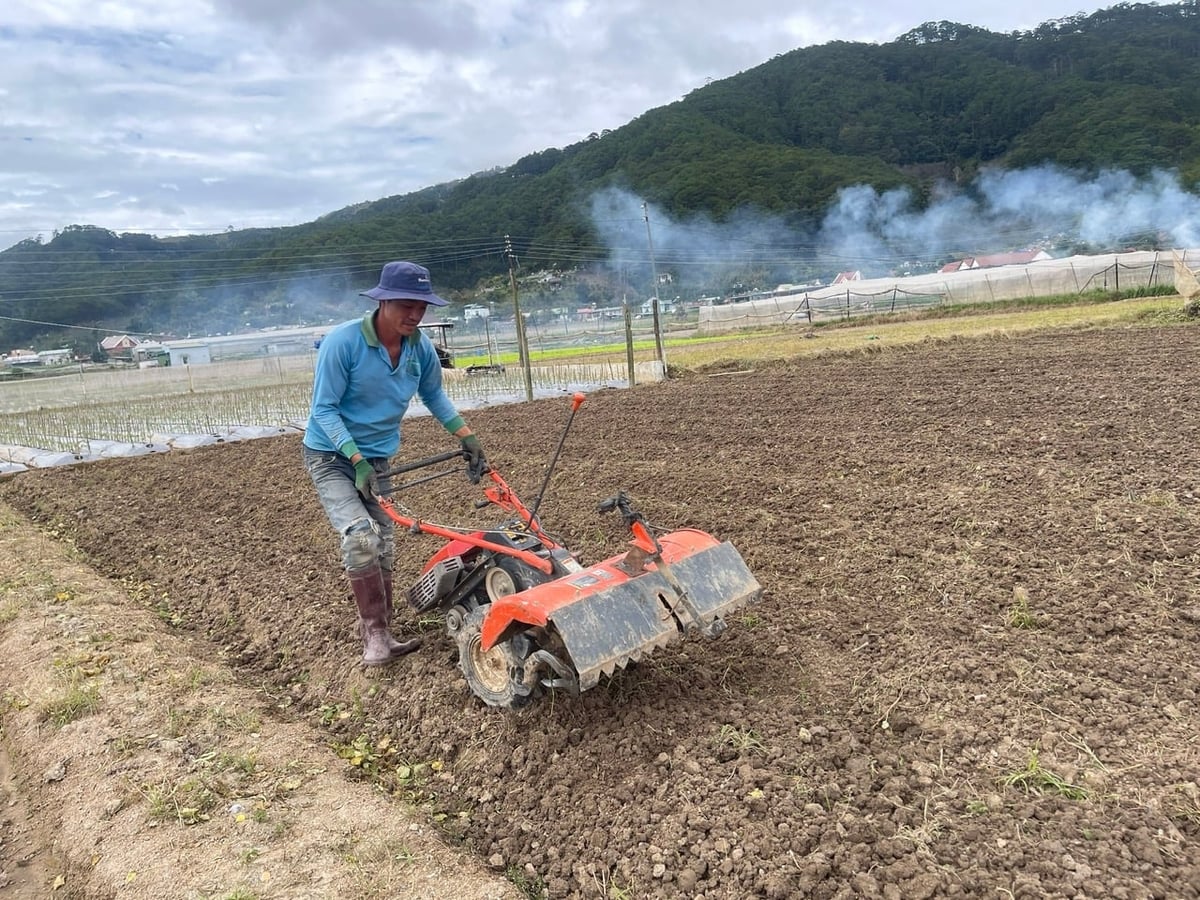
The fields in Lam Dong province are bustling with activity as they return to normal. Photo: Pham Hoai.
Similarly, Mr. Hoang Gia Hung's family in Ka Do commune also lost more than 3 acres of their spice vegetables. The sudden flood during the night not only swept away the crops but also destroyed the entire irrigation system, motors, water pipes, and assets accumulated over many years. Since the beginning of December, he has borrowed more capital to repair the irrigation system and improve the soil in order to replant a short-term vegetable crop.
"It's been almost a month, but thinking back still haunts me. All the hard work I put into the fields is gone. But if I don't get back on my feet now, I'll only end up worse off, so I have to try to hold on to the land, hoping for God's mercy and that everything will gradually pass," Mr. Hung shared.
In the Kazam Dam area of Ka Do commune, approximately 30 households with over 5 hectares of agricultural land were severely affected. Many vegetable fields were buried under thick layers of mud, internal field roads were damaged, and the transportation of supplies and agricultural products became very difficult. Despite this, by early December, many households had begun returning to their fields to gradually restore their damaged areas.

Mr. Hoang Gia Hung in Ka Do commune suffered heavy losses in the flood, but with the spirit of staying on the land and protecting his home, he and his family managed to recover and continue planting in time for the Tet vegetable crop. Photo: Pham Hoai.
According to Mr. Nguyen Huu Chi, Chairman of the People's Committee of Ka Do commune, the recent floods submerged more than 80 hectares of vegetable crops in the area, caused the collapse of approximately 8,000 square meters of greenhouses, and severely eroded many rural roads, canals, and irrigation works. The total estimated damage amounts to billions of dong.
Immediately after the floods, the local authorities mobilized militia forces, youth union members, and young people to assist residents in clearing mud and debris, unblocking waterways, and temporarily repairing production infrastructure. However, many households are still facing significant difficulties in reinvesting capital.
“The commune is continuing to review and compile statistics on the damage to propose timely support policies for the people. At the same time, we are requesting investment in stream embankment systems and upgrading drainage infrastructure to minimize natural disaster risks and help stabilize agricultural production in the future,” Mr. Chi said.

Locals are clearing flood-damaged fields to prepare the land for planting the new crop. Photo: Pham Hoai.
Replanting green shoots in flood-affected areas.
The recent historic floods have almost wiped out many production areas considered the "vegetable capital" of Lam Dong province. According to the Provincial Department of Crop Production and Plant Protection, the province's plan for vegetable cultivation in 2025 is 92,000 hectares. To date, more than 90,500 hectares have been planted, with a production of approximately 2.6 million tons. The floods have damaged 3,000 hectares, equivalent to 90,000 tons of vegetables.
During the recent floods, the entire province suffered damage to over 4,570 hectares of crops, including 4,439 hectares of vegetables and rice, and 130 hectares of perennial crops. Some localities were severely affected, such as D'ran, Ka Do, and Quang Lap communes with over 205 hectares damaged, Don Duong commune with 100 hectares, Duc Trong with 180 hectares, and Quang Phu with over 300 hectares.
Those stark statistics reflect the unprecedented devastation inflicted on Lam Dong's key agricultural region. Yet, amidst the vast expanse of land still bearing the marks of the flood, farmers did not abandon their fields or their homes. As soon as the water receded, they returned to their familiar farmlands, beginning the journey of replanting green seedlings.
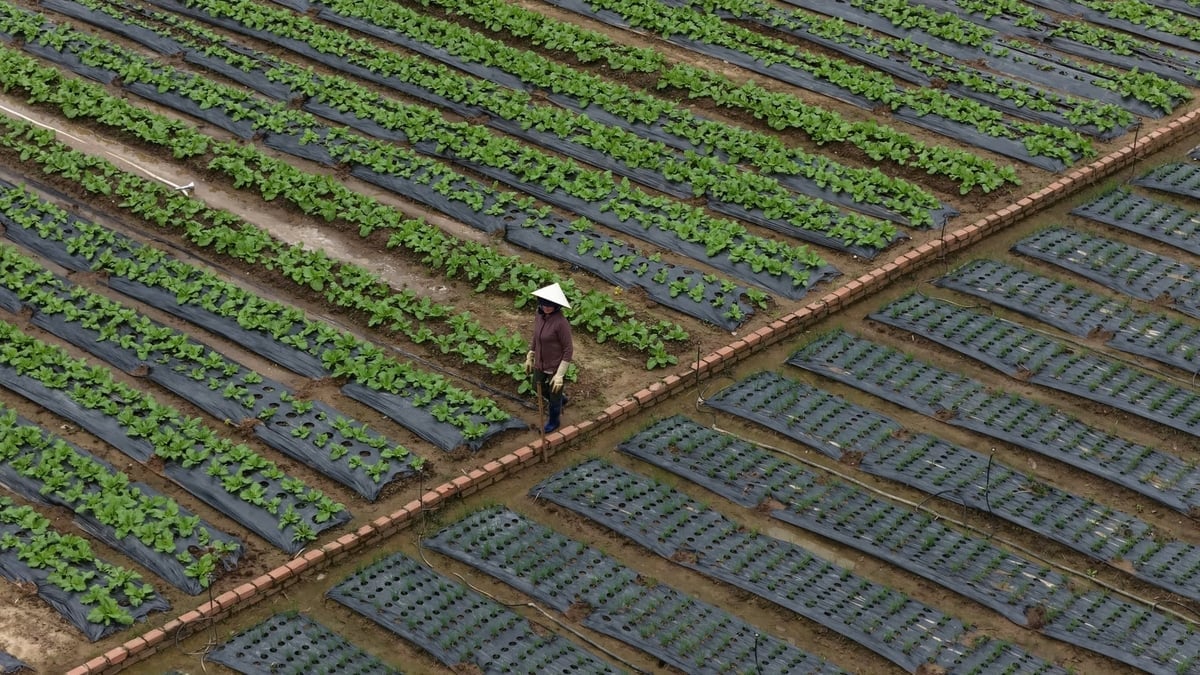
Nearly a month after the floods, people in many communes of Lam Dong province have gradually begun planting crops to nurture new growth. Photo: Pham Hoai.
According to Mr. Ha Ngoc Chien, Head of the Department of Crop Production and Plant Protection of Lam Dong province, the damage has affected local supply but will not cause a shortage of goods during Tet (Lunar New Year) because the planting season starts from the end of November to the beginning of December.
With government support, farmers can quickly stabilize their livelihoods.
Following the historic floods, hundreds of hectares of vegetables, flowers, and perennial plants in Lam Dong province suffered severe damage. Many greenhouses and polytunnels collapsed, agricultural land was covered with silt and eroded, and the lives and livelihoods of the people were severely affected. In the face of this reality, along with the diligence and dedication of the farmers, the timely intervention of the government and relevant agencies became crucial pillars in the gradual recovery of the flood-affected areas.
According to Nguyen Hoang Phuc, Deputy Director of the Department of Agriculture and Environment of Lam Dong province, specialized agencies are implementing a comprehensive range of solutions such as environmental sanitation, livestock disinfection, disease control, guidance on soil improvement, and clearing of irrigation canals to quickly restore production. To date, localities have treated and remedied approximately 4,215 hectares out of a total of 4,570 hectares of affected crops.
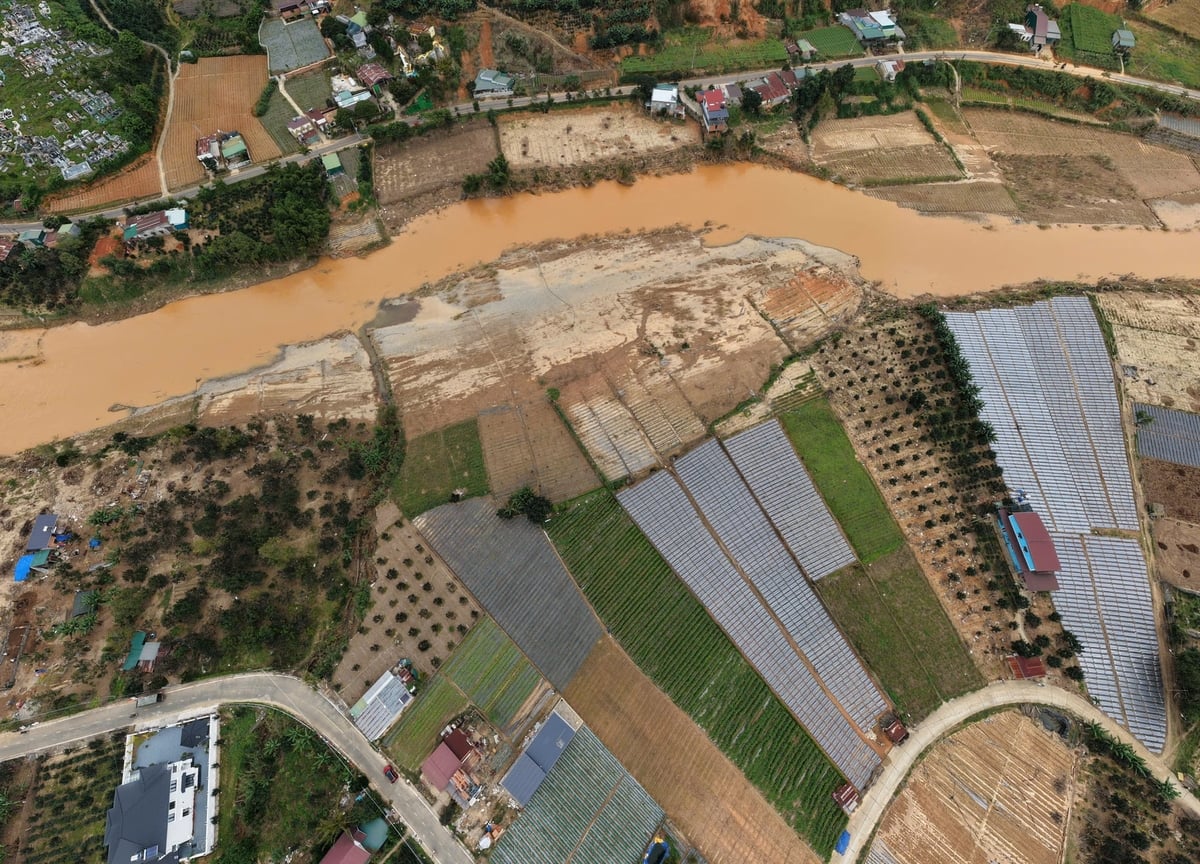
The stream's water is still murky with mud, and the banks still bear the marks of the great flood. However, next to it are newly planted vegetable gardens beginning to sprout. Photo: Pham Hoai.
Mr. Phuc advised people to utilize areas of vegetable crops that are still harvestable, destroy damaged crops, plow and use soil improvement products. For industrial crops and fruit trees, it is necessary to clear drainage ditches, remove debris, and loosen the soil crust to improve root aeration. For orchards bearing fruit, micronutrients should be added to reduce cracking and fruit drop. For pepper plants, loosen the soil crust when it is dry and strengthen prevention measures against diseases that develop after floods.
Permanent Vice Chairman of the Lam Dong Provincial People's Committee Le Trong Yen requested localities to prioritize the restoration of agricultural production in conjunction with house repairs and ensuring environmental sanitation after the floods. Areas severely affected need urgent support to help people quickly stabilize production and ensure the supply of vegetables and crops to the market, especially during the peak season at the end of the year.
"With the spirit of leaving no one behind, we are actively seeking ways to support the reconstruction of production so that people can produce vegetables for the upcoming Tet holiday," Mr. Yen affirmed.
Source: https://nongnghiepmoitruong.vn/ruong-dong-bat-dau-hoi-sinh-sau-lu-d789813.html


![[Photo] First session of the 14th Congress of the Vietnam Trade Union](https://vphoto.vietnam.vn/thumb/1200x675/vietnam/resource/IMAGE/2026/06/03/1780465947883_ndo_br_img-3852-jpg.webp)


![[Photo] General Secretary and President To Lam presides over a meeting with the Central Organizing Committee.](https://vphoto.vietnam.vn/thumb/1200x675/vietnam/resource/IMAGE/2026/06/03/1780482764658_a1-bnd-4741-3342-jpg.webp)
![[Photo] Secretary of the National Assembly Party Committee, Chairman of the National Assembly presides over the meeting of the Standing Committee and Executive Committee of the National Assembly Party Committee.](https://vphoto.vietnam.vn/thumb/1200x675/vietnam/resource/IMAGE/2026/06/03/1780480353201_ndo_br_bnd-2585-jpg.webp)









![Transforming from Resolution 57: [Part 3] High-tech agricultural center](https://vphoto.vietnam.vn/thumb/402x226/vietnam/resource/IMAGE/2026/06/03/1780491765550_2928-4922-img_7193-010813_454-010814.jpeg)








![The Essence of Viet Bac Villages: [Part 3] The Precious Fragrance of Nghinh Tuong](https://vphoto.vietnam.vn/thumb/402x226/vietnam/resource/IMAGE/2026/05/29/1780020600366_5237-tinh-tuy-ban-lang-viet-bac-bai-3-chuyen-o-nghinh-tuong-050626_700.jpeg)
![The Quintessence of Northern Vietnam's Villages: [Part 2] The Famous Cassava Noodles of Kunming](https://vphoto.vietnam.vn/thumb/402x226/vietnam/resource/IMAGE/2026/05/28/1779937455892_3929-3144-mien-dong-15-nongnghiep-023138.jpeg)
![The Essence of the Village: [Part 1] Wine on the mountain, tea in the clouds - Bang Phuc](https://vphoto.vietnam.vn/thumb/402x226/vietnam/resource/IMAGE/2026/05/27/1779841729178_3821-1jpg-nongnghiep-103814.jpeg)






















![[Video] Sunset at Lap An Lagoon – Where the sun sets over the fishing nets](https://vphoto.vietnam.vn/thumb/1200x675/vietnam/resource/IMAGE/2026/05/31/1780192137701_beach-landscape-sea-water-nature-grass-745871-pxhere-com.jpeg)

























Comment (0)