

The Sahara Desert still receives some rain, but typically only a few inches each year, and it rarely occurs in late summer. However, over two days in September, heavy rains fell in some areas of southeastern Morocco after a low-pressure system swept across the northwestern Sahara.
Preliminary satellite data from NASA indicates rainfall exceeding 200 mm in some areas.
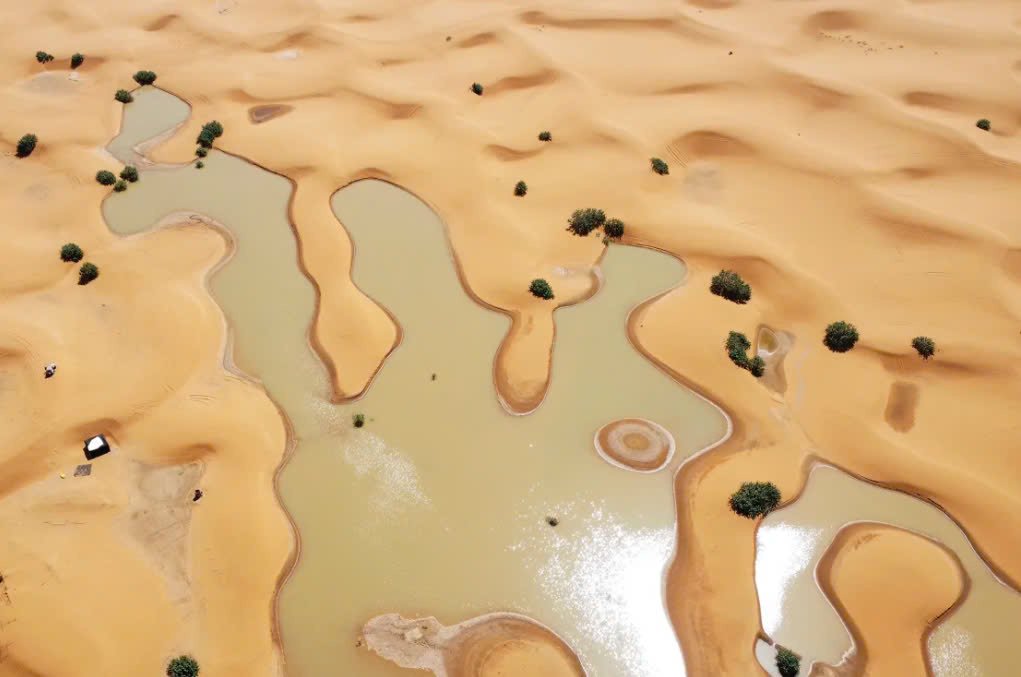
A view of lakes formed by heavy rains among sand dunes in the desert town of Merzouga, near Rachidia, Morocco, on October 2, 2024. Photo: AP
The desert city of Errachidia experienced a historic rainfall event last September. Over 250 mm of rain fell in just two weekend days, far exceeding the average monthly rainfall by four times, equivalent to more than half a year's worth of rain.
"It has been 30 to 50 years since we've had such heavy rainfall in such a short period of time," Houssine Youabeb from Morocco's meteorological agency told AP last week.
These stunning images come from the desert town of Merzouga, where floods have created new lakes amidst the sand dunes. This beautiful landscape has attracted much attention, offering a unique backdrop to this arid region.
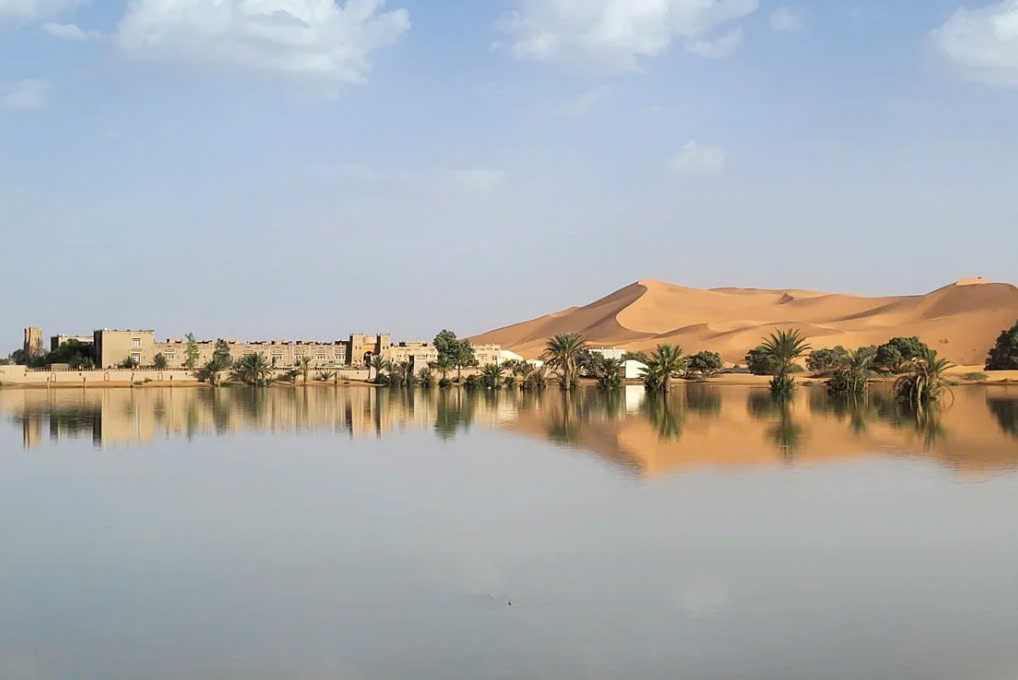
Flooding caused by heavy rains in the desert town of Merzouga on October 2, 2024. Photo: AP
The rains have also filled lakes that would normally dry up, such as the lake in Iriqui National Park, Morocco's largest park. NASA satellite imagery from the area shows newly formed lakes across stretches of land in the northwestern Sahara.
Although most of the rainfall fell on remote areas, a significant portion caused severe flooding in populated areas, particularly in regions near the Atlas Mountains. More than a dozen people were killed and many homes were damaged.
The Sahara Desert, the world's largest non-polar desert, has unexpectedly "turned green" in recent satellite images. However, studies suggest that storms moving further north and causing heavy rainfall in the Sahara are a direct consequence of global warming.
Fossil fuel pollution, which increases temperatures and disrupts the water cycle, has created conditions for such extreme weather events to occur more frequently.
Ha Trang (according to CNN)
Source: https://www.congluan.vn/sa-mac-sahara-cung-phai-roi-vao-canh-ngap-lut-post317030.html


![[Photo] Delegation attending the 14th Congress of the Vietnam Trade Union visits the Mausoleum of President Ho Chi Minh.](https://vphoto.vietnam.vn/thumb/1200x675/vietnam/resource/IMAGE/2026/06/03/1780451842301_ndo_br_img-3824-jpg.webp)
















































































Comment (0)