

 |
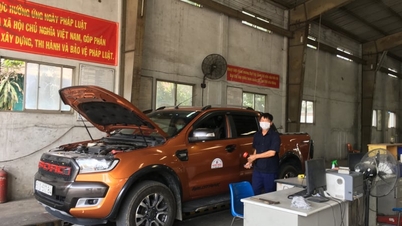
| Officials from the Tuyen Quang Transport Vehicle Inspection Center - 2201S conduct thorough inspections of vehicles undergoing emissions testing. |
According to Decision No. 43/2025 dated November 28, 2025, of the Prime Minister , from March 1st, emission standards level 1 (equivalent to Euro 1 emission standards) will be applied to vehicles manufactured before 1999; level 2 to vehicles manufactured from 1999 to the end of 2016; and level 3 to vehicles manufactured from 2017 to the end of 2021. Vehicles manufactured from 2022 onwards will immediately apply level 4.
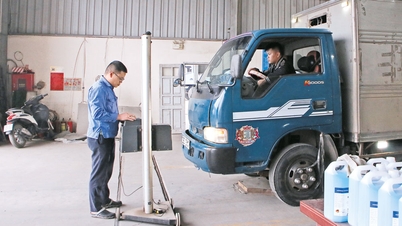
Mr. Vi Quang Banh, from Lang Quan village, Yen Son commune, brought his truck to the Tuyen Quang Transport Vehicle Inspection Center - 2201S for a routine inspection. The truck, used for transporting agricultural products, was purchased by Mr. Banh over a year ago, and this was the second time he had it inspected. This time, the emissions testing followed a new procedure. Before arriving at the inspection center, Mr. Banh proactively took his truck to a garage for a comprehensive maintenance check and technical inspection. Thanks to this, the inspection went smoothly, and all parameters met the requirements. According to Mr. Banh, emissions testing is necessary, not only contributing to environmental protection but also helping vehicle owners improve their awareness of regular vehicle maintenance.
Having just received a "fail" result due to exceeding the smoke index limit, Mr. Le Manh Ha, a resident of Trung Mon 7 residential area, Minh Xuan ward, and owner of a construction material truck, said: "Previously, my truck passed inspections normally; just cleaning the exhaust pipe was enough. But now the new measurement process is too strict; if you press the gas pedal firmly for just one second, the machine immediately reports the result."
According to statistics from the Tuyen Quang Transport Vehicle Inspection Center - 2201S, from March 1st to March 31st, 779 vehicles underwent their first inspection and 122 vehicles underwent their second inspection. Of these, 134 vehicles failed the first inspection and 2 vehicles failed the second inspection, resulting in a failure rate of 14.68%. Specifically, the rate of vehicles failing emission standards was 19.40%, an increase of nearly 10% compared to the same period last year.
For gasoline-powered vehicles, in addition to checking emissions at low idle speed, the vehicle must also be tested at high idle speed by accelerating the engine to approximately 2,000-3,000 rpm to measure emissions. For diesel vehicles, the test is more rigorous, using a free-acceleration cycle. Instead of simply pressing the accelerator pedal all the way down once as before, the new procedure requires the inspector to quickly press the accelerator pedal all the way down to the maximum engine speed at least four times to record the maximum emission level. The first time is used for vehicle safety testing, and at least three subsequent times are used to measure smoke and determine emissions levels.
Mr. Mai Dai Do, Director of the Tuyen Quang - 2201S Vehicle Inspection Center, advises that vehicles should be meticulously maintained before inspection, down to the smallest details: from changing the oil and air filter, cleaning the combustion chamber, to carefully checking the fuel injectors and high-pressure pump. Furthermore, using low-quality fuel, lubricants, or coolants that do not meet recommendations not only reduces operational efficiency but also directly causes emission levels to exceed permissible limits. If the preparation is not thorough enough, potential engine faults will be immediately detected by modern measurement systems, leading to a failed inspection.
Text and photos: Bao Linh
Source: https://baotuyenquang.com.vn/xa-hoi/202604/siet-chat-kiem-dinh-khi-thai-bee418b/
![[Image] Hanoi Police officially crowned champions of V-League 2025/2026](https://vphoto.vietnam.vn/thumb/1200x675/vietnam/resource/IMAGE/2026/05/31/1780244769054_ndo_br_039d561b692be875b13a-jpg.webp)


![[Photo] Solemn bathing ceremony and Buddha procession in Hue](https://vphoto.vietnam.vn/thumb/1200x675/vietnam/resource/IMAGE/2026/05/31/1780228263543_1-jpg.webp)
![[Photo] Admire the coral "masterpiece" amidst the million-year-old heritage of Dak Lak province.](https://vphoto.vietnam.vn/thumb/1200x675/vietnam/resource/IMAGE/2026/05/31/1780221235105_anh-man-hinh-2026-05-31-luc-16-53-27.png)
![[Photo] The General Secretary, President and his wife begin their state visit to the Philippines.](https://vphoto.vietnam.vn/thumb/1200x675/vietnam/resource/IMAGE/2026/05/31/1780230559452_anh-man-hinh-2026-05-31-luc-19-28-11.png)

















![[Video] Sunset at Lap An Lagoon – Where the sun sets over the fishing nets](https://vphoto.vietnam.vn/thumb/340x192/vietnam/resource/IMAGE/2026/05/31/1780192137701_beach-landscape-sea-water-nature-grass-745871-pxhere-com.jpeg)









































































Comment (0)