

 |
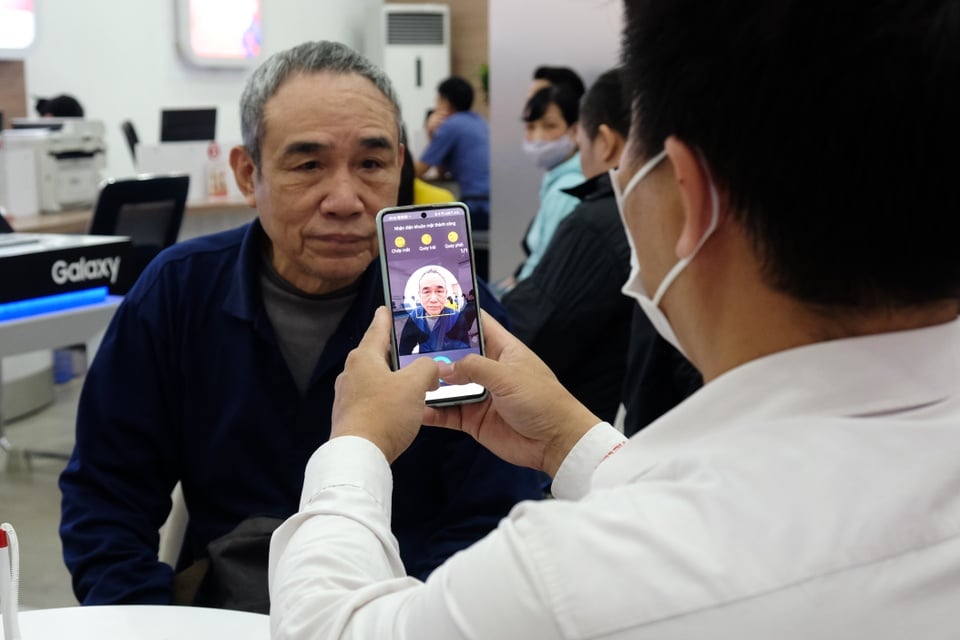
People verify their SIM cards at a telecommunications provider's service point. Photo: Hoang Nam . |
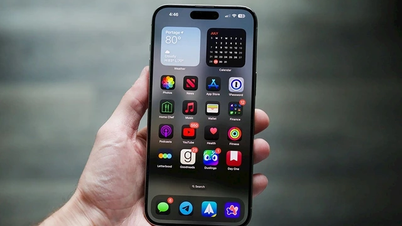
According to Article 8 of Circular 08/2026 of the Ministry of Science and Technology , when a subscriber is found to be using a completely new device, the telecommunications enterprise is responsible for reviewing and requiring the subscriber to perform facial biometric authentication.
Specifically, if the user has not completed biometric authentication within 2 hours of detecting the device change, the network provider will block outgoing calls for the subscriber.
After 30 days from the date of one-way blocking, if the subscriber still has not completed the verification process, the SIM card will be blocked again in both directions. After another 5 days, the telecommunications company has the right to terminate the service contract with this subscriber.
How do users authenticate?
Currently, users can perform biometric authentication through various methods.
For online verification, starting April 15th, people have been able to verify their subscriber information through the VNeID application. However, from June 15th onwards, in cases where there is a change in device, re-verification of biometric information may still be required according to regulations.
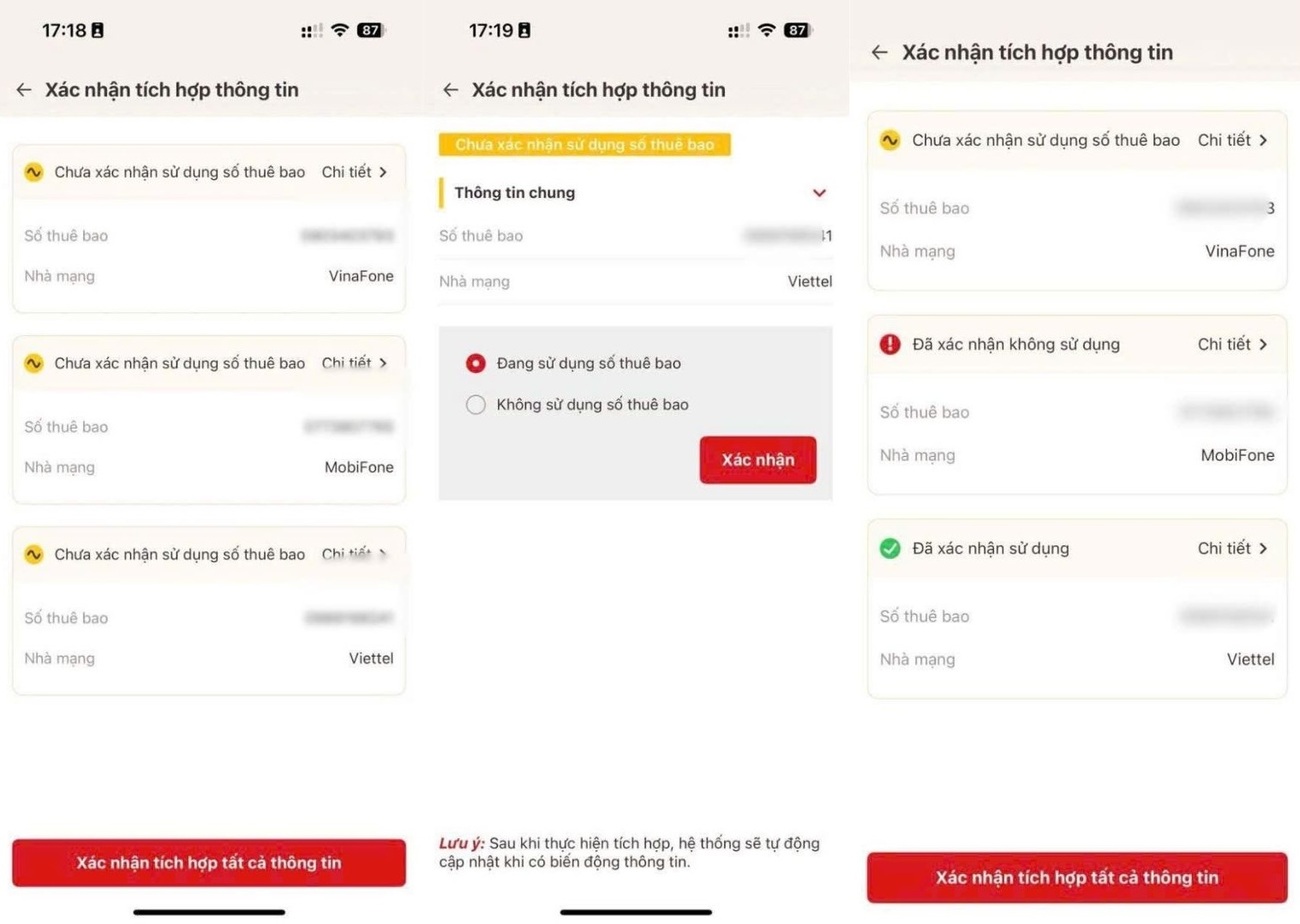 |
Biometric authentication via VNeID. Photo: Nhat Tuong . |
Besides VNeID, users can also perform authentication directly on the mobile network's application.
In cases where online verification is inconvenient, users can visit the network provider's stores or service points for assistance. Verification can also be done at authorized locations where the network provider registers subscriber information as per regulations.
Notably, some network operators have implemented on-site verification support programs to facilitate the process for the public. Viettel Telecommunications Corporation stated that it is implementing a program to support subscriber information verification at home for the elderly and other disadvantaged customer groups to minimize the risk of communication disruption due to technological barriers.
Similarly, VinaPhone also collaborates with local police forces to provide on-site verification support for the elderly, those who do not use smartphones, people in remote areas, border regions, islands, and other groups requiring special assistance.
After the user completes the authentication process, the system will compare the face with previously verified data in the National Population Database, citizen identification data, or data legally stored at the telecommunications company.
According to regulations, the authentication process must meet stringent technical standards for accuracy and anti-fraud capabilities. The system must be able to detect fraudulent activities such as using photos, videos , or 3D masks to bypass facial authentication.
In addition, the authentication information of each subscriber must be recorded, including the date and time of the transaction, for management and verification purposes when necessary.
This regulation applies to cases involving device changes from June 15th onwards. Therefore, those planning to change phones or transfer SIM cards to new devices in the near future should remember to verify their identity when requested by their network provider to avoid service disruptions.
What happens if a SIM card is not registered in the owner's name?
Besides the regulations regarding biometric authentication when changing devices, many people are also concerned about cases where the SIM card is not registered in their name or the subscription is being used by someone other than the person whose name is on the registration.
According to a representative from the Department of Telecommunications (Ministry of Science and Technology), the situation where a phone number simultaneously appears on two different electronic identity accounts does not occur because the verification process is performed automatically and linked to a unique identifier.
If the person actually using the phone is not the person whose name is on the subscriber account, the management agency will standardize the information. If the original subscriber confirms they are no longer using the phone number, the account will be blocked to allow for re-registration under the current user's name.
For cases involving disputes, especially those related to desirable or high-value phone numbers, authorities will apply a separate resolution process. Those wishing to register the SIM card under their own name must provide proof of actual usage, including communication history, usage duration, and ownership of the physical SIM.
With the new regulations coming into effect on June 15th, users should proactively check their subscriber information and verify it when requested by their network provider to avoid communication disruptions, especially with phone numbers linked to banks, e-wallets, or other important services.
Source: https://znews.vn/sim-bi-khoa-tu-156-neu-bo-qua-buoc-nay-post1656529.html
![[Photo] First session of the 14th Congress of the Vietnam Trade Union](https://vphoto.vietnam.vn/thumb/1200x675/vietnam/resource/IMAGE/2026/06/03/1780465947883_ndo_br_img-3852-jpg.webp)
![[Photo] General Secretary and President To Lam presides over a meeting with the Central Organizing Committee.](https://vphoto.vietnam.vn/thumb/1200x675/vietnam/resource/IMAGE/2026/06/03/1780482764658_a1-bnd-4741-3342-jpg.webp)
![[Photo] Secretary of the National Assembly Party Committee, Chairman of the National Assembly presides over the meeting of the Standing Committee and Executive Committee of the National Assembly Party Committee.](https://vphoto.vietnam.vn/thumb/1200x675/vietnam/resource/IMAGE/2026/06/03/1780480353201_ndo_br_bnd-2585-jpg.webp)










































![[Video] Sunset at Lap An Lagoon – Where the sun sets over the fishing nets](https://vphoto.vietnam.vn/thumb/1200x675/vietnam/resource/IMAGE/2026/05/31/1780192137701_beach-landscape-sea-water-nature-grass-745871-pxhere-com.jpeg)


























Comment (0)