

On December 22, 2024, the Politburo issued Resolution 57-NQ/TW on "breakthroughs in the development of science, technology, innovation, and national digital transformation."
In the field of civil enforcement, this resolution is considered a turning point, as it places digital transformation as a strategic pillar for modernizing the entire enforcement process.
According to the Law Newspaper, digital transformation in civil judgment enforcement has helped digitize every stage: from receiving files and processing them to verification, enforcement, and payment.
As a result, the entire enforcement process is made public on a digital platform, allowing for real-time monitoring to detect delays, bottlenecks, or irregularities.
The use of electronic receipts helps to increase transparency in payments: according to data, approximately 375,000 electronic receipts have been issued with a total value of enforcement payments reaching approximately 33,700 billion VND.
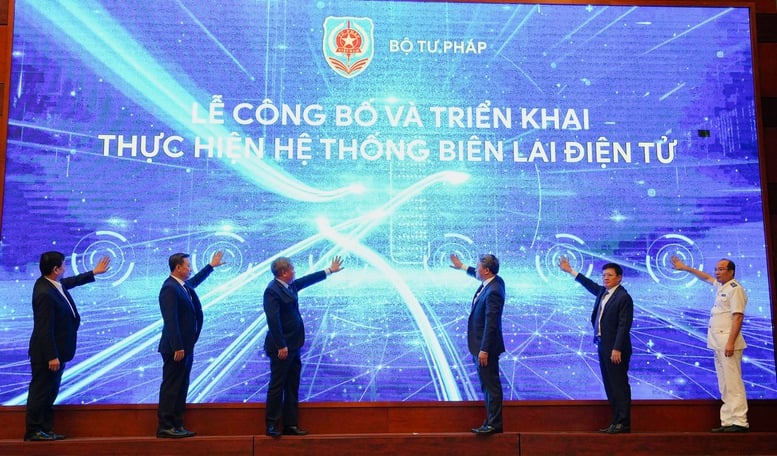
The Ministry of Justice launches electronic receipt software for civil enforcement.
To effectively implement Resolution 57, the Ministry of Justice has assigned the Enforcement Department to develop a specialized digital platform. Accordingly, professional software such as electronic receipt software, enforcement decision-making software, case handling software, citizen reception and complaint resolution software will be developed.
At the same time, THADS is connecting with the Supreme People's Court and the Supreme People's Procuratorate to share data and exchange electronic judgments, shortening the time from when a judgment takes effect to when it is enforced.
Institutionally, the draft Law on Enforcement of Civil Judgments (amended) is being developed with strategic breakthroughs. Accordingly, the organizational structure will be streamlined: provincial Civil Judgment Enforcement Departments and regional Civil Judgment Enforcement Offices will be arranged according to a "single-level locality" model, aiming to ensure unified direction while still promoting local initiative.
The law also anticipates establishing a legal framework for the Socialization of Enforcement Offices and Enforcement Officers in accordance with Resolution 27-NQ/TW, thereby mobilizing social resources and reducing the burden on the state budget.
From a governance perspective, the Resolution emphasizes the need to continue improving the digital institutional framework, investing in technological infrastructure, and developing a high-tech workforce. Proposed measures include the mandatory use of digital signatures in the civil judgment enforcement system, the construction of an intelligent operations center (IOC), and the integration of communication with citizens via the VNeID application to provide timely enforcement notifications.
Nationwide, the implementation of Resolution 57 has been thoroughly disseminated by local authorities. In accordance with the Resolution and related action plans, many localities are developing plans to implement digital innovation initiatives linked to administrative reform, reducing bureaucracy, and improving the efficiency of the enforcement system.
Resolution 57-NQ/TW is considered a crucial strategic step, establishing digital transformation as a fundamental tool for modernizing civil enforcement work. Digitizing processes, increasing payment transparency, and applying technology in supervision can help the civil enforcement sector operate more efficiently, while preventing corruption and enhancing public trust. However, for the goal of "digital transformation breakthrough" to succeed, stronger efforts are needed in improving institutions, investing in infrastructure, and developing digital human resources.
Source: https://doanhnghiepvn.vn/cong-nghe/so-hoa-thi-hanh-an-dan-su-chien-luoc-dot-pha-theo-nghi-quyet-57/20251119050957075
![[Photo] First session of the 14th Congress of the Vietnam Trade Union](https://vphoto.vietnam.vn/thumb/1200x675/vietnam/resource/IMAGE/2026/06/03/1780465947883_ndo_br_img-3852-jpg.webp)

![[Photo] General Secretary and President To Lam presides over a meeting with the Central Organizing Committee.](https://vphoto.vietnam.vn/thumb/1200x675/vietnam/resource/IMAGE/2026/06/03/1780482764658_a1-bnd-4741-3342-jpg.webp)


![[Photo] Secretary of the National Assembly Party Committee, Chairman of the National Assembly presides over the meeting of the Standing Committee and Executive Committee of the National Assembly Party Committee.](https://vphoto.vietnam.vn/thumb/1200x675/vietnam/resource/IMAGE/2026/06/03/1780480353201_ndo_br_bnd-2585-jpg.webp)






















































![[Video] Sunset at Lap An Lagoon – Where the sun sets over the fishing nets](https://vphoto.vietnam.vn/thumb/1200x675/vietnam/resource/IMAGE/2026/05/31/1780192137701_beach-landscape-sea-water-nature-grass-745871-pxhere-com.jpeg)








































Comment (0)