

On May 28th, the frenzied surge in chip industry stocks surpassed a new milestone, with the PHLX Semiconductor Index recording its first 100-day gain of any year ever recorded.
Even by the standards of the artificial intelligence (AI) boom, this increase is still truly extraordinary.
Sandisk shares have surged 570% in just the past 12 months. Intel has more than tripled, while Samsung, Micron, and SK Hynix have all joined the ranks of corporations valued at over $1 trillion .
In fact, Advanced Micro Devices (AMD) currently has a higher valuation than even JPMorgan Chase bank.
The demand for AI and the thirst for supply.
The enthusiasm of investors for platforms that are building AI ecosystems has helped pull the stock market out of the downturn caused by the Iran conflict.
Specifically, in trading on May 28th, SK Hynix shares rose 9.3% in South Korea, while Micron gained 3.6%, contributing to pushing the S&P 500 and Nasdaq Composite indices to new record highs.
 |
Micron became one of the trillion-dollar companies in the US after May 26th. Photo: Reuters . |
As of the current point in 2026, the PHLX Semiconductor Index has risen 82%, marking its best performance ever in the first 100 trading days of the year. The previous record was set in 1995, years before the dot-com bubble burst.
The index's surge even overshadowed the explosive breakouts of some of its largest constituent stocks, including Intel, which has gained more than 200% year-to-date. According to Dow Jones Market Data, companies in the PHLX index have added approximately $5.7 trillion to their total market capitalization.
Behind this skyrocketing price surge is a global shortage of memory chips, a factor that is driving huge profits for chip manufacturers worldwide .
Demand is soaring across almost every chip segment, from the basic central processing units (CPUs) that Intel, Arm Holding, and AMD specialize in, to the AI accelerators (or GPUs) manufactured by Nvidia.
At a deeper level, memory chips that allow servers to store the massive amounts of data cache needed to run AI models have also seen phenomenal growth.
For example, according to data provider Ornn, the hourly rental cost of an Nvidia B200 graphics card has nearly doubled in the past three months, from $2.66 to $5.27 .
According to the same organization, since November 2025, the daily spot price of DDR5, a popular memory chip used in both gaming and AI computing, has more than doubled, soaring to $22.50 .
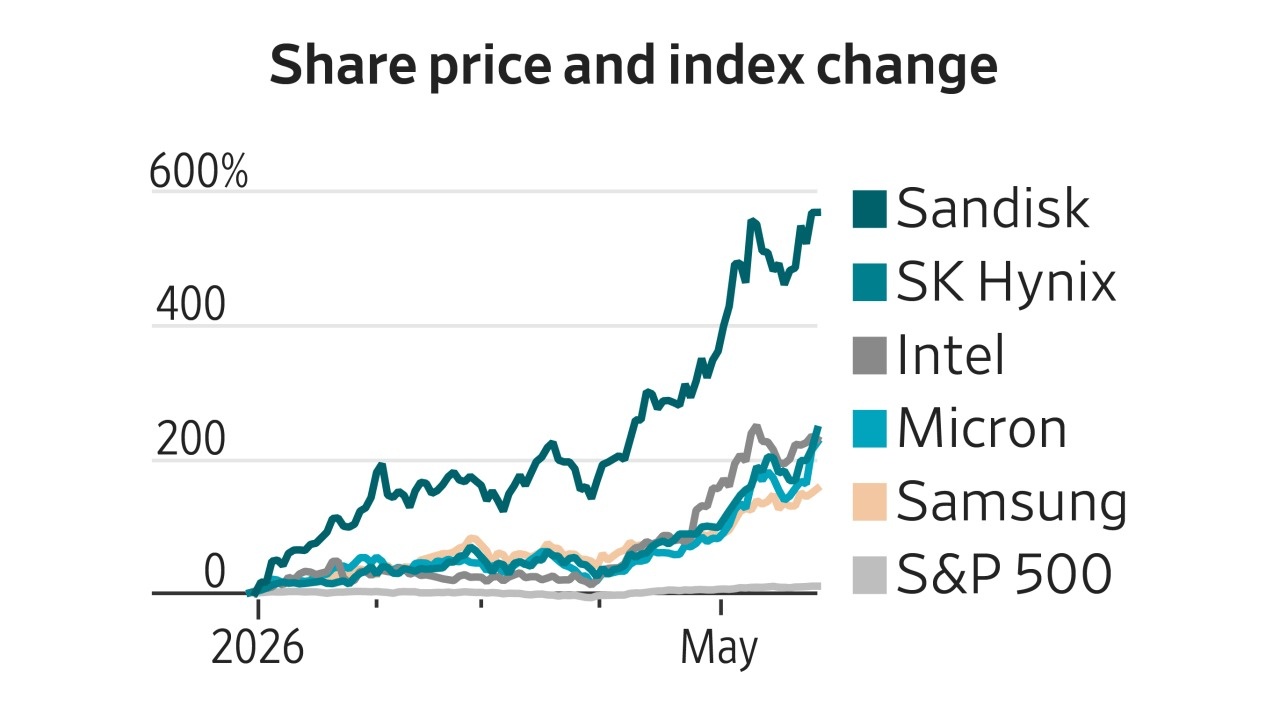 |
The unprecedented price increase of chip industry stocks compared to the S&P 500 index. Photo: FactSet. |
Conversely, the explosion of AI agents – AI tools that use machine learning to perform a wide range of tasks, from programming to travel planning – has also revived the CPU market.
Intel shares jumped 20% in April after the company reported quarterly data center sales of $5.1 billion , beating all Wall Street expectations. The main driver came from its CPU lines serving AI agent platforms.
Warning signals
According to research firm PitchBook , the total value of private market deals related to AI infrastructure reached $80 billion in the last quarter of 2025, the highest level in many years.
However, the data also shows that the scale of deals has shown signs of cooling down this year. While most transactions in the AI infrastructure sector come from venture capital, generating around 400 deals per quarter, private equity funds are the driving force behind the majority of transaction value.
According to Gina Martin Adams, Director of Market Strategy at HB Wealth, investor confidence in both the public and private markets is likely to be tested in the coming months.
She warned that giant cloud service providers like Google and Amazon have begun cutting spending.
Furthermore, the emergence of AI models that require less computing power, or negative policy changes, could pour cold water on the upward momentum of chip industry stocks.
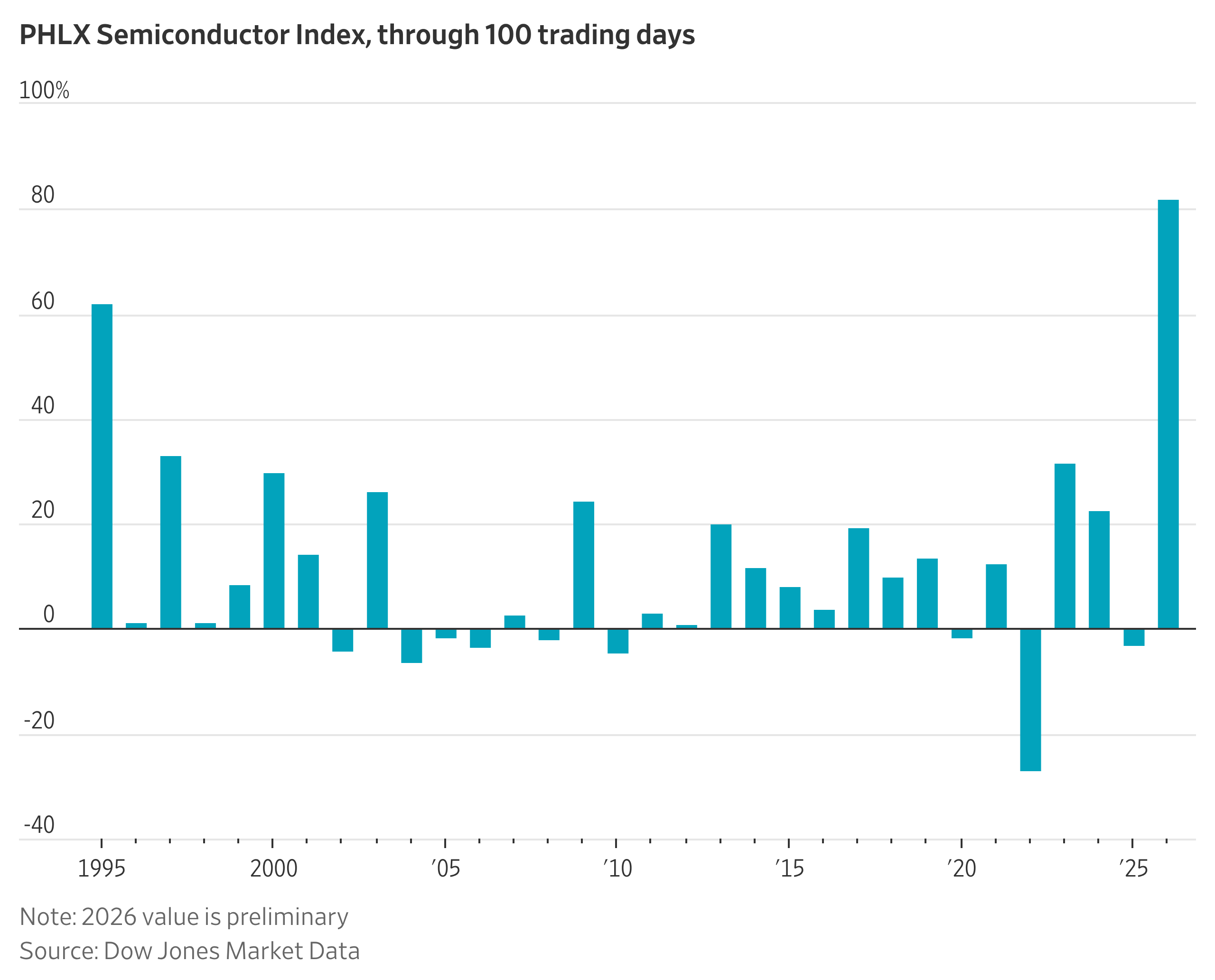 |
The PHLX Semiconductor Index's gains in the first 100 days of the year broke all-time highs. (Image) Wall Street Journal. |
Nevertheless, for most investors, semiconductor stocks still seem like a bargain, despite the soaring prices.
The reason lies in the fact that the price-to-earnings (P/E) ratio has fallen from its peak due to these companies' continuous profit growth. Recently, companies in the PHLX index have been trading at around 26 times their projected earnings for the next 12 months.
This figure is slightly higher than the 10-year average P/E ratio of 21 times, but still significantly lower than the peak during the dot-com bubble.
Furthermore, compared to the dot-com bubble, where most stocks yielded no returns, the massive profits of the chip industry are the core differentiating factor.
Micron's profits have surged to the point where its stock is currently trading at a forward P/E ratio of just 10 times for the next 12 months, according to data from the London Stock Exchange Group (LSEG). For comparison, this is significantly lower than the S&P 500's P/E ratio of 22 times.
Source: https://znews.vn/song-than-nganh-chip-post1655158.html



![[Video] Sunset at Lap An Lagoon – Where the sun sets over the fishing nets](https://vphoto.vietnam.vn/thumb/1200x675/vietnam/resource/IMAGE/2026/05/31/1780192137701_beach-landscape-sea-water-nature-grass-745871-pxhere-com.jpeg)









![[Video] Sunset at Lap An Lagoon – Where the sun sets over the fishing nets](https://vphoto.vietnam.vn/thumb/800x450/vietnam/resource/IMAGE/2026/05/31/1780192137701_beach-landscape-sea-water-nature-grass-745871-pxhere-com.jpeg)



















































![[Video] Sunset at Lap An Lagoon – Where the sun sets over the fishing nets](https://vphoto.vietnam.vn/thumb/402x226/vietnam/resource/IMAGE/2026/05/31/1780192137701_beach-landscape-sea-water-nature-grass-745871-pxhere-com.jpeg)


































Comment (0)