

A giant marine reptile that once dominated the oceans during the dinosaur era has been identified by scientists as a distinct species that had never been recognized before.
Named Tylosaurus rex, this marine reptile was considered a formidable underwater rival to the land-dwelling Tyrannosaurus rex, both in size and its status as a top predator.
The study, published in the Journal of the American Museum of Natural History (AMNH), is based on a review and re-analysis of numerous fossil specimens previously discovered in Texas and Kansas (USA). Instead of excavating a new fossil, the scientists focused on re-evaluating specimens that had been stored in the museum for decades.
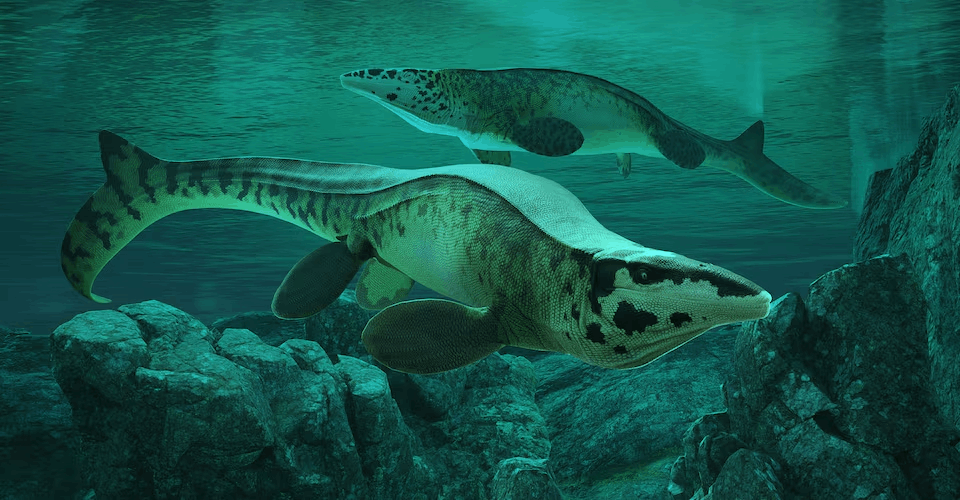
According to the research team, Tylosaurus rex possessed several distinct anatomical features that set it apart from previously known Tylosaurus species. Scientists discovered small serrations along the edges of its teeth, well-developed jaw and neck muscles, and a unique skull structure, suggesting it was a predator that specialized in attacking large prey.
"The skull of Tylosaurus rex alone was as long as my height, about 1.7 meters," says paleontologist Amelia Zietlow of the Castle Museum of History in Appleton, Wisconsin (USA), and lead author of the study describing the incredible scale of this creature.
According to research, Tylosaurus rex lived approximately 80 million years ago in the inland seas of the West Coast that were once separated from North America into two parts during the Cretaceous period. This creature had a slender body, a pointed snout, large teeth, four limbs modified into paddles, and a powerful tail that allowed it to swim at high speeds.
The largest known specimen, nicknamed Bunker, measures approximately 13.2 meters in length and is currently housed at the Biodiversity Institute and Museum of Natural History at the University of Kansas. This size is even larger than the famous Tyrannosaurus rex specimen named Sue, on display at the Field Museum in Chicago, which measures approximately 12.3 meters.
Tylosaurus rex belonged to the mosasaur group, marine reptiles that evolved from land-dwelling lizards and became the dominant predators of the oceans during the last 30 million years of the dinosaur era. Today, the Komodo dragon is considered one of the closest living relatives of this group.
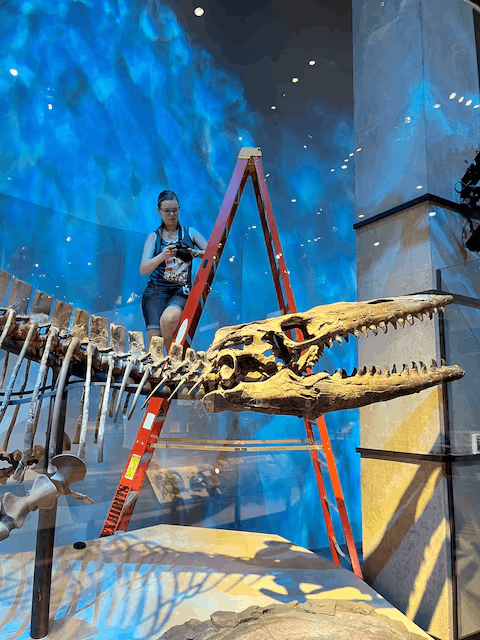
"I am very impressed with the modern Komodo dragon," Amelia Zietlow shared. According to her, it's hard to imagine what it would feel like to stand next to a creature that is many times larger and more ferocious than the largest lizards that exist today.
Co-author of the study, Ron Tykoski, Vice President for Science and Director of Paleontology and Vertebrate Zoology at the Perot Museum of Nature and Science in Dallas, said Tylosaurus rex was twice as long as the largest great white sharks alive today. He likened the creature to a "sea Komodo dragon," measuring between 10.7 and 13.7 meters in length, swimming in the ancient ocean.
The research team concluded that Tylosaurus rex most likely hunted other marine reptiles and large fish. Its strong muscles and sharp teeth allowed it to tear its prey to shreds. This is also why scientists chose the name "rex," meaning king, as a way of relating it to Tyrannosaurus rex, the iconic land predator.
According to Reuters
Source: https://hanoimoi.vn/t-rex-cua-bien-ca-lo-dien-sau-80-trieu-nam-976065.html

![[Image] Pleasant weather helps students enter the 10th grade entrance exam with confidence.](https://vphoto.vietnam.vn/thumb/1200x675/vietnam/resource/IMAGE/2026/05/29/1780034401612_ngay-1-thi-lop-10-minh-duy-8-5009-jpg.webp)
![[Photo] Ba Lang An Lighthouse - the "eye of the sea" amidst the "rock museum" of Quang Ngai province.](https://vphoto.vietnam.vn/thumb/1200x675/vietnam/resource/IMAGE/2026/05/29/1780038698840_anh-man-hinh-2026-05-29-luc-14-10-42.png)



































































































Comment (0)