

The number of civil servants and part-time workers at the commune level is increased in proportion to population size and area, according to a government decree.
On June 10th, the Government issued a decree regulating officials and civil servants at the commune level and non-professional personnel at the commune, village, and residential group levels; effective from August 1st, 2023.
According to the decree, wards and communes are allowed to increase their number of civil servants and part-time workers based on population size and area, in addition to the number already stipulated.
For wards within districts, an increase of one-third of the prescribed population will result in the addition of one civil servant and one part-time worker. For other commune-level administrative units, an increase of half of the prescribed population will result in the addition of one civil servant.
In addition, each commune or ward with an area twice the prescribed size will be allocated one additional civil servant and one additional part-time worker.
According to regulations of the Standing Committee of the National Assembly , wards must have an area of 5.5 km2 or more; wards in districts must have a population of 15,000 or more; wards in cities or provinces must have a population of 7,000 or more; and wards in towns must have 5,000 or more.
Mountainous and highland communes have an area of 50 km2 or more and a population of 5,000; other communes have an area of 30 km2 or more and a population of 8,000 or more.
According to current regulations, wards (types 1 to 3) have a maximum of 23 officials and civil servants, and a minimum of 19; communes and towns have a maximum of 22 officials and civil servants, and a minimum of 18.
The provincial People's Committee will submit to the provincial People's Council for decision the specific number of officials, civil servants, and non-specialized personnel at the commune level. However, the total number of commune officials and civil servants must not exceed the number allocated to each district.
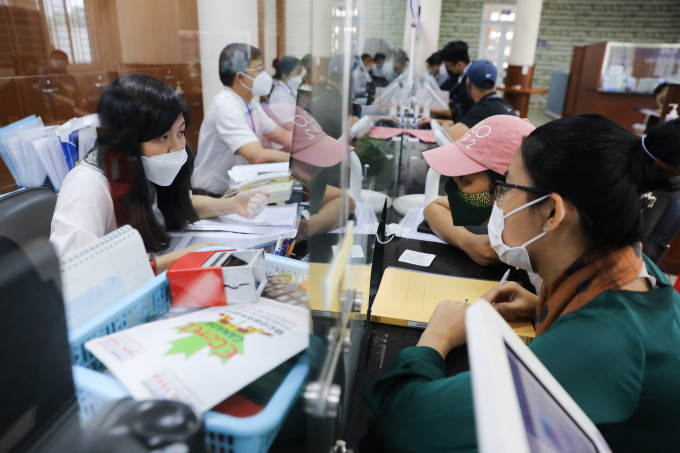
Citizens carrying out administrative procedures at the People's Committee of Thu Duc City, Ho Chi Minh City, August 2022. Photo: Quynh Tran
The government also abolished the position of commune police chief , because regular police officers have been deployed at the commune level.
The decree retains the regulation of three non-professional positions at the village and neighborhood level: Party branch secretary, village head or neighborhood leader, and head of the Fatherland Front working committee. The provincial People's Council will specify the positions and the number of people participating in activities at the village and neighborhood level to ensure they are appropriate to practical circumstances.
In recent times, many wards in large cities such as Hanoi , Ho Chi Minh City, and Da Nang have large populations, while the number of civil servants stipulated by regulations is only 15 per ward, leading to an overload in handling administrative procedures.
In Ho Chi Minh City, the average population per ward is currently nearly 28,400 people, 1.89 times the regulated limit (15,000 people per ward). Population density in districts 3, 4, 5, 10, and 11 reaches over 37,000 people per square kilometer, higher than the city's average of over 14,300 people.
On average, each ward official in Ho Chi Minh City serves more than 1,340 people. In the city's most populous ward, Binh Hung Hoa A (Binh Tan District), with over 123,000 people, each official handles an average of 270 applications per month.
Therefore, from mid-2022, Ho Chi Minh City proposed increasing the number of civil servants for wards as follows: under 30,000 inhabitants - 17 civil servants; over 45,000 inhabitants - 18; over 75,000 inhabitants - 20; over 90,000 inhabitants - 21; over 105,000 inhabitants - 22; and over 120,000 inhabitants - 23.
In Hanoi, the least populated ward has just over 5,000 residents (Phan Chu Trinh ward, Hoan Kiem district), while the most populous has nearly 83,000 (Hoang Liet ward, Hoang Mai district).
In Da Nang City, the ward with the lowest population is over 7,500 (Nam Duong ward, Hai Chau district) and the ward with the highest population is over 65,000 (Hoa Minh ward, Lien Chieu district).
In the draft Decree amending and supplementing several articles related to the organization of urban government in Hanoi, Ho Chi Minh City, and Da Nang, the Ministry of Interior proposes that for every additional 20,000 inhabitants in a ward, there should be one more staff position.
Source link
![[Image] National Assembly discusses the implementation of the socio-economic development plan.](https://vphoto.vietnam.vn/thumb/1200x675/vietnam/resource/IMAGE/2026/04/20/1776696707422_ndo_br_img-20260420-185419-jpg.webp)




![[Photo] General Secretary and President To Lam meets with National Assembly delegates from ethnic minorities.](https://vphoto.vietnam.vn/thumb/1200x675/vietnam/resource/IMAGE/2026/04/20/1776696701056_a1-bnd-8331-3342-jpg.webp)





































































































Comment (0)