

 |
| A panoramic view of the Banh It Tower complex. Photo: Contributor. |
Banh It Tower is a complex of ancient Champa towers, consisting of 4 towers, covering an area of over 7,000 square meters. This is the largest complex in terms of the number of towers and scale among the 8 remaining ancient Champa tower complexes in the former Binh Dinh province (now Gia Lai province).
A spring travel option
The Banh It Tower complex is located in Dai Le village, Tuy Phuoc Bac commune, about 20km from the center of Quy Nhon city and right next to National Highway 1, making it very convenient for tourists to visit. The Banh It Tower complex was built in the late 11th and early 12th centuries and consists of four towers: the Main Tower (Kalan), the Gate Tower (Gopura), the Fire Tower (Kosagrha), and the Stele Tower (Posah). From a distance, the entire complex resembles a Banh It cake – a local specialty – hence the name Banh It Tower. Remaining traces show that in the past, there were more structures, forming a complete religious center in the heart of three ancient citadels: Thi Nai citadel, Cha citadel, and Do Ban citadel.
Located on a hill approximately 100 meters above sea level, visitors must walk and climb the steps to reach the main tower. The staircase leading up to the tower slopes gently from the foot to the top of the hill, with many resting places along the way. The steps are relatively low and easy to climb. The spring weather in this martial arts region is quite pleasant. Along the way, lush green trees line both sides, allowing visitors to breathe in the fresh air and rest at the resting places when tired.
The main tower is situated in the middle of a hill, surrounded by flat land. Therefore, visitors can walk around the tower and enjoy panoramic views from any angle. Below lies a peaceful rural landscape with lush green rice fields, two winding branches of the Con River, and scattered villages and residential areas…
In a peaceful, breezy setting, visitors can freely admire and explore the architectural, artistic, and cultural beauty of Champa thanks to digitized information about the relics. By scanning QR codes, those interested in learning about culture and history can read relevant information themselves without needing a tour guide.
During their spring trip across Vietnam, Mrs. Nguyen Thai Ha's family of nine (from Hanoi ) chose Banh It Tower as a destination, after visiting famous tourist spots such as Quang Binh, Hoi An, and Mang Den. Mrs. Ha expressed her surprise and delight at seeing this unique ancient tower, which has stood for nearly 1,000 years, with her own eyes.
The number of visitors who choose to visit Banh It Tower during the Lunar New Year holiday is quite diverse, including locals, domestic tourists, and foreign visitors. The Lunar New Year holidays are also the time when Banh It Tower receives the most visitors compared to other times of the year.
In 1982, the Banh It tower complex was recognized as a National Architectural and Artistic Monument. In 2014, it was ranked among the top 10 ancient towers attracting the most tourists, as announced by the Vietnam Record Organization.
Unique Champa architectural art
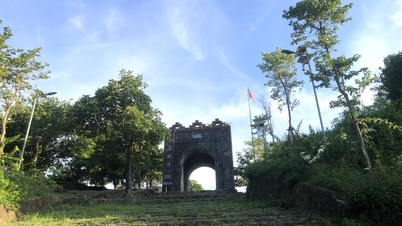
In earlier documents, the Banh It Tower was also known as the Thi Thien Tower, and the French called it Tour D'argent (Silver Tower). Approaching from the foot of the hill, visitors will first encounter the Gate Tower. This tower is located to the east of the temple complex. Because it served as a gate, this tower has two interconnected doors oriented east-west, and they lie on the same axis as the main tower's entrance at the top of the hill.
Further up, turning to the left of the Gate Tower, is the Posah Tower. This tower is similar in size to the Gate Tower, but differs in that all four walls have openings facing outwards in the four directions: east, west, south, and north.
 |
| The Gate Tower, with its two interconnected east-west entrances, leads up to the Main Tower. Photo: Hai Yen |
At the top of the hill, opposite the Gate Tower, is the Main Tower (Kalan). This is where the Cham people held their religious ceremonies. The tower was built with a square plan, each side currently measuring 12m, the thickness of the tower walls is 3m, the tower has a single entrance facing east - the entrance is 2m wide, the interior of the tower each side measures 5.5m, the tower is 29.6m high. The structure of the tower consists of a main body and three smaller levels above, at the corners of the tower on each level there is a small corner tower for decoration…
Inside the tower is a statue of the god Shiva. This statue, measuring 1.54m in height and 1.06m in width, was restored in 2013 based on the original Shiva statue currently on display at the Guimet Museum (France). This Shiva statue is one of the earliest Champa sculptures in former Binh Dinh province and belongs to the Chanh Lo sculptural style (late 11th century).
Next to the main tower is the Fire Tower (Kosagrha). This tower is built on a rectangular plan, measuring 12m in length, 5m in width, and approximately 10m in height. It functions as a storage building, where sacrificial offerings are prepared before being brought into the main tower for religious ceremonies. The Fire Tower has a curved shape, concave in the middle, resembling a saddle, hence it is also known as the Saddle Tower.
After nearly ten centuries, the four towers in the Banh It tower complex remain almost completely intact. Thanks to restoration and preservation efforts, time has not been able to cover the towers with moss; the distinctive red fired brick color of Champa towers still stands out against the natural landscape and sky. For those who love exploring culture, this remains an attractive destination, worth returning to many times.
Source: https://baodongnai.com.vn/dong-nai-cuoi-tuan/202603/tham-thap-co-giua-long-gia-lai-a2d2a88/













































































Comment (0)