

Tourists have a high spending power.
In fact, in 2025, Vietnam is expected to welcome 21.2 million international tourists, with Ho Chi Minh City alone receiving 8.5 million international tourists and 45 million domestic tourists. With the number of tourists and the demand for spending, the question is whether the conversion of spending into local consumption has been truly effective. According to Mr. Dung, the answer is not yet truly effective. This presents an opportunity to contribute to the economic development of Ho Chi Minh City in particular and Vietnam in general.

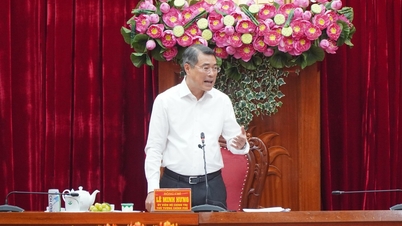
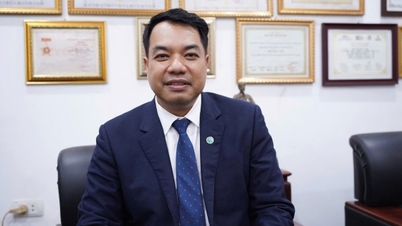
Mr. Tran The Dung - General Director of Vietluxtour Travel Joint Stock Company, spoke at the seminar on the morning of May 22nd.
PHOTO: INDEPENDENT
Mr. Dung emphasized: Tourists have very different spending needs. At home, they may be more cautious and budget-conscious, but when traveling, they can allow themselves to spend more freely, spending according to emotion, convenience, and experiencing products with local characteristics. However, currently, most travel companies are hesitant to confidently include shopping destinations in their programs. This is because we currently lack standardized shopping centers that build brand credibility for customers, so if travel companies include them, they fear customers will accuse them of being a sales pitch. Meanwhile, neighboring countries organize very well-structured shopping tours. When organizing tours abroad, he himself has observed that Vietnamese tourists also spend a lot on shopping. Thus, the issue is that tourists do have a need to spend, and the spending capacity of Vietnamese tourists is also very high. So the question is, how should the Vietnamese market create a shopping ecosystem that is attractive enough to keep this spending money within the country?
There is a need for outlets, night markets, and shopping streets that meet the standards for tourists.
From there, he proposed four solutions. First, make shopping a key part of tourism stimulus activities. Tourists are willing to spend if a destination has a story, brand, and quality. Second, there is a need for large shopping centers such as outlets, night markets, and shopping streets that meet the standards for tourists. Ho Chi Minh City has the conditions to implement this, but currently there is still no outlet or shopping center of sufficient scale… Previously, Mr. Jonathan Hanh Nguyen - Chairman of the Inter Pacific Group (IPP) - also mentioned this many times, but unfortunately, there is still no outlet center while travel companies are eagerly awaiting this. Third, we need to link travel, retail, production, and localities. A travel company cannot create a shopping center alone; it must collaborate with many parties to have products that reflect regional characteristics and are attractive enough to tourists. As a result, travel companies are willing to include shopping destinations in their tours, even introducing them to tourists before they arrive in Vietnam.
Fourth, we must build trust. This is the most crucial issue. If tourists believe that the product is worth buying, the price is transparent, and the quality is guaranteed, they will be willing to spend money. "When stimulating consumer demand, we shouldn't just focus on price reductions, but also on increasing the perceived value for customers, so that they confidently choose to buy a particular product. Tourists don't lack spending needs; what they need is a reason why the product is attractive enough and trustworthy enough to make them willing to open their wallets and spend. From there, tourism is not just a service industry but a very effective driver of consumer demand stimulation for Ho Chi Minh City in particular and Vietnam in general," Mr. Tran The Dung further shared.
Source: https://thanhnien.vn/khach-du-lich-la-vi-di-dong-o-diem-den-185260522103917473.htm


![[Photo] General Secretary and President To Lam presides over the meeting to approve the draft report on the results of the second inspection by the Politburo of the Standing Committee of the Hanoi City Party Committee.](https://vphoto.vietnam.vn/thumb/1200x675/vietnam/resource/IMAGE/2026/05/26/1779789811432_a2-bnd-4430-9620-jpg.webp)



























































Comment (0)