

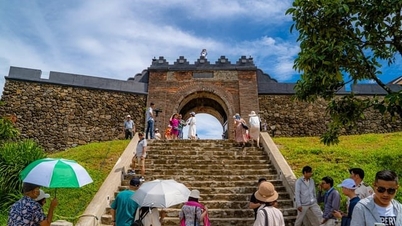
Visiting Hon Ba during this time of year, tourists can enjoy the cool climate, pristine scenery, and learn more about the life and career of A. Yersin.

A. Yersin (1863 - 1943) was a world-renowned French scientist of Swiss origin. He arrived in Indochina by ocean-going ship in 1890, reaching Nha Trang in 1891. Later, in the fishing village of Nha Trang, A. Yersin fell in love with and became deeply attached to this land until the end of his life.
In the field of medicine, A. Yersin was the first to discover the bacterium that causes the plague; together with Dr. Roux, he developed a serum to treat the plague in late 1894. He was also the founder of the Pasteur Institute in Nha Trang; the founder of the Medical School in Hanoi (now Hanoi Medical University) and became its first rector. A. Yersin was also an outstanding agronomist, being the first to import rubber trees to Vietnam, and to conduct experimental cultivation of cinchona trees to produce quinine for treating malaria. He also discovered the Lang Biang plateau (Lam Dong) and Hon Ba (Khanh Hoa), and mapped out the land route from Central Vietnam to Cambodia…

Following in the footsteps of the Yersin Admirers Association and the students on their "Journey in the Footsteps of Doctor A. Yersin," our first destination was the tomb of Doctor A. Yersin. After offering incense and listening to explanations about the life of Doctor Yersin and the plants grown on the hill, many visitors were deeply moved as they lit incense at A. Yersin's tomb, expressing their admiration and gratitude for the immense contributions made to Vietnam and humanity.
Learning about cinchona trees, Mr. Nguyen Van Xang, a member of the A. Yersin Admirers Association, guided the students in the group on how to use their phones so that the AI system could identify the leaves and provide appropriate scientific results. Mr. Xang explained that the cinchona trees planted at A. Yersin's tomb were brought from Lam Dong by the A. Yersin Admirers Association and the Khanh Hoa Association for the Protection of Nature and Environment. The bark of this tree was used by Europeans to make medicine to treat malaria. Initially, the cinchona trees were planted in Hon Ba, but the results were not good, so A. Yersin switched to planting them in Lam Dong, where they proved effective. “The fact that the associations brought cinchona trees back to Hon Ba to replant them carries cultural and historical significance, and is also a tribute to A. Yersin – an honorary citizen of Vietnam, who was deeply connected to Nha Trang – Khanh Hoa with a kind heart,” Mr. Nguyen Van Xang said.

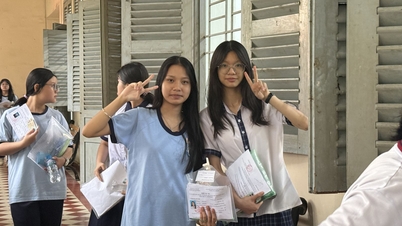
Mr. Pham Vu Thanh An (Head of the STEAM Nha Trang, Khanh Hoa group, who accompanied the delegation) and the students thoroughly enjoyed the trip because here, he and the children not only learned about the culture but also spread the scientific values that Mr. A. Yersin painstakingly researched and left behind. The Hon Ba Nature Reserve has a diverse and rich plant ecosystem, which has been included in the curriculum. Using mobile phones to guide the children in tracing the origins of plants through AI applications is also a way to educate and enhance their life experiences.
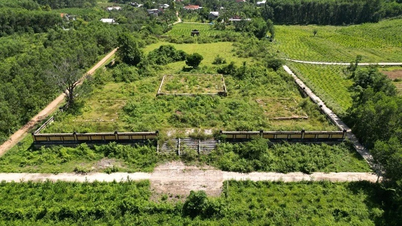
Leaving the burial site, visitors head up to Hon Ba, witnessing a vast area of hundreds of hectares along the way. During his lifetime, Dr. A. Yersin established a horse farm on this land, producing serum to treat the plague; he also created a farm for cultivation and livestock to fund scientific research and help the poor. To this day, the Suoi Dau Livestock Farm continues its mission of breeding animals for medical research.

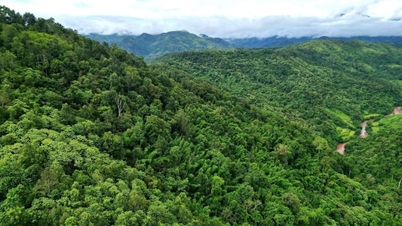
To reach the summit of Hon Ba, tourists must travel by car for nearly an hour along a winding mountain pass. Along both sides of the road are Suoi Dau Lake and a relatively intact primary forest with diverse flora and fauna. At the summit of Hon Ba, 1,578m high, the scenery is breathtakingly beautiful. Here stands a two-story wooden house, nestled peacefully on the hilltop, shrouded in mist. Inside, restored scenes depicting the work and rest of Dr. A. Yersin are on display. Outside, remnants of stone basins around the house, used for sowing cinchona seeds, and a cement horse trough in the stable not far from the wooden house…
Ms. Dang Thi Minh Hoa, a resident of Bac Nha Trang ward, Khanh Hoa province, said that here she can feel the peaceful atmosphere and admire the scenery where Dr. A. Yersin once worked, creating many scientific values for humanity. "From the bottom of my heart, I am extremely grateful and appreciative of the great contributions and achievements that Dr. A. Yersin dedicated to humanity," Ms. Hoa said.

Admiration was evident on the face of Mr. Nguyen Cao Nguyen from Nam Nha Trang ward, Khanh Hoa province. Mr. Nguyen said that Dr. A. Yersin left behind many valuable scientific research contributions. Therefore, through this trip with his daughter, he hoped she would both experience the beautiful natural scenery and learn from the good things Dr. A. Yersin left behind, especially regarding scientific research and exploration for nature conservation.
For over a century, the name of the scientist Alexandre Yersin has been associated with Nha Trang, Khanh Hoa, where people still affectionately call him – “Mr. Yersin”. Dr. A. Yersin inspired many generations of people in Nha Trang in particular and around the world in general. He said: "Life is not life if you don't travel."
Mr. Nguyen Van Xang further informed, “The journey following in the footsteps of Doctor A. Yersin” is a journey for him and the members of the association and the community to spread the spirit of A. Yersin's last wish – to work together for the community. This journey is for anyone who loves nature and wants to learn more about a beautiful and miraculous story in life. In addition, through this field trip, he also hopes that the A. Yersin workplace site will be better utilized and become a tourist attraction for a large number of visitors.
Source: https://baotintuc.vn/du-lich/theo-dau-chan-bac-si-a-yersin-20260126122953906.htm
![[Photo] General Secretary and President To Lam presides over a meeting on preparations for the review of one year of operation of the three-tiered government system.](https://vphoto.vietnam.vn/thumb/1200x675/vietnam/resource/IMAGE/2026/06/02/1780391821195_a1-bnd-4595-9717-jpg.webp)





























































Comment (0)