

According to the Law Committee, the regulations on the conditions and standards for members of apartment building management boards are too vague, leading to abuse of power and profiteering, while lacking sanctions for violations.
This content was presented by the Law Committee in its thematic monitoring report "Implementation of policies and laws on the management, operation, renovation, and reconstruction of apartment buildings," issued on August 22nd.
The Legal Committee noted that the 2014 Housing Law does not stipulate the conditions and standards for members of the condominium management board, while Circular No. 28/2016 of the Ministry of Construction on the Regulations on the Management and Use of Condominiums stipulates "very briefly and simply". Accordingly, members of the management board only have to meet the conditions and standards of being owners and users of the condominium or being authorized by the owners to attend the condominium meeting.
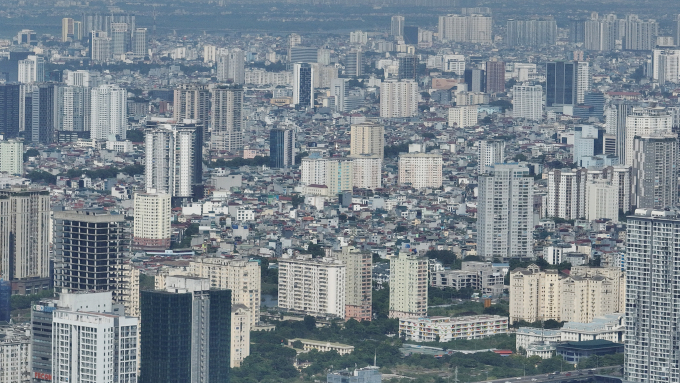
Apartment buildings and high-rises in the western area of Hanoi . Photo: Ngoc Thanh
Meanwhile, the management board is an organization representing all residents of the apartment building, performing many important tasks related to the use of residents' funds (maintenance fund), management, and operation of the building's technical infrastructure. In reality, because the conditions and standards for membership in the management board are very simple, most residents are eligible to participate.
According to the Legal Committee, this has led to some management boards violating regulations in the use of funds for maintenance, management, and operation of apartment buildings; a lack of full understanding of housing laws has resulted in disagreements and disputes with investors and residents in some apartment buildings.
There have been cases of management board members abusing their power for personal gain, such as hiring services outside the management and operation unit, arbitrarily using maintenance funds, and appointing contractors for security, cleaning, maintenance, and upkeep of the building in exchange for commissions. "There have also been cases of management boards inciting residents to file complaints, gather in large numbers, and disrupt public order and security," the report stated.
The Legal Committee also pointed out that current law does not specifically regulate the methods of organizing condominium meetings (in person, online, etc.); sanctions for violations by management boards and members are not comprehensive, specific, or effective.
Therefore, the Legal Committee proposes that the draft Housing Law (amended) should include provisions on sanctions for cases where the management board or its members overstep their authority or abuse their power, causing harm to residents.
According to the Housing Law, the management board must include a representative of the developer if the apartment building has private ownership by the developer. Taking advantage of this regulation, some developers intentionally do not participate in the management board. Without the developer's representative, the results of the management board election will not be recognized by the local People's Committee.
Therefore, the Legal Committee proposes amending the regulations so that if the investor does not appoint a representative, the management board only needs to include representatives of the apartment owners and users.
Referring to the abuse of power, profiteering, and group interests by management boards in many apartment complexes in recent times, Pham Thanh Tung, Chief of the Office of the Vietnam Association of Architects, also stated that part of the reason is due to the lack of knowledge, skills, and qualifications of management board members. Management board members are required to have experience and knowledge in economics and construction, and priority should be given to those who understand safety and fire prevention regulations.
To attract qualified individuals to the board of directors, Mr. Tung said the most important thing is to have a suitable, even attractive, remuneration package to encourage many people to apply. "If it's only one or two million dong, no one will want to do it. But if the remuneration reaches 7-8 million dong, there will certainly be people who meet the requirements to apply, especially given the increasing level of education and legal knowledge among the people today," he said.
According to the Housing Law of 2014 and Circular No. 02/2016 of the Ministry of Construction, apartment buildings constructed from 1994 to the present with 20 or more apartments must establish a management board. Nationwide statistics show that the total number of apartment buildings required to establish a management board is 2,715, while only 1,973 (73%) have actually been established.
The management board of a multi-owner apartment building or complex is established and operates according to the model of a cooperative or joint-stock company's board of directors. The apartment building's general meeting decides on the operating model of the management board that best suits the specific circumstances of each building or complex.
Source link
![[Image] Pleasant weather helps students enter the 10th grade entrance exam with confidence.](https://vphoto.vietnam.vn/thumb/1200x675/vietnam/resource/IMAGE/2026/05/29/1780034401612_ngay-1-thi-lop-10-minh-duy-8-5009-jpg.webp)


![[Photo] Ba Lang An Lighthouse - the "eye of the sea" amidst the "rock museum" of Quang Ngai province.](https://vphoto.vietnam.vn/thumb/1200x675/vietnam/resource/IMAGE/2026/05/29/1780038698840_anh-man-hinh-2026-05-29-luc-14-10-42.png)






















































































Comment (0)