

 |
| The fish catches were plentiful after a morning of fishing in the rice fields. |
Fishing in the rice fields of Phiêng Lằm is a habit, a way of life that many people who have left their hometown still fondly remember. Every year, the rice fields don't yield as much as the winter crop, so the people take advantage of the opportunity to raise fish. The fish waste enriches the soil, ensuring a bountiful harvest in the following season.
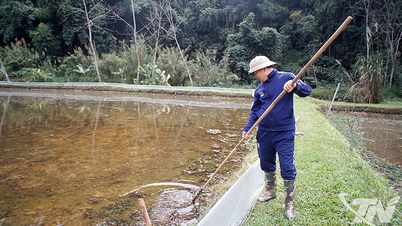
This method is both economical and natural, and has been preserved by the Red Dao people here for many generations. At dawn, Mr. Trieu Tai Phuong, 64 years old, went out to check the water in his rice fields. Mr. Phuong was formerly a commune official, but is now retired and working as a farmer.
Mr. Phuong's rice field covers more than 2,000 square meters. Right from the start of the season, he called his family members, including those working far away and those from other communes, to release fish together, agreeing to return on the day of harvesting.
The fishing took place at its own pace, with people following the receding tide. Women stood along the banks, scooping up fish carried away by the overflowing water or transferring them to a gathering point, while the stronger men waded deeper, moving quickly, nets in hand, catching the larger fish. Children followed behind, learning how to catch fish while laughing loudly as mud splashed onto their clothes and faces.
The fish caught were mainly tilapia, carp, and grass carp, the same fish released at the beginning of the rainy season. The fish were gathered together and placed in a large net in the stream to recover.
Mr. Phuong recounted that in the old days, before people could afford to buy fish fry, they would catch large fish from ponds and release them into rice fields. Pond fish were healthy, had eggs, and when they encountered fresh rice field water with plenty of food, they reproduced well and produced many fish fry.
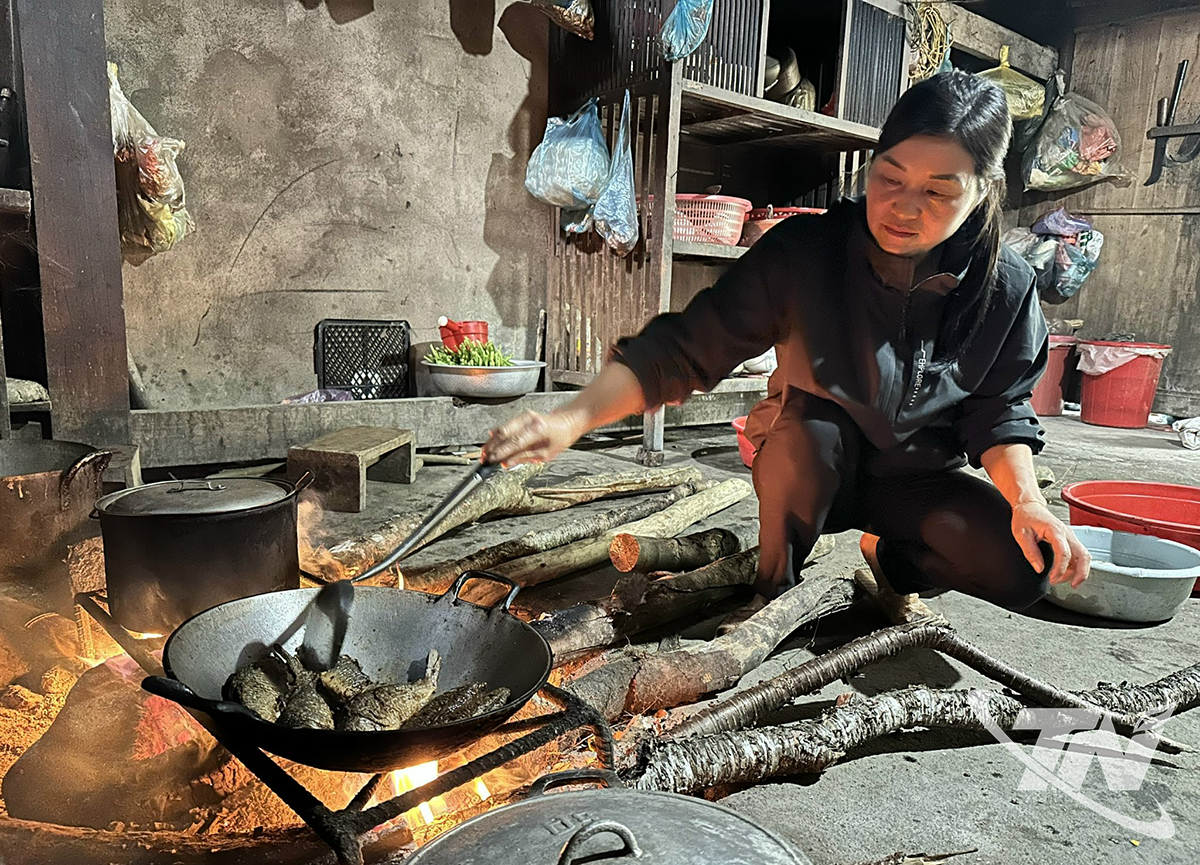 |
| The freshwater fish are fried until crispy, ready for the family's reunion meal. |
Even now, with readily available fish fry, the people of Phiêng Lằm still maintain their old methods. They release small fish back into the ponds, avoiding overfishing. They remind each other: the fish ponds are for today, but they are also for tomorrow.
By midday, when the fishing was almost finished, small fires were lit right by the edge of the rice fields. The fresh fish was grilled on the spot. The aroma of grilled fish mingled with the scent of straw and smoke, spreading across the fields. Everyone gathered, ate a few bites, and shared stories about the village and their families.
This year, Mr. Phuong's fish pond yielded a good harvest. After deducting expenses, his family earned nearly 10 million dong from selling fish to people in the village and commune. I asked Mr. Phuong why he continues to cultivate fish in his pond every year, despite the hard work and the fact that it's not the family's main source of income.
Mr. Phuong smiled and shared: "We earn a little more money. But the main thing is to remind our children and grandchildren of the fields and home. No matter where they go, they'll always come back for fishing day. When everyone is together, the fields are joyful; without people, even if there are many fish, it's still sad."
From that fish pond, a large feast with six tables of food was prepared. Mr. Phuong's eight brothers, each from a different place, were all present. Laughter and chatter filled the house, which was usually quiet. During the meal, no one mentioned how much money had been earned from selling the fish.
People talk more about who came home early this year, who came home late, which children have grown bigger, and which elderly people are still healthy. We understand that, for them, catching fish in the rice paddies is an excuse to meet, to sit together after days of each going their separate ways to make a living.
Source: https://baothainguyen.vn/kinh-te/202512/thu-hoach-ca-ruong-vung-cao-45614bc/
![[Photo] Capturing each moment at the "People We Meet" photography exhibition.](https://vphoto.vietnam.vn/thumb/1200x675/vietnam/resource/IMAGE/2026/04/15/1776245695648_1-8944-jpg.webp)
![[Image] Current status of the land area of over 5.5 hectares that Ho Chi Minh City is considering reclaiming.](https://vphoto.vietnam.vn/thumb/1200x675/vietnam/resource/IMAGE/2026/04/15/1776245690095_1-3102-8409-jpg.webp)
![[Photo] General Secretary and President To Lam and his wife, along with General Secretary and President Xi Jinping and his wife, attending a tea party.](https://vphoto.vietnam.vn/thumb/1200x675/vietnam/resource/IMAGE/2026/04/15/1776245678527_vna-potal-tong-bi-thu-chu-tich-nuoc-to-lam-va-phu-nhan-cung-tong-bi-thu-chu-tich-nuoc-tap-can-binh-va-phu-nhan-du-tiec-tra-8702812-9829-jpg.webp)
![[Photo] General Secretary and President To Lam and General Secretary and President Xi Jinping meet with youth from both countries.](https://vphoto.vietnam.vn/thumb/1200x675/vietnam/resource/IMAGE/2026/04/15/1776245687540_vna-potal-tong-bi-thu-chu-tich-nuoc-to-lam-va-tong-bi-thu-chu-tich-nuoc-tap-can-binh-gap-go-thanh-nien-hai-nuoc-8702371-jpg.webp)
![[Image] Overview of the Tam Trinh-Giai Phong connecting road section after land clearance is completed.](https://vphoto.vietnam.vn/thumb/1200x675/vietnam/resource/IMAGE/2026/04/15/1776245679644_ndo_br_dji-0195-jpg.webp)
![[Photo] National Assembly Chairman Tran Thanh Man concludes official visit to Italy, departs for IPU-152](https://vphoto.vietnam.vn/thumb/1200x675/vietnam/resource/IMAGE/2026/04/15/1776253436109_vna-potal-chu-tich-quoc-hoi-ket-thuc-tham-chinh-thuc-italy-len-duong-du-ipu-152-tai-tho-nhi-ky-8702876-7969-jpg.webp)












































Comment (0)