


Prime Minister Pham Minh Chinh delivered the concluding remarks at the nationwide online conference on improving the efficiency of providing and using online public services.
On the morning of August 31, 2024, in Da Nang , Prime Minister Pham Minh Chinh, Chairman of the National Committee on Digital Transformation, chaired a nationwide online conference on improving the efficiency of providing and using online public services.
Minister of Information and Communications Nguyen Manh Hung, Vice Chairman of the National Committee on Digital Transformation, attended the conference.
The conference was conducted online, connecting the main venue at the Da Nang City Public Administration Center with the People's Committees of provinces and centrally-governed cities.
Attending the conference via video link were Comrade Nguyen Hoa Binh, Member of the Political Bureau, Standing Deputy Prime Minister; General Luong Tam Quang, Member of the Political Bureau, Minister of Public Security; Deputy Prime Minister and Minister of Foreign Affairs Bui Thanh Son; 9 Ministers and heads of ministerial-level agencies; and leaders of provinces and centrally-administered cities.
Entering a phase of in-depth development of online public services.
According to a report by the Ministry of Information and Communications, Vietnam has gone through two phases of development in online public services from 2011 to the present. Phase 1 was the initial stage, with a very small number of high-level online public services implemented nationwide; Phase 2 was the broader development stage, with a breakthrough in the number of online public services.
The implementation of online public services has been successful, but not uniformly across ministries, sectors, and localities. While some units have achieved high results, many others have very low rates, particularly regarding the entire online application process. Some localities have achieved very high rates, up to 69%, while many others have very low rates below 5%, with the average for all localities being only 17.9%.
Full-process online public services are truly effective because citizens and businesses can easily and conveniently complete the entire process online without having to be present at government agencies, as evidenced by the high percentage of full-process online applications.
To move into the in-depth development phase, it is necessary to focus on popularizing full-process online public services to all citizens and businesses, with the goal of achieving a 70% rate of full-process online applications.
The widespread adoption of online public services will bring all activities of civil servants and public officials serving citizens and businesses to the online environment. At that point, state agencies will have access to sufficient digital data to direct and manage operations online and based on data.
By achieving the full rollout of online public services, Vietnam will have completed its task of developing e-government and transitioned to developing digital government.

Minister of Information and Communications Nguyen Manh Hung delivered a speech at the conference.
Speaking at the conference, Minister of Information and Communications Nguyen Manh Hung stated that, in order to implement online public services in the new phase, developing them in depth and effectively popularizing online public services in a comprehensive manner, ministries, sectors, and localities need to achieve the goal of developing comprehensive online public services by 2024 and 2025.
Specifically, in 2024, for ministries and agencies, the rate of online applications throughout the entire process must reach at least 70%; for localities, it must reach at least 30%. In 2025, for ministries and agencies, the rate of online applications throughout the entire process must reach at least 85%; for localities, it must reach at least 70%.
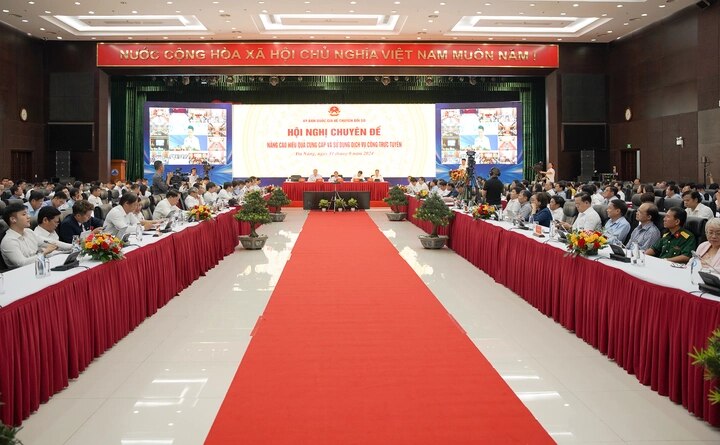
A view of the symposium on improving the efficiency of providing and using online public services, held in Da Nang on the morning of August 31st.
In his concluding remarks, Prime Minister Pham Minh Chinh basically agreed with the content of the reports, presentations, and opinions expressed, and instructed the Ministry of Information and Communications and the Government Office to incorporate the feedback, finalize, and submit the Prime Minister's Conclusion Notice, Chairman of the National Committee on Digital Transformation, for unified implementation in the coming period.
Prime Minister Pham Minh Chinh analyzed and further emphasized several key points regarding the political and legal basis; achievements, shortcomings, and limitations; causes and lessons learned; perspectives, orientations, and tasks and solutions for the future implementation of online public services.
In terms of political and legal basis, the Politburo issued Resolution No. 36-NQ/TW on July 1, 2014, on promoting the application and development of information technology to meet the requirements of sustainable development and international integration.
The Central Committee issued Resolution No. 10-NQ/TW on June 3, 2017, on the development of the private economy, which clearly states: "Strengthen the application of information technology and modernize public administrative services to save time and costs in carrying out administrative procedures for citizens and businesses."
Resolution No. 52-NQ/TW dated September 27, 2019, of the Politburo on some guidelines and policies for proactively participating in the Fourth Industrial Revolution sets out the following goals by 2025: “Building digital infrastructure to reach the advanced level of the ASEAN region; broadband internet coverage to 100% of communes… Be among the top four ASEAN countries in the ranking of e-government according to the United Nations assessment…”.
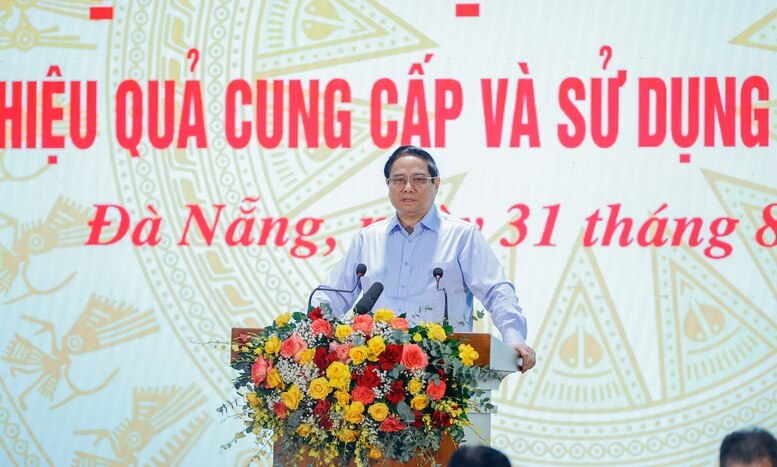
The Prime Minister pointed out eight outstanding achievements as well as shortcomings and inadequacies in the implementation of online public services.
The Government has issued Resolution No. 50/NQ-CP dated April 17, 2020, promulgating the Government's Action Program to implement Resolution No. 52-NQ/TW of the Politburo; and Resolution No. 76/NQ-CP dated July 15, 2021, promulgating the overall program for state administrative reform for the period 2021-2030. The Prime Minister has issued strategies and programs on digital transformation, e-government development, digital economy development, and digital society development.
8 groups of outstanding results
Regarding the achievements, the Prime Minister stated that, firstly, leadership, direction, management, and implementation were carried out decisively and synchronously with high determination from the central to the grassroots level.
From 2021 to the present, the Prime Minister has issued 9 decisions and 5 directives to guide and manage the implementation of online public services for citizens and businesses. All 63 localities have issued policies to exempt or reduce fees and charges for the provision of online public services.
Secondly, awareness and actions regarding improving service quality and satisfaction levels in the implementation of administrative procedures and the provision of online public services have seen many positive changes. The satisfaction level of citizens and businesses with the handling of administrative procedures increased from 90% in 2022 to 93% by August 2024.
According to the United Nations' 2022 assessment, Vietnam's online public services ranked 76th out of 193 countries, an increase of 5 places compared to 2020; open data ranked 87th out of 193 countries, an increase of 10 places compared to 2020.
Thirdly, efforts to improve institutions and policy mechanisms to create a favorable legal framework for providing online and digitized public services have been actively implemented. The National Assembly has enacted the Law on Electronic Transactions; the Government has issued 6 Decrees; and ministries and agencies have issued 4 Circulars within their authority.
Fourth, administrative procedures and business regulations continue to be reduced and simplified; the quantity and quality of online public services are improved.

Analyzing both objective and subjective causes, the Prime Minister pointed out several lessons learned.
From 2021 to the present, nearly 3,000 business regulations have been reduced and simplified; nearly 700 administrative procedures have been decentralized to localities. Since 2021, nearly 1,800 additional online public services have been provided, bringing the total number of online public services available on the National Public Service Portal to 4,400, accounting for 70% of the total number of administrative procedures.
The rate of fully implemented online public services increased from 28% in 2021 to 51.5% in August 2024. Notably, 43 out of 53 essential online public services have been deployed; of which, 23 out of 25 essential public services under Project 06 have been fully implemented, saving the State and society nearly 3.5 trillion VND per year.
The rate of digitization of records and results of administrative procedures at ministries and agencies reached 43.4% (an increase of 23% compared to 2023), and at localities reached 64.3% (an increase of 35% compared to 2023).
Fifth, digital infrastructure, digital platforms, equipment, and digital transformation technologies in government agencies and for serving citizens and businesses are receiving significant investment.
100% of state agencies have deployed dedicated data transmission networks down to the commune level for data exchange and sharing. 100% of ministries, sectors, and localities have built and upgraded administrative procedure processing information systems. 82.2% of households use broadband fiber optic internet; 84% of mobile phone subscribers use smartphones.
Sixth, the development, connection, and sharing of national and specialized databases are being accelerated.
The national population database has connected, shared, verified, and cleaned data with 18 ministries and agencies, 63 localities, and 4 state-owned enterprises. Over 87.7 million chip-embedded identity cards have been issued; and over 57.1 million VNeID accounts have been activated.
Secondly, on Saturday, several ministries, sectors, and localities have made efforts to innovate and implement effective models and solutions in providing online public services to citizens and businesses, such as the Ministries of Public Security, Finance, and Industry and Trade; and localities such as Da Nang, Quang Ninh, Ca Mau, and Tay Ninh… These ministries and localities should be commended and learned from, the Prime Minister emphasized.
Eighth, actively implement the ASEAN Single Window Mechanism and the national single window, facilitating trade and preparing for digital customs. Vietnam is currently connecting and exchanging ASEAN customs declarations with eight ASEAN member countries; creating a foundation for further connection with South Korea, the Russian Federation, and New Zealand.
The national single-window mechanism has provided access to 250 administrative procedures from 13 ministries and agencies, connecting with over 70,000 businesses; millions of administrative documents are processed electronically, shortening processing time and reducing customs clearance costs.
On behalf of the Government, Prime Minister Pham Minh Chinh acknowledged, commended, and highly appreciated the efforts, endeavors, and achievements of ministries, sectors, and localities; the decisive and close guidance of the National Committee on Digital Transformation; and the unity, support, and active participation of the people and the business community.
Furthermore, the implementation of online public services still faces shortcomings and inadequacies. The development and improvement of the legal environment, mechanisms, and policies need to be done better. Administrative procedure reform remains slow, and procedures are still cumbersome.
The quality of online public service delivery has not shown significant improvement; the results of implementing online public services are uneven across agencies and units. Many online public services are not widely used by citizens and businesses or do not meet the requirements for comprehensive service delivery. The rate of comprehensive online public services generating applications at the local level is only 17%, with a target of at least 80% by 2025. Data reuse, so that citizens only need to provide information once, remains low.
The implementation of the provincial-level administrative procedure information system and the national public service portal still faces many shortcomings. Not many state management agencies have implemented internal administrative procedures electronically. Digital human resources and digital infrastructure have not met the requirements and have not seen any breakthroughs. The situation regarding cyberattacks, especially ransomware, has increased sharply. Information and communication efforts to build social consensus to promote online public services and implement Project 06 have sometimes been neglected in many places.
Analyzing both objective and subjective causes, the Prime Minister pointed out several lessons learned. Accordingly, leaders must pay attention to leadership, direction, organization, implementation, inspection, supervision, resolving difficulties, and timely rewarding and disciplining; while also emphasizing individual responsibility and strictly enforcing administrative discipline and order.
“Experience also shows that ‘nothing is impossible,’ the issue is whether there is determination to do it, whether there is the right way to do it, how to mobilize resources, the strength of the people and businesses, and whether the entire political system is involved. The spirit is ‘only discuss doing, not discussing retreat,’ ‘not saying no, not saying it’s difficult, not saying yes without doing it,’ ‘what is said must be done, what is committed must be implemented, what is discussed must be agreed upon, and what is launched must be victorious’,” the Prime Minister stated clearly.
Citizens only need to provide information to government agencies once.
Regarding future perspectives and directions, the Prime Minister affirmed that digital transformation plays a very important role, contributing to changing the methods of leadership and direction in the new situation, making them appropriate and effective, and enhancing policy responsiveness.
The Prime Minister outlined one objective, two pillars, three breakthroughs, four "no's," and five areas for strengthening in the implementation of online public services.
One common goal is to reduce compliance costs and implementation time, facilitating and providing the best possible service to citizens and businesses.
The two pillars include: resolutely cutting down on internal administrative procedures and creating favorable conditions for the provision of public services to citizens and businesses.
The three breakthroughs are legalization, digitalization, and automation.
The "four no's" are: No paperwork; no cash; no contact unless mandated by law; and leaving no one behind.
“5 enhancements” include: (1) Strengthening decentralization and delegation of power coupled with resource allocation, improving implementation capacity, clearly defining the responsibilities of each individual, each level, each sector and strengthening supervision and inspection; (2) Strengthening transparency, simplification of administrative procedures associated with data integration, connection and sharing; (3) Strengthening investment in digital infrastructure; (4) Strengthening dialogue, handling arising problems; promoting discipline and order, pushing back negativity; (5) Strengthening digital knowledge and skills, developing digital human resources to meet the requirements in the new situation.
Regarding the main tasks and solutions for the coming period, the Prime Minister first requested that ministries, sectors, and localities proactively and actively implement the tasks , especially by promoting the role of leaders in deploying online public services.
Secondly, focus on building and perfecting institutions, mechanisms, and policies , including reviewing, identifying, and promptly amending and supplementing inadequacies and contradictions in the system of regulations and legal documents, as well as difficulties and obstacles in practice. The principle is that whatever practical needs, demands, and requirements are mature and clear must be amended, supplemented, and designed into regulations to create a legal framework for implementation, thereby removing bottlenecks, promoting and unlocking all resources, and serving socio-economic development. "Open policies, smooth infrastructure, smart governance," the Prime Minister emphasized.
Reduce and simplify business regulations and administrative procedures to the maximum extent; resolutely eliminate the "request-and-grant" mechanism; create an open, transparent, and clean environment to prevent officials from committing violations; actively prevent and combat corruption and negative practices;
Promote the reduction and simplification of internal administrative procedures (reducing and simplifying at least 50% of administrative procedures and reducing at least 50% of the costs of complying with internal administrative procedures) and strongly shift towards processing work documents electronically. Expeditiously decentralize authority to localities to carry out administrative procedures. Promptly submit for promulgation all guiding decrees for the implementation of the Law on Electronic Transactions (under the leadership of the Ministry of Information and Communications).
Amend and supplement legal regulations on administrative procedures related to import, export, and transit goods; and the entry, exit, and transit of people and transport vehicles, towards the use of administrative documents in digital data format.
Third, focus on improving the quality of online public services.
Review, reassess, and innovate the provision of online public services, ensuring they meet requirements in terms of accessibility, convenience, simplicity, and user-friendliness.
Promote the restructuring of processes, design, and provision of public services based on maximum reduction and simplification of administrative procedures, data reuse, and electronic interconnection. Successfully implement the tasks by 2025, ensuring that 100% of eligible administrative procedures are provided as full-process online public services; at least 80% of administrative procedure dossiers are processed entirely online. Complete the provision of all 53/53 essential public services according to Project 06.
Early research and evaluation are needed to expand the provision of online public services to include public service activities and public utilities, in order to complete the digital ecosystem for citizens and businesses.
Continue to innovate and improve the quality of operations of the Public Administrative Service Centers and One-Stop Shops at all levels, transforming them into digital hubs that provide public services across administrative boundaries, supporting citizens and businesses in digital transformation, especially vulnerable groups.
Fourth, promote the digitization of records and results of administrative procedures; build, complete, and put into operation national and specialized databases; strengthen the connection, sharing, and reuse of data to serve the resolution of administrative procedures and the provision of public services, so that citizens only provide information once to state agencies.
Strengthen negotiations with Vietnam's trading partners to achieve mutual recognition of standards and regulations, along with the exchange of information and mutual recognition of electronic commercial data/documents and administrative documents.
Fifth, continue to focus on and invest in developing the information technology infrastructure system to meet the requirements of serving the national digital transformation smoothly and effectively. Focus on building the National Data Center in accordance with Government Resolution 175. Continue to upgrade and improve the National Public Service Portal and the Information System for resolving administrative procedures at the ministerial and provincial levels, fully meeting the requirements of digital transformation. Expeditiously eliminate areas with weak signal and electricity coverage. Increase investment in machinery, equipment, and technology to better meet operational needs.
Sixth, conduct a comprehensive review and assessment of the cybersecurity situation for information systems under management, following guidelines from the Ministry of Public Security, the Ministry of National Defense, and the Ministry of Information and Communications.
Seventh, innovate and improve the effectiveness of communication, guidance, and support for the implementation of online public services for citizens and businesses. The Ministry of Information and Communications should urgently finalize and submit for promulgation the Project "Communication and Dissemination on the Effective Provision and Use of Online Public Services until 2025, with a vision to 2030" in September 2024.
“The most important thing is to enhance awareness of the position, role, and importance of digital transformation in the rapid, comprehensive, and sustainable development of the country, improving the material and spiritual lives of the people, and ensuring their happiness and well-being. All levels and sectors, especially the leaders, must thoroughly understand the spirit of exemplary leadership, taking the lead, providing truly close guidance and direction, organizing effective implementation, inspecting, supervising, resolving difficulties, and promptly rewarding and disciplining in this work,” the Prime Minister stated, expressing confidence that after this conference, the provision and use of online public services will continue to show positive and stronger progress, achieving better results each quarter and each year.


![[Photo] Prime Minister Pham Minh Chinh attends the Conference on the Implementation of Tasks for 2026 of the Industry and Trade Sector](/_next/image?url=https%3A%2F%2Fvphoto.vietnam.vn%2Fthumb%2F1200x675%2Fvietnam%2Fresource%2FIMAGE%2F2025%2F12%2F19%2F1766159500458_ndo_br_shared31-jpg.webp&w=3840&q=75)































































































Comment (0)