

BAC GIANG - Currently, in the ethnic minority and mountainous areas of the province, many people still lack land for housing and production, leading to very difficult living conditions. To address this issue, the 2024 Land Law has stipulated a policy to provide initial land support to ethnic minority individuals who are classified as poor or near-poor households in ethnic minority and mountainous areas. Currently, the relevant departments and localities in the province are focusing on reviewing, identifying, and classifying eligible beneficiaries to implement the policy.
Poverty due to lack of land
The family of Vi Van Gioi (born in 1993), a Tay ethnic minority member from Cha village, Phong Van commune (Luc Ngan district), is one of the households facing difficulties regarding land ownership. The entire family only owns about 30 square meters of residential land and has no land for farming. Lacking arable land, Mr. Gioi and his wife have to take on various odd jobs, but they still haven't escaped poverty. At the end of 2024, Mr. Gioi was diagnosed with severe kidney failure and requires frequent dialysis at the district health center. The mounting difficulties have made the family's life even more precarious.
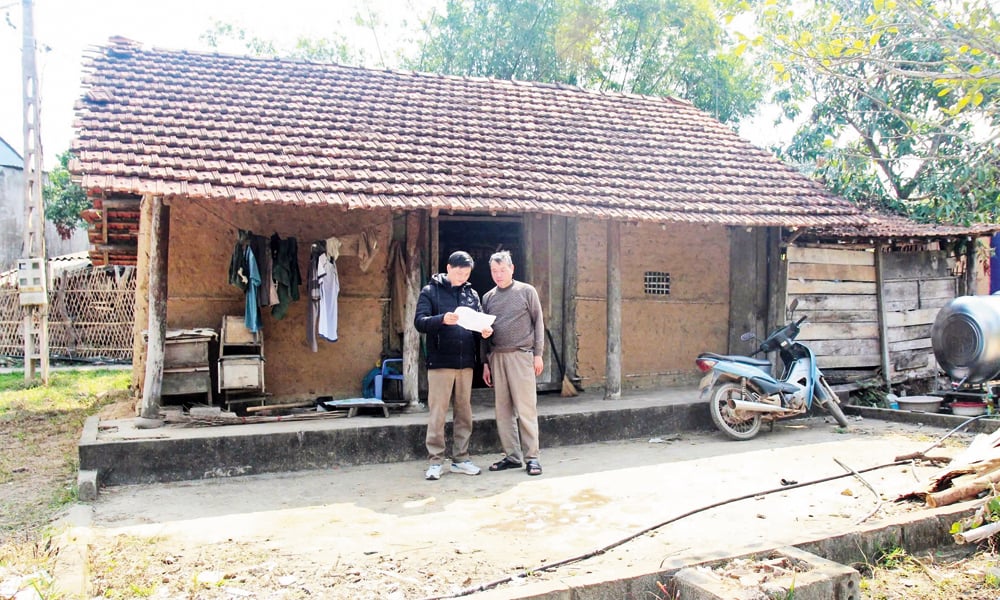 |
Mr. Hoang Van Ha's family, of the Tay ethnic group in Bieng village, An Lac commune (Son Dong district), lacks land for housing. The house the family is currently living in is built on garden land. |
It has been learned that Phong Van commune has more than a dozen households lacking land for production. Currently, the commune's public land fund is depleted, and resolving the land shortage for these households is beyond the local authority's jurisdiction. Therefore, the commune has reported the situation and requested higher authorities to provide support to help the people alleviate their difficulties and stabilize their lives as soon as possible.
The situation of ethnic minority and mountainous people lacking housing or production land is still occurring in many other localities in the province. In Bieng village, An Lac commune (Son Dong district), there is the case of Mr. Hoang Van Ha, a Tay ethnic minority. Mr. Ha is living with his son in an old house built on land used for perennial crops, which is in serious disrepair. Because it is not classified as residential land, the local authorities have been unable to include his family in the list of those eligible for assistance to eliminate temporary housing.
| According to the 2024 Land Law, the entire province has 9,300 ethnic minority people eligible for land support policies; the highest numbers are in Son Dong district with over 6,500 people, Luc Nam district with over 1,000 people, and the remainder in Lang Giang, Yen The, and Luc Ngan districts. |
According to a review by the authorities, the entire province has more than 9,300 ethnic minority people from poor and near-poor households lacking residential and agricultural land who are eligible for land support. The highest numbers are in Son Dong district with over 6,500 people, followed by Luc Nam district with over 1,000 people, and the remainder in Lang Giang, Yen The, and Luc Ngan districts. This situation is due to the complex terrain of ethnic minority areas, with many high mountains and being fragmented by rivers and streams, resulting in limited residential and agricultural land.
The mountainous areas have rocky and gravelly land, and transportation is difficult, hindering production and trade. These factors contribute to the consistently higher poverty and near-poverty rates among ethnic minority and mountainous communities compared to the provincial average. By the end of 2024, the poverty rate in the province's 28 particularly disadvantaged communes was 9.25%, higher than the provincial average of 7.52%.
Putting policies into practice.
In recent years, the Party and State have implemented many policies to support ethnic minorities and people in mountainous areas. Due to the lack of surplus land, localities mainly apply support methods such as: organizing free vocational training, providing financial assistance for purchasing tools and machinery for production (lawnmowers, plows, etc.), and offering preferential loans. However, these methods have not fundamentally addressed the difficulties faced by the people. The 2024 Land Law stipulates a land support policy for individuals in ethnic minority areas who are poor or near-poor and lack residential or production land, and provides exemptions or reductions in land use fees and land rent as prescribed.
The newly enacted policy has addressed the bottleneck of land shortages for housing and production for ethnic minority communities. However, the biggest challenge currently is the limited land available to solve the housing problem for the people. According to Mr. Le Duc Thang, Vice Chairman of the Son Dong District People's Committee, most of the land in the locality has been allocated to the people and forestry units for management and use, making it very difficult to reclaim it to create new land reserves. The district proposes that the province prioritize the conversion of land use for residential purposes for those who already have houses built on other land areas (such as agricultural land, garden land, wasteland, etc.) to residential land.
According to a representative from the Land Management Department (Department of Agriculture and Environment), based on the regulations in the Land Law, among those eligible for land support, nearly 8,800 cases currently own houses on land that is not classified as residential land, covering an area of approximately 87 hectares. These cases wish to have their land recognized or converted to residential land, thus eliminating the need for new land allocation. This approach is considered optimal because it allows residents to legalize their land ownership at their current location while simultaneously reducing costs from the state budget. Additionally, statistics show that the province has 560 cases of individuals without residential land.
The maximum land area required to support these cases is 6.7 hectares. In addition, there are over 500 cases without agricultural land and over 8,700 cases with agricultural land but less than 50% of the allocated land limit, all of which are eligible beneficiaries of the policy. These cases will be considered and resolved in accordance with regulations, conditions, and the actual land availability in the locality.
The concretization of policies supporting housing and production land clearly demonstrates the special attention of the Party and the State to ethnic minorities and people in mountainous areas. To ensure the policies are implemented effectively, people hope that the review process will be carried out by relevant agencies and local authorities in the province in a public, transparent, and rigorous manner, targeting the right beneficiaries and ensuring compliance with the law.
Source: https://baobacgiang.vn/thuc-hien-hieu-qua-chinh-sach-ho-tro-dat-dai-doi-voi-dong-bao-dan-toc-thieu-so-postid420827.bbg








![[Photo] Party and State leaders attending the ceremony commemorating the 80th anniversary of the first general election to elect the Vietnamese National Assembly.](https://vphoto.vietnam.vn/thumb/402x226/vietnam/resource/IMAGE/2026/01/06/1767667837484_ndo_br_bnd-2975-jpg.webp)












































































Comment (0)