

STO - In recent years, due to the impact of African swine fever and rising feed prices, pig farmers have not been restocking their herds on a massive scale, but have only developed their herds in moderate numbers, while also seeking ways to reduce costs and increase profits in pig farming.
With over two years of experience in pig farming, Ms. Tang Thi Huong from Phu My commune, My Tu district ( Soc Trang province ) shared: "I use fermented rice bran and rice bran mixed with pellet feed as my pig feed. In addition, I use the land behind my house to grow sweet potato vines to provide green vegetables for the pigs every day. Thanks to supplementing with readily available feed, I reduce the amount of commercial feed I use, saving about 50% on feed costs. With a herd of 15 pigs, feeding them entirely with commercial feed for two days uses up one bag of feed (530,000 VND/bag), so the profit by the time of sale is not much."
“I expect to sell them in about a month, estimating the weight at sale to be 100-110 kg/pig. With an estimated price of 57,000 VND/kg for live pigs, after deducting expenses, the profit will be over 25 million VND (after raising them for 3-4 months). The price of live pigs is also on the rise, so if the price increases as predicted, the profit will be even higher. Besides the income from pork, my family doesn't spend money on fuel for cooking daily meals because we utilize the waste from the pig farming process in a biogas system,” added Ms. Tang Thi Huong.
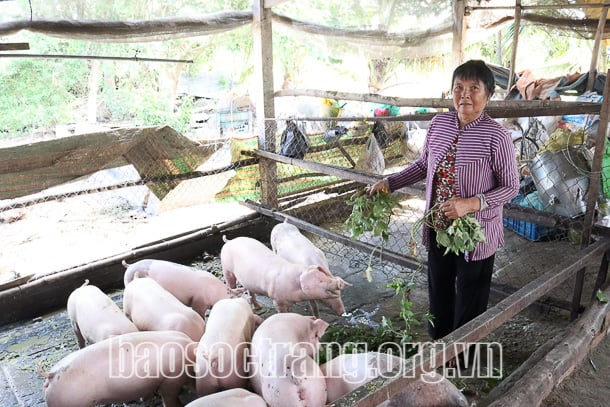
Ms. Tang Thi Huong, from Phu My commune, My Tu district (Soc Trang province), with her family's pigs. Photo: THUY LIEU
To ensure her pigs are healthy and grow quickly, Ms. Huong has to vaccinate them against various diseases; regularly clean the pigpens to ensure they are always spotless; restrict access to the pigpens; provide mosquito nets for the pigs to sleep under to prevent mosquito bites; disinfect the area around the pigpens once a week; and give the pigs daily cool baths during hot weather.
To reduce costs during the pig farming process, Ms. Son Thi Hong Xuan, from Tai Van commune, Tran De district (Soc Trang province), has devised a farming method to ensure good and safe weight gain in her pigs by cooking leftover food for them to eat. According to Ms. Hong Xuan, her household raises 34 pigs, which will be divided into separate pens according to age to facilitate care and feeding, ensuring uniform weight gain. Of the 34 pigs, 17 will be ready for market in about a month, and the rest will be sold about 20 days later, with an estimated total pork production of over 3.4 tons. Currently, the price of live pigs is 56,000 VND/kg and is continuing to increase daily. It is predicted that by the time of sale, the price will be over 59,000 VND/kg. After deducting all expenses, Ms. Hong Xuan will pocket over 50 million VND. Ms. Hong Xuan plans to expand her pig breeding program by raising a few more breeding sows to create a herd of pigs for meat production and supply to the market.
According to statistics from the provincial Department of Agriculture , the total pig population in the province is over 167,500, with 90 pig farms (including 6 large-scale farms, 13 medium-scale farms, and 61 small-scale farms), while the remaining farms are run by households in the form of family farms and small-scale operations.
To maintain and develop a sustainable pig farming herd, Mr. Dao Van Bay, Deputy Head of the Department of Animal Husbandry and Veterinary Medicine of Soc Trang province, advised households to prevent and control pig diseases, especially African swine fever, during the transitional seasons by vaccinating their pigs. This is the most effective disease prevention measure to ensure the health of the pig herd, and vaccination should be carried out scientifically to achieve high effectiveness. At the same time, farmers need to implement African swine fever control measures such as: cleaning, disinfecting, and sterilizing pig pens and farms; installing nets around pens to prevent insects and disease vectors; having a waste disposal area; and not sharing farming equipment between pens. Piglets purchased must have a clear origin and be healthy; feed must be of traceable origin, within its expiration date, and of guaranteed quality and safety; and probiotics should be added to the feed to improve digestibility. Apply appropriate breeding procedures for each stage of pig growth and development; after each breeding cycle, clean and disinfect the pens and breeding equipment, and leave the pens empty for at least 7 days before introducing new pigs…
THUY LIEU
Source link

![[Photo] Prime Minister Pham Minh Chinh attends the Conference on the Implementation of Tasks for 2026 of the Industry and Trade Sector](/_next/image?url=https%3A%2F%2Fvphoto.vietnam.vn%2Fthumb%2F1200x675%2Fvietnam%2Fresource%2FIMAGE%2F2025%2F12%2F19%2F1766159500458_ndo_br_shared31-jpg.webp&w=3840&q=75)
















































































Comment (0)