

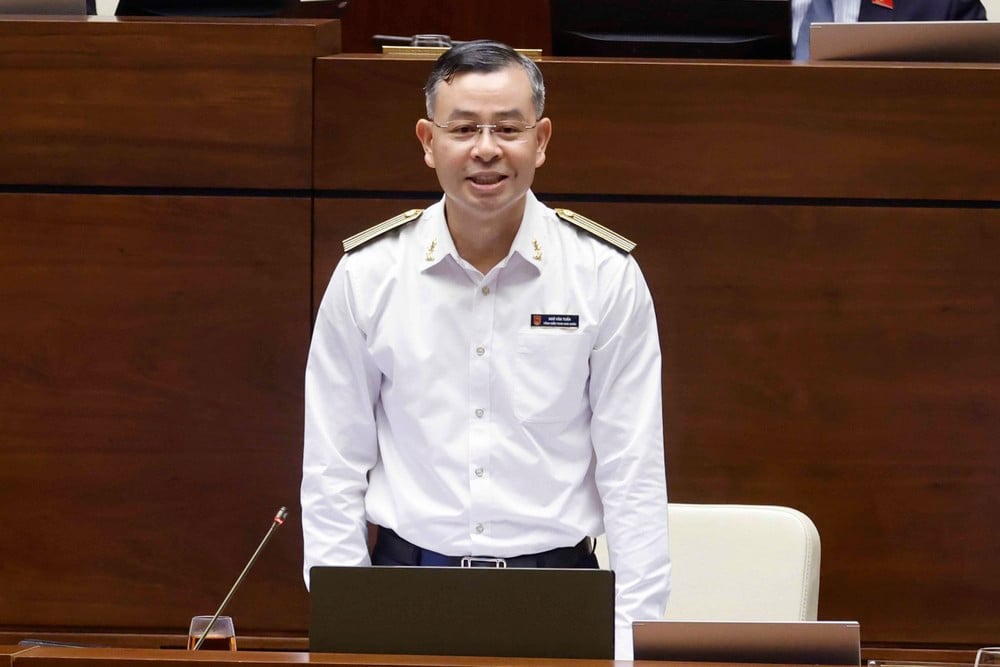
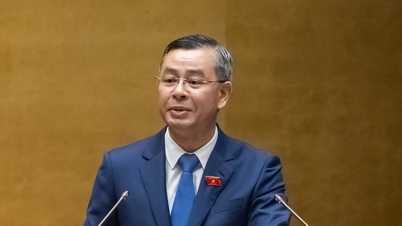
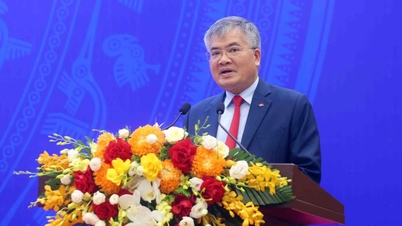
During the question-and-answer session on auditing held this morning, June 5th, the parliamentary session became truly heated with numerous questions from delegates to the State Auditor General Ngo Van Tuan regarding major cases that have caused social unrest recently.
Responsibility stemming from major corruption cases
Citing the cases at Phuc Son Group and Thuan An, which show collusion between non-state enterprises and officials in public investment projects to profit from state assets, National Assembly delegate Nguyen Manh Cuong from Quang Binh province stated that private enterprises are not subject to state audit, but these cases all involve the misuse of public finances and assets.
Therefore, delegate Nguyen Manh Cuong requested that the State Auditor General inform us whether, based on such cases, there are any recommendations for the State Audit Office to participate in preventing and stopping violations.
Meanwhile, on the same topic, Representative Trinh Minh Binh from the Vinh Long National Assembly delegation stated that recently, some projects had been audited, but the authorities still discovered irregularities in the bidding process. The representative requested the Auditor General to explain this situation and what solutions are being implemented.
Auditor General Ngo Van Tuan stated that the State Audit Office is an agency established by the National Assembly, with the function of evaluating, verifying, concluding, and making recommendations on the management and use of public finances and public assets. Therefore, the entities subject to State Audit are those that use public finances and public assets in accordance with the law.
Recently, several major cases related to bidding, such as the Phuc Son and Thuan An cases, involved irregularities in the bidding process. However, according to the State Audit Office, neither Phuc Son nor Thuan An received state funding, and therefore "are not subject to state audit." Nevertheless, because they involved several investors and contractors with state funding, the State Audit Office still reviewed the entire process based on the documents they provided to make recommendations within its authority.
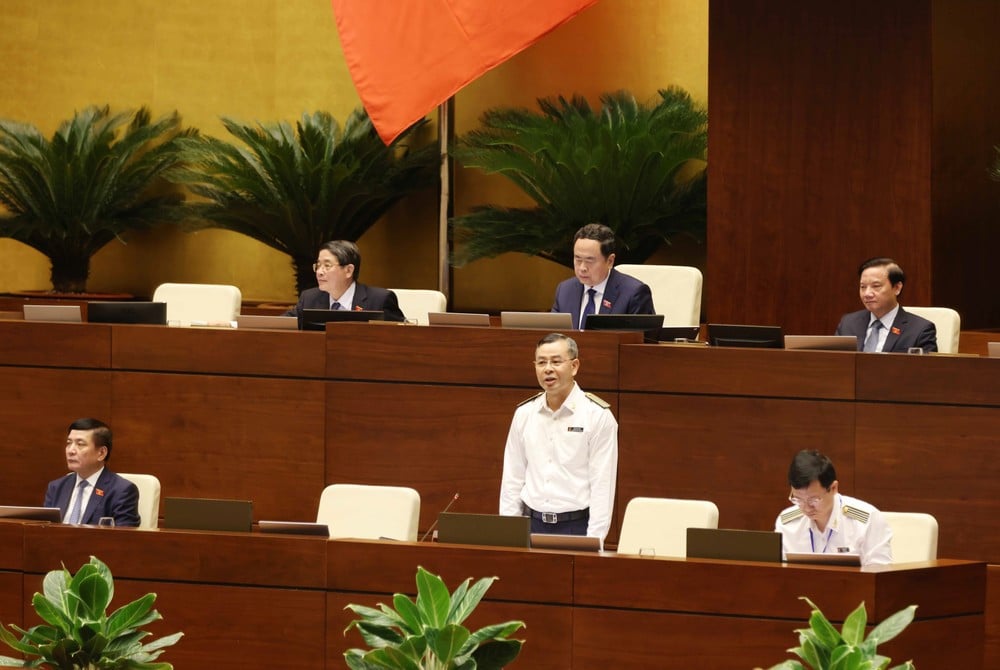
In response to a question from delegate Nguyen Manh Cuong regarding the State Audit Office's role in preventing and deterring wrongdoing, the Auditor General stated that the term "investigative auditing" had been mentioned before but remained only a subject of debate. He noted that very few countries in the world have audit offices that perform investigative functions.
Not only was the case at Phuc Son Group in Thuan An questioned by delegates, but delegate Mai Van Hai, Deputy Head of the National Assembly Delegation of Thanh Hoa province, also mentioned that in the recent SCB Bank case, many companies had conducted audits but failed to detect any irregularities. "From that, many voters are questioning the responsibility of auditors, and especially the responsibility of the State Audit Office, in cases like SCB," delegate Mai Van Hai questioned.
Responding to this issue, the State Auditor General Ngo Van Tuan stated that the case at SCB Bank is not related to the State Audit Office and does not fall within its scope. According to him, SCB Bank is a public company and therefore subject to independent auditing, and he affirmed that "responsibility in the case at SCB lies with the independent auditing firms that provided the services."
How can we achieve a situation where we "don't dare, and don't need to, engage in corruption"?
Representative Vu Thi Luu Mai, from the Hanoi National Assembly delegation, stated that the State Audit Office plays a crucial role in detecting acts of corruption. While acknowledging the positive results achieved in the fight against corruption over the years, she noted that there is still a fear of making mistakes and of taking responsibility. "So what should be done to strictly punish acts of corruption while still protecting those who dare to think and act?" Representative Vu Thi Luu Mai questioned.
In response to this question, the State Auditor General Ngo Van Tuan commented that "the question from delegate Mai is difficult" and suggested that three things need to be done well if the fight against corruption is to continue to be promoted without reducing dynamism and creativity, as General Secretary Nguyen Phu Trong once said, "to catch the mouse without breaking the vase."
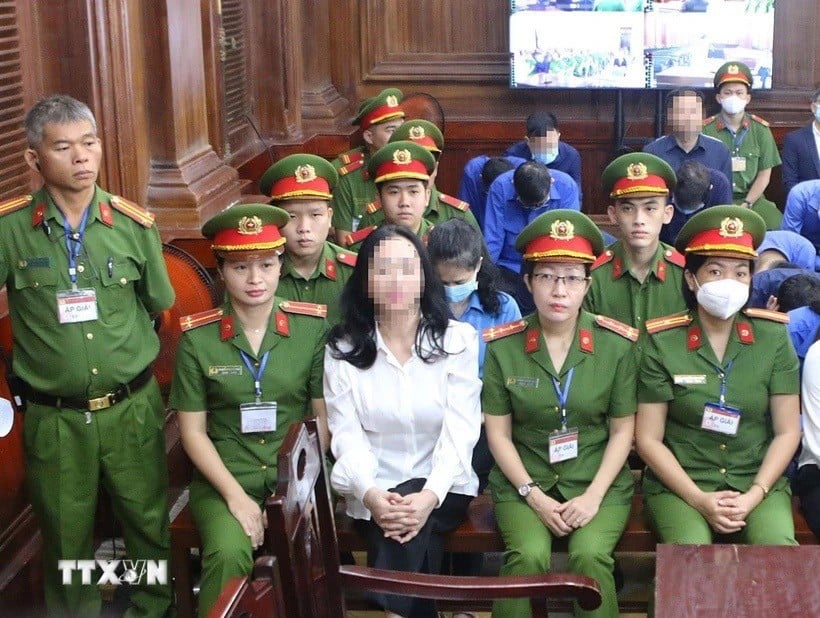
According to the State Auditor General, the first step is to build effective and rigorous preventive mechanisms to make corruption impossible, along with mechanisms to detect and severely punish corruption so that people don't dare to commit it. Finally, it is necessary to build appropriate incentive systems to eliminate the need for corruption.
Regarding the phenomenon of shirking and passing the buck as seen recently, Mr. Ngo Van Tuan believes that the causes stem from a lack of responsibility, insufficient skills and capabilities to meet requirements, and inadequate guidance.
The solution proposed by the State Auditor General is to raise awareness and improve qualifications; and to perfect the institutional framework to clearly define the rights and obligations of each civil servant and public employee. Mr. Ngo Van Tuan gave the example of a civil servant in position A: what they are allowed and not allowed to do, and how their benefits are linked to their rights and benefits. From there, responsibilities linked to benefits, along with inspection and supervision, can be quantified for officials.
Also questioning the responsibility of auditing agencies in the face of recent corruption, Representative Ha Duc Minh from the Lao Cai National Assembly delegation raised the issue of a situation where the State Audit Office conducts an audit but fails to detect violations, while subsequent investigations by relevant authorities uncover numerous major irregularities. He questioned who is responsible for this – the collective or an individual?
Regarding this issue, the Auditor General Ngo Van Tuan stated that Article 68 of the Law on Prevention and Combat of Corruption clearly stipulates the responsibility of the auditing agency to investigate if it fails to detect violations.
Accordingly, if the issued audit report did not mention any violations, but the authorities later investigated and determined violations to exist, Mr. Ngo Van Tuan stated that the handling of such cases would depend on the responsibility, whether criminal or administrative, thereby clarifying collective or individual responsibility.
The State Auditor General stated: "In nearly 30 years, the State Audit Office has not had a single case handled in this manner."
VN (according to Vietnam+)Source
![[Photo] The General Secretary, President and his wife begin their state visit to the Philippines.](https://vphoto.vietnam.vn/thumb/1200x675/vietnam/resource/IMAGE/2026/05/31/1780230559452_anh-man-hinh-2026-05-31-luc-19-28-11.png)

![[Photo] Solemn bathing ceremony and Buddha procession in Hue](https://vphoto.vietnam.vn/thumb/1200x675/vietnam/resource/IMAGE/2026/05/31/1780228263543_1-jpg.webp)

![[Photo] Admire the coral "masterpiece" amidst the million-year-old heritage of Dak Lak province.](https://vphoto.vietnam.vn/thumb/1200x675/vietnam/resource/IMAGE/2026/05/31/1780221235105_anh-man-hinh-2026-05-31-luc-16-53-27.png)












![[Video] Sunset at Lap An Lagoon – Where the sun sets over the fishing nets](https://vphoto.vietnam.vn/thumb/340x192/vietnam/resource/IMAGE/2026/05/31/1780192137701_beach-landscape-sea-water-nature-grass-745871-pxhere-com.jpeg)































![[Photo] Admire the coral "masterpiece" amidst the million-year-old heritage of Dak Lak province.](https://vphoto.vietnam.vn/thumb/402x226/vietnam/resource/IMAGE/2026/05/31/1780221235105_anh-man-hinh-2026-05-31-luc-16-53-27.png)






























Comment (0)