

 |
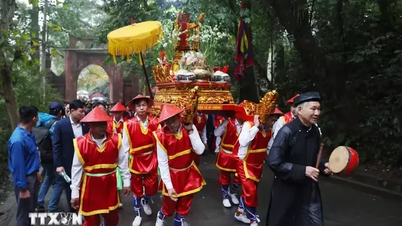
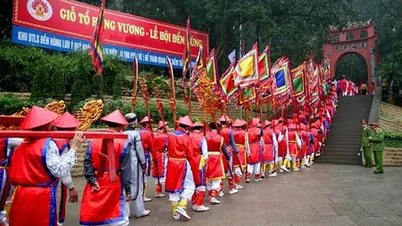
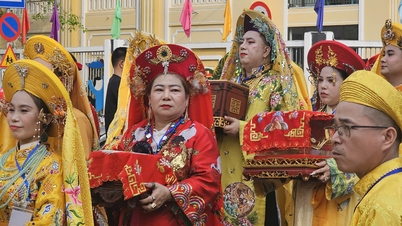
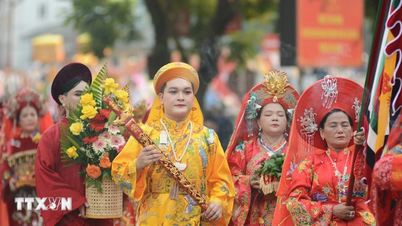
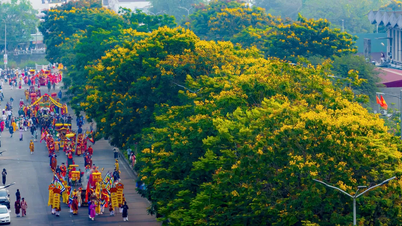
| The procession of palanquins departed from the ceremonial center and proceeded to the Upper Temple. |
With each passing era, the wheel of history leaves its mark on the path forward. The history of each nation often leaves behind evidence. Evidence can be seen, can be touched, but the essence of history has entered the consciousness of each person through the circulation of blood and endures in the resonant interplay between the past and the present. As a Vietnamese person, one can weep each morning upon waking, placing one's feet on the ground, and listening to the profound source of history and civilization from ancient times. Historical records and legends bear witness: Vietnamese history and civilization began in the era of the Hung Kings.
Many years ago, someone posed the question: Did the Hung Kings era exist? In fact, over the past few hundred years, and especially in the last few decades, historians, ethnographers, archaeologists, and art scholars, driven by patriotism and national pride, have diligently lifted the veils of history, gradually revealing the past and the reality of a national ancestor from four thousand years ago.
History or legend? I was truly fascinated to read the opinion of the late Professor of History Tran Quoc Vuong: "Legends shroud historical sites and landmarks like a light mist, blurring the lines of plants and architecture as if they were merely reflections of real life." I was also deeply moved by the famous Bulgarian writer Blaga Dimitrova's observation during her visit to Vietnam: "In this country, it is difficult to distinguish between legend and history." Thank you to the late Professor Tran Quoc Vuong and Blaga Dimitrova for their concise insights that have illuminated a clearer perspective when contemplating the historical origins of our country…
Since childhood, I've been fascinated by the story of the princess, daughter of King Hung XVIII, because she angered both the Mountain God and the Water God. I loved the love story of Tien Dung and Chu Dong Tu. I admired the filial prince Lang Lieu, who chose to offer his father, the king, sticky rice cakes symbolizing the square earth and the round sky.
In my childhood dreams, I saw the image of Phu Dong, a three-year-old boy from Giong village who couldn't yet speak or laugh, suddenly standing up and eating "seven baskets of rice, three baskets of eggplant, and drinking a whole section of the river dry in one gulp," then uprooting bamboo to chase away the invaders and save the country. Back then, in my immature mind, I couldn't distinguish between reality and fantasy; I only knew it was a story from the past of my country. I was born, raised, and lived within this stream of emotions and thoughts.
 |
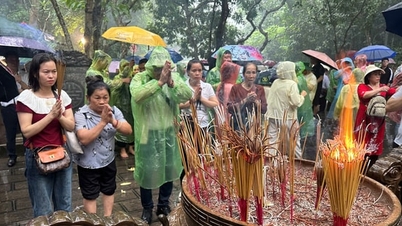
| People flock to Hung Temple festival. |
Westerners, though rational, have spawned an incredibly rich treasury of mythology, culminating in the kingdom of Zeus on Mount Olympus. Could this mythology be a reflection of their own ancient, prehistoric nations? This is just a casual observation, not intended as a comparison…
History and legends of the Hung Kings era are intertwined and blended. The work of scientists is to "deconstruct reality" to reconstruct and recreate the objective truth of the Hung Kings' era, while the people of the past internalized all historical experiences, revealing, through mythical or legendary perspectives, stories passed down through generations.
In the ancient times of our forefathers, they were romantic in their deification of earthly powers, things that were "real" but not "real." The history and legends of the Hung Kings era and the ancestral land of Phu Tho are viewed through such a lens. Mother Au, the Immortal, and Father Lac, the Dragon, are the mythical couple who originated the Vietnamese nation. However, the Au Viet of the hills and valleys, combined with Lac Viet of the sea to form the Au Lac nation, represents reality.
Lifting the veil of myth, the nation-building achievements of the Hung Kings and the resistance against northern expansionism by the ancient Vietnamese people are revealed as historical realities. This history is vaguely present in the legend of the Sơn Tinh-Thủy Tinh "water control" battle, and in the image of the young boy Gióng wielding an iron whip to drive the Yin invaders out of the country. This history can be touched and seen through hundreds of early Stone Age, Bronze Age, and Iron Age sites discovered and excavated continuously over the past few decades in the ancestral land.
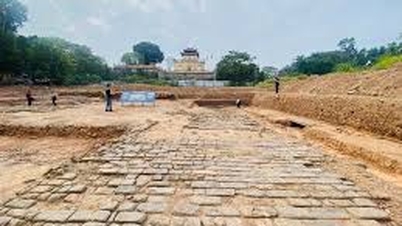
During my visit to the Hung Vuong Museum, I saw bronze plowshares, bronze sickles, iron axes, stone hoes, spearheads, bronze arrowheads in leaf and triangular shapes… It was a treasure trove of artifacts that bore witness to a long period of Vietnamese history spanning several millennia before Christ.
Not only Vietnam, but the world is increasingly paying attention to the echoes of the Hung Kings era. A British professor, Mr. OWWohers, in a research paper, summarized it as follows: The Van Lang Kingdom of the Hung Kings was a mystical social space, where each Lac leader governed a region, a locality often referred to as a "tribe".
 |
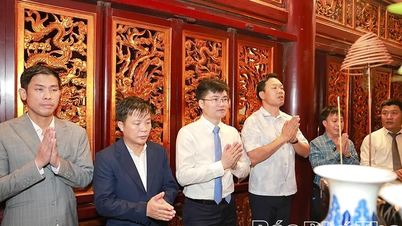
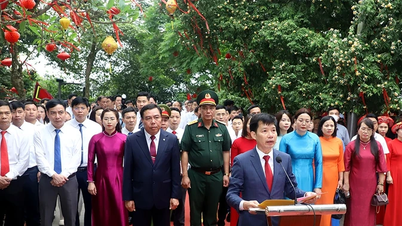
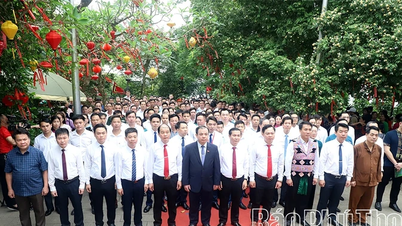
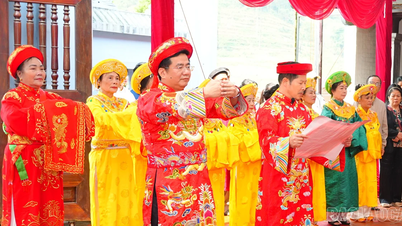
| Performing rituals at the commemoration ceremony for National Ancestor Lac Long Quan. |
The most prominent region is the apex of the Northern Delta, nestled between the Tam Dao and Ba Vi mountain ranges, with the Thao River flowing between them. The leader of that region, thanks to his talent, rose to become the supreme ruler—King Hung. Furthermore, Dr. K. Taylor, an American, in his dissertation demonstrated that King Hung was the ancestor who began establishing and defending the Vietnamese nation before the Common Era.
K. Taylor further elaborated: The era of the Lac nobles was the period when deep-rooted traditions of the Vietnamese people were formed, never fading, creating a foundation for a village-based, self-sufficient society following Asian methods. Meanwhile, the dissertation of Dr. I. Sakurai from Japan addresses the unique process of exploiting the Nhi River delta with its system of dikes, canals, ponds, etc., beginning from the time of the Hung Kings.
I am truly grateful to the genuine foreign scientists who have offered such a heartfelt and accurate perspective on Vietnamese history. I am especially grateful to Dr. K. Taylor for demonstrating that: “The era of the Lac nobles was the era in which the profound traditions of the Vietnamese people were formed, traditions that will never fade.” Reflecting on his idea, I am reminded of the poem by the poet To Huu: “For four thousand years we are still ourselves.” Vietnam has endured countless hardships throughout its history, thousands of years of Chinese rule, hundreds of years of Western rule, yet we have not lost our identity; we remain, an enduring truth. The Vietnamese people have found, and continue to find, themselves within their own history…
The Hung Kings era – history and legend intertwine, dream and reality, reality and dream. This is the beauty and wonder in the spirit of pilgrimage to the roots. Birds seek their nests, people seek their ancestry; if only on the tenth day of the third lunar month, all Vietnamese people around the globe could gather in the ancestral land for a communal festival. We would visit the Upper Temple, the Middle Temple, the Lower Temple, the Well Temple; we would gaze upon the majestic Bach Hac crossroads, the bowl-shaped hills of the central highlands. We would seek reality within dreams. We would place our feet on the foundation of the ancestral land, allowing our souls to be immersed in the magical, legendary incense smoke. We would return to our origins, to see ourselves within ourselves, and to feel embraced by the kinship of our compatriots…
Source












































Comment (0)