

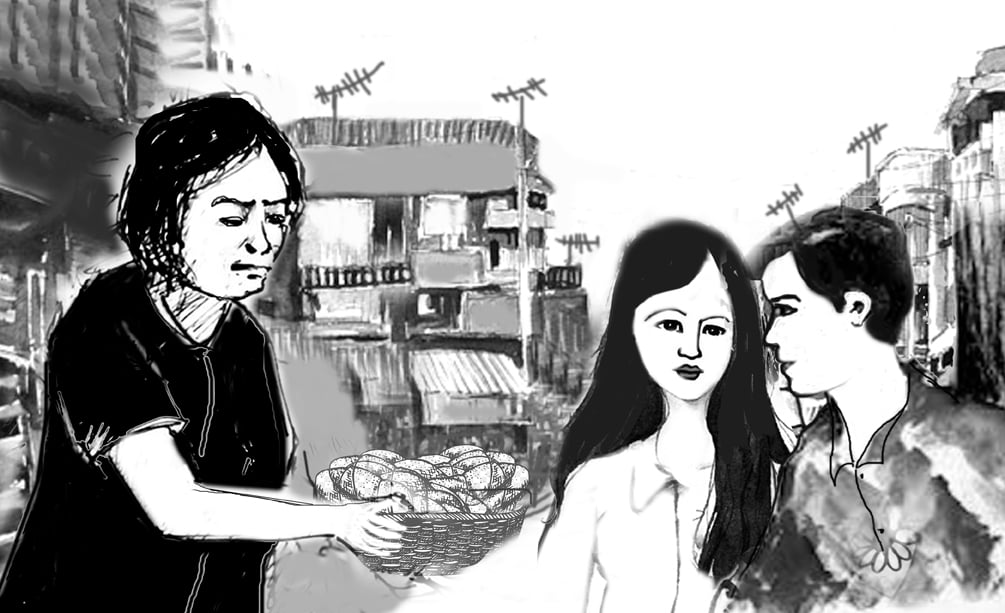
( Quang Ngai Newspaper) - After putting his wages in his jacket pocket, Trao intended to go home, but his stomach was rumbling with hunger, so he decided to buy something to eat to warm himself up. Suddenly, Trao saw an old woman huddled in a corner of the market with a basket covered in a piece of cloth. Walking closer, Trao asked:
What are you selling, ma'am?
The old woman was overjoyed to see someone stop to inquire about buying something, and with trembling hands, she pulled back the curtain and said:
- I'm selling bread, would you like to buy some?
He wanted to ask if the bread was still crispy, but when he saw the soggy bread in the old woman's hands and her expectant gaze, he couldn't bring himself to leave.
- I'll take five, Grandma. What time do you usually close for work?
- We'll go home when it's all gone, Uncle.
- Is your house nearby? Your children and grandchildren must be very worried about you selling things at night like this. Anyway, let me take whatever you have left.
- I'm going home right over there. Just take enough to eat. Taking too much would be a waste. I'll be sitting here until morning. I won't be able to sleep anyway.
Following the old woman's pointing hand, Trạo's eyes fell upon the foot of the bridge. The chewy piece of bread got stuck in his throat, and Trạo sat down on the sidewalk, gazing at the glittering city lights. Picking up his bag of bread, Trạo returned to his rented room. Several dogs rushed out from the alleys, barking loudly whenever Trạo passed by.
Trao started working as a factory worker at the age of eighteen. Initially, he worked at a tea factory near his home. Back then, his adoptive mother was still alive, so Trao had a home to return to. After his mother passed away, and his siblings were fighting over land, as an adopted child, Trao had no home left. Leaving his hometown for the city and wandering through industrial zones, Trao worked at various factories. It wasn't that he was "looking for greener pastures," but rather that times were tough, and orders were uncertain, so businesses only hired seasonal workers. For the past few years, Trao has had a stable job at one company, earning enough to cover his living expenses. Actually, a single life, without a family or burdens, would be simple, but to shoulder the responsibility of a family, a factory worker's salary is simply insufficient.
The phrase "let's break up" was all too familiar to Trạo. For years, he hadn't pursued any woman. It wasn't because he'd lost faith in love, but as he got older, joy became more precious and scarce. One day, drunk, someone asked Trạo if he was bored with his life as a poor factory worker. Trạo shook his head and smiled. Life isn't easy. The past few years have been difficult, inflation has affected every family's meals, and many people are struggling. Having a job to make a living is already a great blessing. We may be poor in money, but we can't be poor in spirit. We can't keep dragging ourselves down forever. We have to fly! Even without wings, we must fly above the burdens of money.
 |
- That sounds great. But if it weren't for the money, why would you keep working as a hired laborer loading goods at the wholesale market after your shift ends?
- Well... so that when someone needs to rely on me later, things will be less difficult for them.
The man patted Trạo on the shoulder in greeting, then quietly disappeared down the small alley. Trạo hurried to the wholesale market to be on time for unloading his goods. The women at the market were very fond of Trạo. Everyone teased him, asking, "Would you like to be my son-in-law?" Trạo smiled gently and said, "I'm only afraid your daughters will look down on me for being poor." Someone clicked their tongue and said, "That guy, he may be poor, but whoever marries him will be lucky. Many people who marry rich men end up living in tears." Those casual remarks made Đào blush. Trạo didn't know that in this bustling marketplace, there was someone quietly waiting for him. When she hired Trạo to carry those sacks of goods, Đào secretly watched his sturdy back disappear into the market. She wanted to give Trạo a handful of hot sticky rice but didn't dare. When paying him, she wanted to give him a few extra coins, but Trạo wouldn't accept them. Sometimes, she wanted to ask him how he was doing, but the words just choked in her throat.
Suddenly, Trạo remembered the old woman who sold bread. He couldn't understand why he hadn't seen her selling bread for the past few days. Following the old woman's pointing finger, Trạo went to the foot of the bridge. He asked about the old woman selling bread, and someone called back, "The old woman has been sick over there for the past few days. This morning, I bought some medicine from her." The old woman was curled up on an old mat spread on the ground. Seeing someone approach, she opened her eyes, overjoyed to recognize him.
Trạo wanted to ask the old woman why she didn't go back to her hometown, but luckily the words didn't leave his throat. If she had a hometown and children, she wouldn't be huddled under the bridge. As he slipped the old woman a few coins into his jacket pocket and turned to leave, Trạo suddenly felt a pang in his heart. He wondered what would happen to the old woman tonight, given the strong wind and her frail health. Would he ever see her again with her basket of bread sitting at the market gate? Or... The thought suddenly flared up like a fire, and Trạo turned back and said, "Let me take you back to my rented room for a few days to take care of you until you recover. It's too windy here."
That night, Dao didn't see her beloved at the market. A few days later, the market buzzed with talk of Trao bringing an old woman home to care for. Some muttered, "He's already poor, and now he's bringing an old woman home? What girl would marry him?" But others said, "He's poor, but kind-hearted. He cares so much for a stranger, let alone a wife and children."
Dao, feeling anxious, closed her stall early to go find Trao. When Dao arrived, Trao had just gone into the factory. Several people in the boarding house curiously asked if Dao was Trao's girlfriend. Pushing aside a few strands of hair that were clinging to her blushing face, Dao could only smile. The old woman, seeing someone arrive, sat up from her bed and tremblingly asked, "Are you looking for Trao?" For some reason, a feeling of compassion welled up in Dao's heart. The simple boarding room was somewhat messy, lacking a woman's touch. On the table, a bowl of porridge was still slightly warm, probably cooked by Trao for the old woman before going to work. Under the bed, a set of worker's clothes lay in the basin, unwashed. Dao was about to grumble a few words, but suddenly remembered what she was to him. After feeding the old woman the porridge, doing the laundry, and tidying up, Dao finally left...
Trạo asked the old woman if some fairy had just emerged from a jar of salt, because the house was so clean and tidy. Or... was she sick but still trying to do all that work? The old woman smiled and said, "There really is a fairy. This fairy is very pretty and kind." The fairy only appeared when Trạo went to work. These past few days, the company had a large order, so the workers had to work overtime constantly. Despite the fatigue, Trạo felt happy because someone was waiting for him at home after work. He hadn't experienced that feeling in years. He envied others who had parents to share meals with, laughing together from morning till night. There were times he wished he had parents to take care of in his old age. The old woman appeared, and even with simple meals, she was happy. That's why several times she suggested packing up and moving under the bridge, but Trạo refused. It was just an extra bowl and chopsticks, after all. Trạo worked overtime, and when he had free time, he worked as a porter at the market; he could make ends meet. "How about you stay here and be my mother?" he thought. That statement wasn't actually that difficult to utter. Once spoken, Trạo felt a great weight lifted from his heart. Only the old woman remained, her eyes welling up with tears, unable to speak. She had lived almost her entire life, wandering and encountering countless people, hearing countless stories of human nature and the ways of the world. She had only ever seen people abandon their parents for money. Who would ever pick up a stranger and bring them home to be their mother? Trạo chuckled and said, "There are plenty of good things in the world, you just haven't heard them yet."
Everyone pitched in to help, adding a cloth wardrobe and giving Trao a larger bed. Some gave him a bottle of medicated oil, others some packs of medicine. Some bought him a new pair of sandals and a new hat. Others, seeing Trao was away working and worried about the old woman's meager meals, brought him a bowl of soup. Sometimes they would invite the old woman over to eat with them; the more people, the merrier. Trao's act of taking the old woman in was like a refreshing rain, nourishing souls withered by the struggles of making a living and the weariness of daily life. They reflected that life still held so much goodness, and that they should live peacefully and show compassion for one another.
The old woman, bored staying home all the time, decided to pickle vegetables and take them to the market at the end of the street to sell. The market mainly catered to factory workers, so everything was cheap. While selling, she noticed it was raining and felt sorry for the young workers who had no one to bring in their clothes, so she hurried back home. The yard was covered in fallen leaves; the workers were busy with overtime, so luckily she was there to sweep it up. She also tilled the overgrown patch of land and planted a few rows of vegetables.
One time, when Trạo came home from work, he saw Đào sitting on the doorstep sewing clothes. He stood there, gazing at her for a long time, his heart filled with emotion. Neighbors, seeing this, were washing rice and humming: "My shirt is torn at the seam / My wife isn't here yet, my old mother isn't here to sew." Đào, embarrassed, pretended to scold Trạo for not having a needle and thread at home. They'd had to go to the market to find one earlier. She wondered what kind of clothes he wore, that every worker's uniform had loose threads by a hand's width? And why was his beard and hair so thick? He looked old and ugly. Trạo felt incredibly happy hearing the scolding. His mother also said, "Only someone who cares would nag about your hair and clothes." Sometimes, because he longed for attention, Trạo would let himself become a little more disheveled. In the morning, he'd intentionally leave his bedding and slippers scattered on the doorstep. In the evening, he'd return to find everything neatly arranged. Watching Đào picking vegetables outside, Trạo said to his mother:
- We have to keep a close eye on such a clever girl like Tam. If we let our guard down, someone will snatch her away. Right, Mom?
The old woman smiled toothlessly as she saw the couple exchanging shy, loving glances. Trạo never imagined happiness would come to him so sweetly. From someone with no hometown or family, he now had a family with his elderly mother and a hardworking, loving woman. She didn't complain about his meager worker's salary. She didn't complain about the smell of sweat on his faded worker's shirt. She didn't complain about the poor boarding house with its honest, simple workers. The people in the boarding house rejoiced for Trạo, saying that happiness often comes to those who deserve it. Watching Trạo and his mother gathered around the dinner table after a hard day's work, one could see that this glamorous city wasn't just "flowers for the rich, tears for the poor," as people often say. These solitary individuals would find solace in each other, forming a home...
VU THI HUYEN TRANG
Source link


![[Photo] Standing Committee member of the Party Central Committee Tran Cam Tu working with the Central Inspection Committee](https://vphoto.vietnam.vn/thumb/1200x675/vietnam/resource/IMAGE/2026/05/28/1779969579668_ndo_br_bnd-2495-jpg.webp)













































































Comment (0)