

From the arid, sloping hills of the highlands, coffee cultivation has risen to become a key agricultural sector, opening up opportunities for poverty alleviation and wealth creation for the people of Son La. However, in the context of deep integration and new demands from the global market, the development journey of Son La coffee is at a crucial crossroads: either continue developing in the old way with inherent limitations, or undertake a radical transformation to reach higher values.
From experimental crops to pillars of the agricultural economy .
Looking back at the economic development journey In Son La's agriculture , the imprint of coffee cultivation is closely linked to the province's ongoing innovation in agricultural production thinking.
In the early 1990s, when coffee was introduced to Son La province , few people imagined it could bring about such a dramatic change. At that time, most of the sloping land was still used for growing corn and cassava with low yields, and many households faced considerable hardship.
In this context, developing coffee cultivation is seen as a new direction to exploit the advantages of climate and soil and create sustainable livelihoods for the people.
Experience has proven this to be the right choice.From just a few thousand hectares initially, Son La has now developed into the largest Arabica coffee growing region in Vietnam, with over 33,600 hectares, mainly concentrated in 48 communes and wards, including 28 communes and wards with concentrated cultivation areas. Tens of thousands of households have a stable income from coffee cultivation; many previously struggling localities have gradually transformed thanks to the development of this industry.
More importantly, coffee cultivation has contributed to changing people's production mindset. From subsistence production, people have gradually moved towards commodity production, participating in value chain linkages, applying technological advancements, and gradually integrating with the market.
It can be affirmed that coffee plants not only create economic value but also contribute to promoting the transformation of Son La's agriculture towards a more modern direction.
When natural advantages become competitive advantages
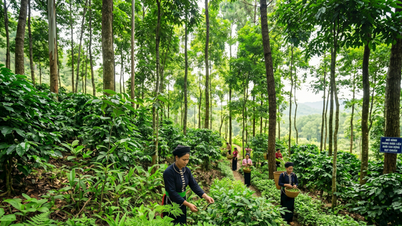
It's no coincidence that Son La has become the Arabica capital of Vietnam. Nature has bestowed upon this land unique conditions that few other places possess. Its altitude, ranging from 600 to over 1,200 meters above sea level, cool climate year-round, suitable temperature levels, and large diurnal temperature variations have created coffee beans with a distinctive flavor.

Farmers in Son La harvest coffee.
Many industry experts consider Arabica from Son La to have a delicate aroma, mild acidity, and a sweet aftertaste, aligning with the global trend of consuming high-quality coffee.
Leveraging these advantages, the Son La coffee brand has gradually established itself. The geographical indication "Son La Coffee" is protected, many products have received OCOP certification, and many businesses and cooperatives have built a supply chain linking production to consumption.
However, looking at the broader global picture, natural advantages are only a necessary condition, not a sufficient one, to create a strong brand. The world today has no shortage of coffee-growing regions with similar conditions. What makes the difference lies not in climate or soil, but in how each locality organizes production, manages quality, and builds its brand. That is the challenge Sơn La is currently facing.
Limitations of the old development model
The rapid development of the coffee industry over the past years has yielded positive results, but it has also revealed a number of limitations.
In many areas, production remains fragmented and small-scale. The links between farmers, cooperatives, and businesses are not yet truly sustainable. The rate of deep processing is still low. The added value created from each coffee bean does not match its inherent potential.
A concerning reality is that despite possessing the largest Arabica coffee growing region in the country, the majority of the product is still consumed as raw or semi-processed coffee. Meanwhile, the greatest value of the coffee industry lies in deep processing, branding, and market development. This makes producers vulnerable to price fluctuations and dependent on the raw material market.
On the other hand, global development trends are changing very rapidly. While product quality was previously the most important factor, now environmental factors, social responsibility, and traceability are becoming mandatory standards. These requirements place unprecedented pressure on the coffee industry.
A turning point for a key industry.
It can be said that the coffee industry in Son La is at a crucial turning point in its development.
On one side is the traditional production model based on natural advantages and raw material exports. On the other side is a new development path based on science and technology, digital transformation, ecological production, deep processing, and brand building.
This choice will not only determine the future of the coffee industry but also directly impact the livelihoods of tens of thousands of households dependent on this crop.
Recognizing these opportunities and challenges, the Standing Committee of the Son La Provincial Party Committee issued Conclusion No. 607-KL/TU on April 22, 2026, regarding the sustainable development of coffee production, processing, and consumption in an ecological direction until 2030, with a vision to 2035. This is not only a guideline for an agricultural sector but also a crucial economic development strategy for the province in the new period.
More than anyone else, Son La understands that to go further in the global market, coffee beans cannot simply carry the distinctive flavor of the Northwest mountains. They need to carry the values of innovation, environmental responsibility, and a strong enough brand to compete in a world that is changing every day.
Bui Thu Ha - Provincial Political School
Source: https://sonla.dcs.vn/tin-tuc-su-kien/noi-dung/tu-doi-dat-doc-den-thuong-hieu-ca-phe-son-la-8003.html





































































Comment (0)