

In recent years, to optimize treatment outcomes, 3D printing technology has been applied throughout the entire process at Military Central Hospital 108, from simulation design to surgical planning.
In recent years, to optimize treatment outcomes, 3D printing technology has been applied throughout the entire process at Military Central Hospital 108, from simulation design to surgical planning.
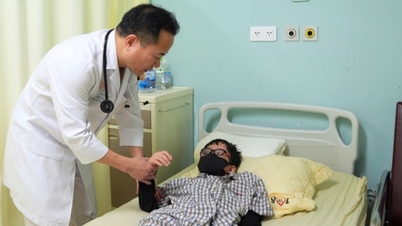
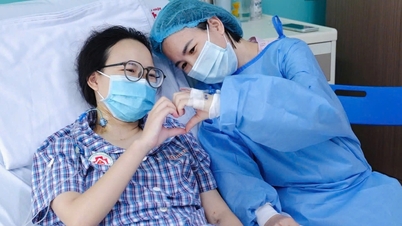
Recently, the Craniofacial and Plastic Surgery Center of Military Central Hospital 108 received a 30-year-old female patient who presented with swelling and deformation in the right cheekbone and upper jaw area.
 |
| Illustrative image |
After examination by doctors and a CT scan, the patient was diagnosed with ameloblastoma of the upper jaw. This is a benign tumor but it grows very rapidly, causing destruction of the jawbone.
The patient subsequently underwent surgery to remove half of the upper jawbone to eliminate the entire tumor. However, this left a large defect, posing a risk of severe facial disfigurement after surgery, as well as affecting chewing and breathing functions.
Doctors at Military Hospital 108 performed "immediate" upper jaw reconstruction in a single surgery using a bone flap taken from the patient's own leg through microsurgical techniques.
The patient was subsequently discharged from the hospital and returned to their normal life and work after the dangerous tumor was completely removed, while their facial features remained symmetrical.
To ensure a successful surgery and complete facial reconstruction for the patient, doctors used 3D technology to create a detailed plan for the entire operation. This is one of the new medical advancements currently being researched in developed countries around the world .
According to Dr. Le Kim Nha, Department of Plastic and Microsurgery, Central Military Hospital 108, the above-mentioned patient's case is one of several cases diagnosed with maxillofacial bone cancer or ameloblastoma in the past year at the Craniofacial and Plastic Surgery Center, Central Military Hospital 108.
All patients subsequently underwent detailed preoperative planning using 3D technology and maxillofacial osteotomy using a microsurgical fibula flap.
The emergence of 3D technology in recent years has opened up many applications in various fields of life. Particularly in the medical field, 3D technology is a trend in developed countries worldwide and promises to offer many opportunities to assist surgeons in difficult and complex surgeries.
At the Craniofacial and Plastic Surgery Center, doctors use 3D simulation software to plan pre-operative procedures using computed tomography images of the patient's jaw and fibula.
The surgeon performs bone reconstruction, "simulating" the surgery on computer software with tasks such as bone cutting and shaping, with millimeter precision.
After performing a "simulated surgery" on a computer, the surgeon will create and print bone models and bone cutting guides using 3D-printed materials. These models guide the surgeon during the actual operation, allowing them to repeat the planned procedures. This reduces the time and complexity of the surgery and significantly increases accuracy.
Dr. Pham Ngoc Minh, Department of Plastic and Microsurgery, Military Central Hospital 108, said that to reconstruct the facial bones, they take a fibula flap along with the small blood vessels nourishing the bone from the patient's lower leg. Then, they connect it to the blood vessels in the facial area using a microscope.
This is a complex technique, so surgeries usually last 8-10 hours. But now, thanks to the application of pre-operative planning technology using software and 3D printed models, surgical time has been significantly reduced to just 5-6 hours, and may even be shorter in the future.
Thanks to the accuracy of the bone shaping results, we can place the dental implants in a single surgery, saving patients money and reducing the number of subsequent interventions.
3D technology is not only used in the field of maxillofacial surgery to treat bone and facial diseases, but it is also applied to cosmetic surgery to create facial contours such as jaw reshaping, cheekbone reduction, and jaw angle reduction.
The bone cutting guides are meticulously designed before surgery to ensure safety, avoid damage to vital nerve structures, and increase efficiency, ensuring facial symmetry after surgery.
The application of 3D technology in surgery, which is being routinely performed at Military Central Hospital 108, has brought many practical benefits to patients and doctors, while also opening up many new avenues in medicine.
Source: https://baodautu.vn/ung-dung-cong-nghe-in-3d-trong-dieu-tri-ung-thu-xuong-ham-mat-d246503.html

![[Photo] Prime Minister Pham Minh Chinh attends the Conference on the Implementation of Tasks for 2026 of the Industry and Trade Sector](/_next/image?url=https%3A%2F%2Fvphoto.vietnam.vn%2Fthumb%2F1200x675%2Fvietnam%2Fresource%2FIMAGE%2F2025%2F12%2F19%2F1766159500458_ndo_br_shared31-jpg.webp&w=3840&q=75)


























































































Comment (0)