

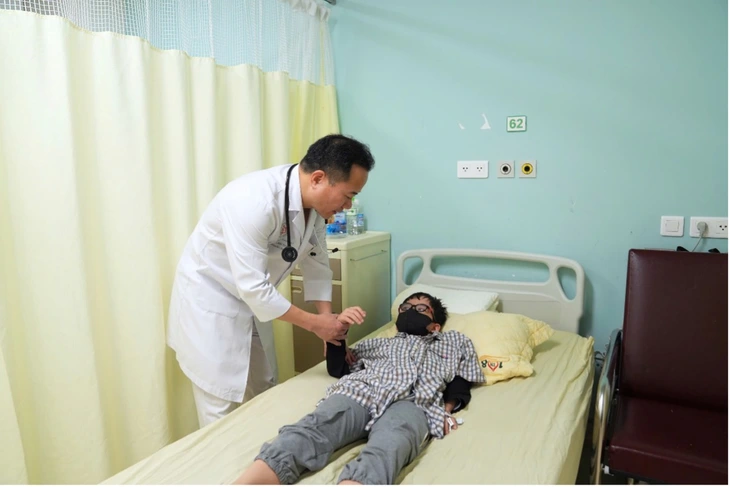
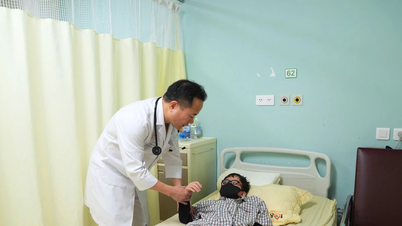
Dr. Nguyen Van Tuyen - Director of the Institute of Neurology, 108 Central Military Hospital examines an 8-year-old child with a stroke - Photo: BVCC
Stroke, once considered a disease of adults, is now appearing more and more in young people, with unclear symptoms but sudden and especially dangerous developments.
Thought it was a normal cold, but it turned out to be a stroke.
While studying, baby D.K. born in 2017 ( Hanoi ) suddenly collapsed on the table, the left side of his body was weak. This is a symptom of transient ischemic attack. Fortunately, teachers and friends discovered it in time, informed the family to take the baby to the hospital.
Computed tomography angiography (CTA) results showed that the baby had a cerebral infarction due to right middle cerebral artery dissection, a rare condition in children.
The baby received emergency intervention, balloon angioplasty and stent placement to reopen the blood vessels. Thanks to being brought to the hospital early, K. has recovered almost completely, with no neurological sequelae.
Another case is TQ, born in 2011 (old Ha Nam ). 10 days before being hospitalized, Q. had a severe headache and fainted at the commune health station. After taking medicine, he felt normal again but then the headache returned.
At first, the family thought it was a common cold, but to be sure, they took Q. to the hospital. A CTA scan discovered that Q. had a small brain hemorrhage due to a ruptured arteriovenous malformation in the right temporal region.
After consultation, the doctors performed intervention to remove the malformed node and pseudoaneurysm. Currently, Q. has fully recovered.
Q.'s mother shared: "I didn't think he had a brain hemorrhage because he was completely healthy before. If I had known it was that serious, I would have taken him to the doctor sooner. I hope parents don't be subjective when they see their children having headaches or showing strange symptoms."
According to doctors, stroke intervention in children is much more difficult than in adults. Children's vascular systems are small and vulnerable, and inserting instruments into the vessels requires absolute precision.
Currently, the Neurological Institute is treating 4 children aged 8-16 years old, this is a warning bell about the rejuvenating trend of this disease.
Doctor Nguyen Van Tuyen - Director of the Neurology Institute and Head of the Stroke Department, 108 Central Military Hospital, said that although stroke in children is still considered rare, in recent years, the rate of young patients under 45 years old having strokes is increasing.
In 2025, the stroke department will have about 10-15% of patients being treated as young people. According to Dr. Tuyen, the main causes are cerebral infarction and cerebral hemorrhage.
In children, the mechanism of infarction is less related to atherosclerosis than in adults, but often comes from arterial dissection (this condition accounts for about 30-50% of very dangerous progression). Arterial dissection can occur when children play, run, jump, collide or turn their neck strongly causing damage to the endothelium, or due to vasculitis...
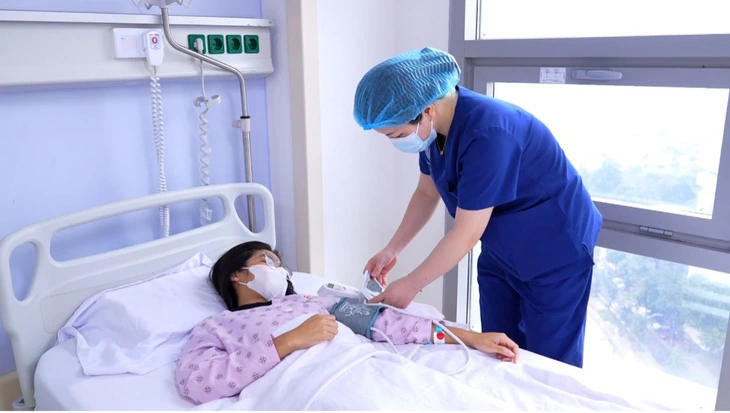
TQ, born in 2011, was discovered to have a brain hemorrhage from a transient headache - Photo: BVCC
Pay attention to signs of stroke in children
Stroke at any age is a race against time. Every minute, every second that passes, billions of nerve cells are damaged beyond repair. According to international recommendations, treatment with thrombolytic drugs is effective in the first 3 - 4.5 hours; mechanical thrombectomy is usually performed within 6 hours.
However, doctors emphasize that families should not wait or rely on the "golden hours" to delay taking their children to the hospital. The longer the delay, the lower the chances of survival and recovery.
What is worrying is that strokes in children are easily missed because the symptoms are not typical and children have difficulty describing their feelings. Signs such as severe headache, weakness in the limbs, blurred vision, difficulty speaking, convulsions, sudden collapse… even if very mild need to be closely monitored.
In many cases, parents think their children are tired or dizzy due to studying or a normal cold, leading to missing the golden time for treatment.
According to Dr. Nguyen Van Cuong, Department of Neurovascular Intervention, Institute of Neurology, there is currently no absolute method to prevent stroke in children because the cause is often unclear.
"But one thing is certain: early detection is the key to minimizing damage and protecting lives. Stroke can happen at any age, so the vigilance of family, teachers and the community is a decisive factor in the effectiveness of diagnosis and treatment for patients. Don't let subjectivity take away your child's opportunity," Dr. Cuong warned.
Source: https://tuoitre.vn/moi-8-tuoi-14-tuoi-bi-dot-quy-bac-si-canh-bao-phu-huynh-dung-nham-lan-voi-cam-cum-20251205181633802.htm

![[Photo] 60th Anniversary of the Founding of the Vietnam Association of Photographic Artists](/_next/image?url=https%3A%2F%2Fvphoto.vietnam.vn%2Fthumb%2F1200x675%2Fvietnam%2Fresource%2FIMAGE%2F2025%2F12%2F05%2F1764935864512_a1-bnd-0841-9740-jpg.webp&w=3840&q=75)


![[Photo] National Assembly Chairman Tran Thanh Man attends the VinFuture 2025 Award Ceremony](/_next/image?url=https%3A%2F%2Fvphoto.vietnam.vn%2Fthumb%2F1200x675%2Fvietnam%2Fresource%2FIMAGE%2F2025%2F12%2F05%2F1764951162416_2628509768338816493-6995-jpg.webp&w=3840&q=75)












































































Comment (0)