

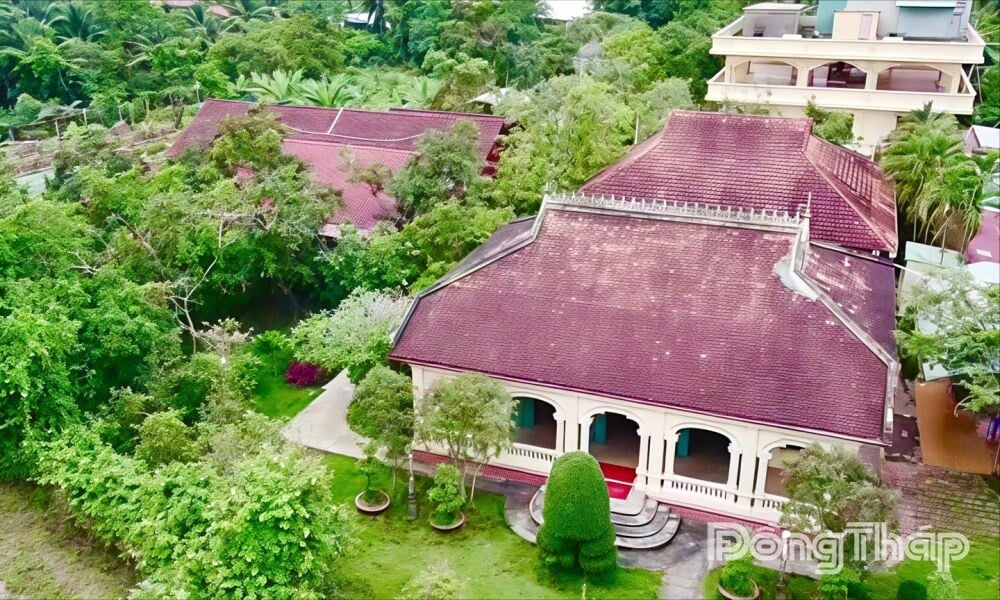
Here, the living space is like an open book of memories. The wind from the Tien River carries a hint of the salty alluvial soil, passing through each house, each intricately carved wooden window, and then stopping at the back porch, where the locals leisurely brew lotus tea and tell stories of their ancestors who settled the land.
Dong Hoa Hiep is beautiful not only because of its antiquity. It is beautiful because its people preserve the village as if it were their soul. The villagers live in harmony with nature: during the flood season, they cast nets and fish with hooks; during the dry season, they tend their orchards. Each ancient house is not only a tangible heritage but also a "school" without a blackboard, teaching lessons about restraint, about respecting one's roots, and about living in harmony with the land, water, trees, and people.
Visitors come here not only to sightsee, but also to experience the lifeblood of a cultural region. They can walk in the shade of ancient trees, listen to the gentle creaking of beams and pillars like the music of time, and enjoy simple yet heartwarming meals. It feels as if each step is taken softly, so as not to disturb a sleeping tradition.
Walking along the tree-lined paths of the ancient village of Dong Hoa Hiep, one easily encounters old houses with a unique beauty: a blend of the familiar charm of Southern Vietnamese folk architecture and a hint of European influence through the moldings, cornices, and patterns in the French style. Arched doorways, yin-yang tiled roofs, rows of lim wood columns, and exquisitely carved classical decorative motifs... all blend together like a silent dialogue between two cultures separated by half the globe.
Each old house is like an open page of history amidst everyday life. Dong Hoa Hiep is not only a repository of memories of a fertile land but also recounts the journey of more than a century of Southern Vietnam through many changes: land reclamation, trade, colonization, and then integration. Therefore, the architecture of these old houses is not simply a place to live, but a trace of layers of culture, a testament to the adaptability and harmony of the people of Southern Vietnam, both embracing the new and holding fast to their roots.
In Dong Hoa Hiep, heritage is not housed in glass. It lives with the people, interwoven into the way they tell stories, the way they welcome guests, in their food, in their orchards, and even in their small but enduring customs. This is what creates the value of "living heritage," a concept increasingly important in modern economic thinking: heritage is not just for viewing, but can become a driving force for development.
From a heritage economics perspective, the Dong Hoa Hiep ancient house offers a valuable lesson: when a community understands the value of its heritage and knows how to tell its own story, the heritage will naturally create livelihood opportunities. Experiential tourism, local cuisine , garden cultural spaces, accommodation services in ancient houses… all can become components of a sustainable economic and cultural ecosystem. What is most needed is not to build a lot of new things, but to preserve the old in a way that allows it to continue to live, breathe, and spread.
Those houses have stood firm through countless floods and the vicissitudes of time. Now, they continue to accompany the people on a new journey, a journey to transform heritage into a resource, not a burden; into a source of pride, not just nostalgia. Dong Hoa Hiep, therefore, is not just an ancient village, but also a symbol of Southern Vietnam's heritage-based economic thinking: cherishing the past to build the future.
The ancient village of Dong Hoa Hiep reminds us that development doesn't necessarily mean destroying the old; sometimes, it is the old that opens up new perspectives. Preserving an ancient village is not just about keeping a few houses, but about preserving a way of life, a philosophy, and the identity of a riverside community.
And that's why Dong Hoa Hiep has become a place where everyone understands that the future of the countryside lies not only in modern models, but also in what has endured through time, from the intricate carvings on wooden doors to the generosity of the people of the rural areas.
Le Minh Hoan
Source: https://baodongthap.vn/noi-thoi-gian-cham-lai-tren-nhung-nep-nha-xua-a233720.html

![[Photo] Reception to welcome General Secretary and President To Lam and his wife on their State visit to the Philippines](https://vphoto.vietnam.vn/thumb/1200x675/vietnam/resource/IMAGE/2026/06/01/1780295488620_vna-potal-chieu-dai-chao-mung-tong-bi-thu-chu-tich-nuoc-to-lam-va-phu-nhan-tham-cap-nha-nuoc-toi-philippines-8798060-7855-jpg.webp)

![[Photo] General Secretary and President To Lam and the President of the Philippines hold talks.](https://vphoto.vietnam.vn/thumb/1200x675/vietnam/resource/IMAGE/2026/06/01/1780286997787_anh-man-hinh-2026-06-01-luc-11-09-43.png)




























































Comment (0)