

Today, cyberspace is no longer merely a communication tool, but has become a comprehensive information environment where each individual is both a recipient and a producer and disseminator of content in real time. This change brings clear benefits in terms of connection speed, knowledge sharing, and expanding the space for information transmission and reception for humanity, but it also poses numerous challenges. Among these, the risk of information distortion is particularly noteworthy.
"Complex Information Highway"
In cyberspace, information is no longer filtered using traditional methods, but flows at very high speeds, far exceeding the verification capabilities of most users.
The consequence is the formation of a "complex information highway," where accurate, unverified, and misinformation coexist and "compete" for influence. Notably, misinformation arises and exists in more sophisticated forms, not only as simple fake news but also through data manipulation, the fabrication of information and events out of context, or one-sided interpretations aimed at creating distorted perceptions.
The concerning issue is that much misinformation sometimes doesn't stem from deliberate distortion or sabotage, but rather from a lack of verification in receiving and sharing it. That is, many users tend to accept information based on immediate emotions, "attractive" headlines, or "impressive" images, then share it without fully verifying the source. When this behavior occurs on a large scale, it creates a chain reaction, inadvertently spreading misinformation throughout the community.
Furthermore, the algorithmic operation of social media platforms, which optimizes interaction, contributes to the increased spread of controversial or emotionally charged content. This inadvertently allows unverified information to appear more frequently, while accurate but less "provocative" content is easily overshadowed. The line between right and wrong, truth and falsehood, thus becomes blurred for the average consumer, especially those lacking the skills to evaluate and analyze information.
The consequences of this phenomenon extend beyond information disruption; it also negatively impacts the formation of social awareness. When misinformation is repeated for a sufficient period and spread widely enough, it can form "alternative beliefs," influencing how individuals evaluate political , economic, and social issues. In some cases, this even contributes to increased political polarization in public opinion, weakening social consensus and hindering the process of receiving official information.
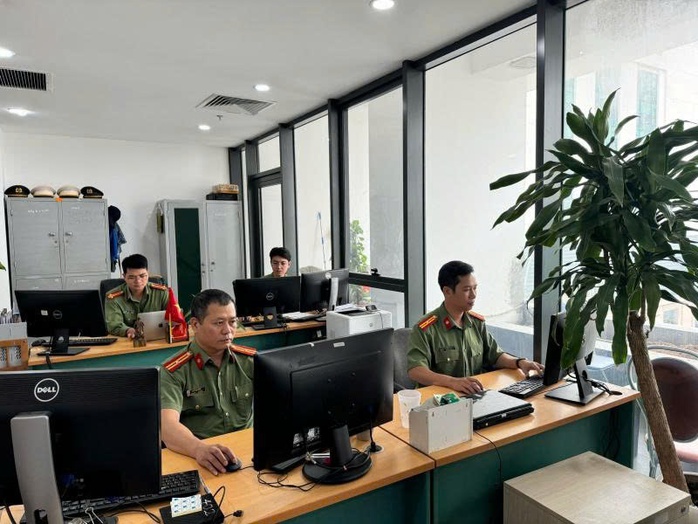
The Cyber Security and High-Tech Crime Prevention Department of the Ministry of Public Security is a pioneering force in combating harmful and toxic information on social media. (Photo: Public Security Newspaper)
Building a healthy digital environment
Given this situation, the question is not just how to control information, but more importantly, how can each social media user protect themselves from this complex flow of data?
The answer lies in establishing norms of conduct in the digital environment – not to restrict freedom of speech, but to strike a balance between the right to access information and social responsibility.
First and foremost, information reception needs to shift from a passive to an active approach. Instead of blindly believing everything that appears on their timeline, users need to develop the habit of checking sources, comparing information from multiple channels, and placing it in its specific context. In the digital environment, the ability to "doubt at the right time" is sometimes just as important as the ability to quickly absorb information.
Furthermore, responsibility in digital speech needs to be taken more seriously. Every comment, share, or interaction can go far beyond the personal sphere. Using appropriate language, avoiding misinterpretations, generalizations, or attacks, is not only a manifestation of good manners but also contributes to maintaining the quality of the shared information space.
An important principle is not to contribute to misinformation. Sharing, commenting on, or even simply interacting with unverified content can inadvertently increase its spread. Conversely, choosing not to interact with, or proactively reporting, infringing content are small but practical actions that significantly limit the negative impact of harmful information.
Approaching information from multiple perspectives is essential to avoid falling into biased perceptions. Every social issue has many viewpoints; expanding sources of information, comparing and verifying them helps users develop a more comprehensive and objective assessment ability.
Most importantly, each individual needs to be aware that they are not just users, but also integral parts of the digital information ecosystem. The online space is shaped not only by technology or management mechanisms, but also by millions of small actions every day. Choosing to share accurate, useful, and responsible information is a direct way to contribute to building a healthy digital environment.
We live in an era where information spreads at unprecedented speeds. The existence of misinformation is unavoidable, but its impact is not static. It depends on how each individual receives, processes, and disseminates information. A healthy digital environment doesn't form itself; it's created by the awareness and actions of the community. In that environment, every click is not just an operation, but a responsible choice.
Source: https://nld.com.vn/ung-xu-chuan-muc-tren-khong-gian-mang-196260426212513516.htm
![[Photo] General Secretary and President To Lam presides over the meeting to approve the draft report on the results of the second inspection by the Politburo of the Standing Committee of the Hanoi City Party Committee.](https://vphoto.vietnam.vn/thumb/1200x675/vietnam/resource/IMAGE/2026/05/26/1779789811432_a2-bnd-4430-9620-jpg.webp)













![[GALLERY] Ubisoft suffers record losses, cancels 7 games, shocking the gaming industry.](https://vphoto.vietnam.vn/thumb/402x226/vietnam/resource/IMAGE/2026/05/26/1779805711288_uni-2-png.webp)


![[GALLERY] USB-C AA batteries are causing a sensation because they're so convenient for tech enthusiasts.](https://vphoto.vietnam.vn/thumb/402x226/vietnam/resource/IMAGE/2026/05/26/1779798818575_p-png.webp)















































































Comment (0)