

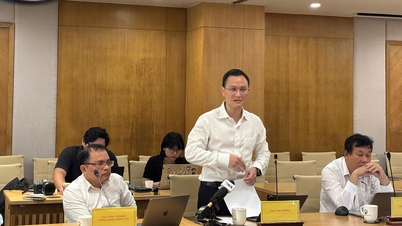
On April 8th, in Hanoi, the Ministry of Education and Training (MOET), in collaboration with Tien Phong newspaper and higher education institutions, organized the seminar "Training and Utilizing Talent in the New Context".
The risk of "brain drain" arises from a lack of policies to attract talent.
Speaking at the conference, Professor Nguyen Tien Thao, Director of the Department of Higher Education , Ministry of Education and Training, affirmed that for rapid and sustainable development, Vietnam must become a country with a comprehensive policy of identifying, nurturing, utilizing, and retaining talented individuals. To achieve double-digit growth in the coming years, we need a high-quality workforce; a team of scientific talents is the core of development.

In recent years, the Vietnamese higher education system has undergone changes in the scale of training for STEM fields, directly contributing to key technology and engineering sectors.
However, we also need to frankly acknowledge that policies have not been implemented consistently. Compensation policies, working environments, and development opportunities are not competitive enough in the context of the globalization of high-quality human resources. The phenomenon of "brain drain" and wasted talent still exists. We need leading scientists to lead core technologies, emerging technologies, next-generation energy, and so on.
Based on his experience working with young people, particularly through the Outstanding Young Vietnamese Award, journalist Nguyen Ngoc Tien – Deputy Editor-in-Chief of Tien Phong newspaper – believes that Vietnam does not lack talent. The problem lies in the mechanism for timely identification, the appropriate training system, and the policies for deserving utilization. Talented individuals need to be given opportunities, placed in the right positions, and provided with conditions to develop their abilities.

According to Mr. Tien, in the context of digital transformation, artificial intelligence, and the knowledge economy reshaping the social structure, the concept of talent is also changing, expanding to include individuals with creative thinking, adaptability, a spirit of commitment, and a desire to contribute. This requires the education system to innovate, human resource management to be more flexible, and society to create an environment that encourages creativity and accepts differences.
Talent development is facing pressure for comprehensive change.
At the workshop, delegates proposed solutions for identifying, nurturing, and effectively utilizing high-quality human resources to meet the country's development requirements in the new era.
From the perspective of a high school, Ms. Tran Thuy Duong, Principal of Hanoi Amsterdam High School for Gifted Students, said that at Hanoi Amsterdam High School for Gifted Students, the view of talent is changing in line with the development of the times.
While previously, academically gifted students were often confined to subjects like Math and Literature, the landscape has broadened. A student specializing in Math can not only aim for international competitions but also excel in other fields such as robotics, engineering, and STEM.
According to Ms. Duong, to nurture "good seeds," schools need more than just a team of excellent teachers. Facilities, especially STEM laboratories, are becoming a key factor in the context of rapidly developing science and technology.

Professor Chu Duc Trinh, Rector of the University of Technology, Vietnam National University, Hanoi, believes that high-quality human resources are key for our country to seize opportunities and overcome challenges in the process of international integration.
Currently, the Vietnamese economy is undergoing a strong transformation towards high-tech fields such as information technology, telecommunications, semiconductors, automation, artificial intelligence, and biomedical technology.
To meet these development requirements, according to Professor Chu Duc Trinh, we must address the shortage of high-quality human resources.
In this context, the role of universities is extremely important. Higher education institutions not only need to ensure the quality of training but also must be centers of research, innovation, and technology transfer. In particular, collaboration with businesses and the international community is crucial in providing students with access to new technological trends, thereby better preparing them for the global labor market and enabling them to face any challenges.
Associate Professor Dr. Nguyen Phong Dien – Vice Director of Hanoi University of Science and Technology – affirmed that, in the context of rapidly developing AI, university education, especially talent training, faces pressure for comprehensive change.
Mr. Dien stated that Hanoi University of Science and Technology views this problem from multiple perspectives, with the university focusing most heavily on the first two areas: student recruitment and training programs.
Another important point is the integration of training with research. Talented students are directly involved in research projects in labs, thereby developing their creativity and problem-solving skills. Simultaneously, the university is expanding international cooperation and will not place a strong emphasis on nationality when attracting faculty in the coming period, aiming to create a diverse academic environment.
“The reality shows that this approach is proving effective. There are former students who have worked in Silicon Valley and returned to support training programs in the country. This means that if properly trained, students are not only professionally competent but also capable of spreading knowledge and integrating internationally,” Associate Professor Dr. Nguyen Phong Dien emphasized.
According to Dr. Dang Van Huan, Deputy Director of the Department of Higher Education (Ministry of Education and Training), the Ministry has developed a plan to train human resources to serve the development of high technology in the period 2025-2035 and with a vision to 2045.
High-quality, talented human resources in key STEM (science, technology, engineering, mathematics) fields have become a core competitive factor among nations…
Eight fields of application: Natural sciences, life sciences, mathematics, computer science, engineering technology, engineering, manufacturing, architecture, and construction.
Source: https://daidoanket.vn/van-thieu-co-che-giu-chan-nguoi-gioi.html




















![[Photo] Reception to welcome General Secretary and President To Lam and his wife on their State visit to the Philippines](https://vphoto.vietnam.vn/thumb/1200x675/vietnam/resource/IMAGE/2026/06/01/1780295488620_vna-potal-chieu-dai-chao-mung-tong-bi-thu-chu-tich-nuoc-to-lam-va-phu-nhan-tham-cap-nha-nuoc-toi-philippines-8798060-7855-jpg.webp)























































Comment (0)