

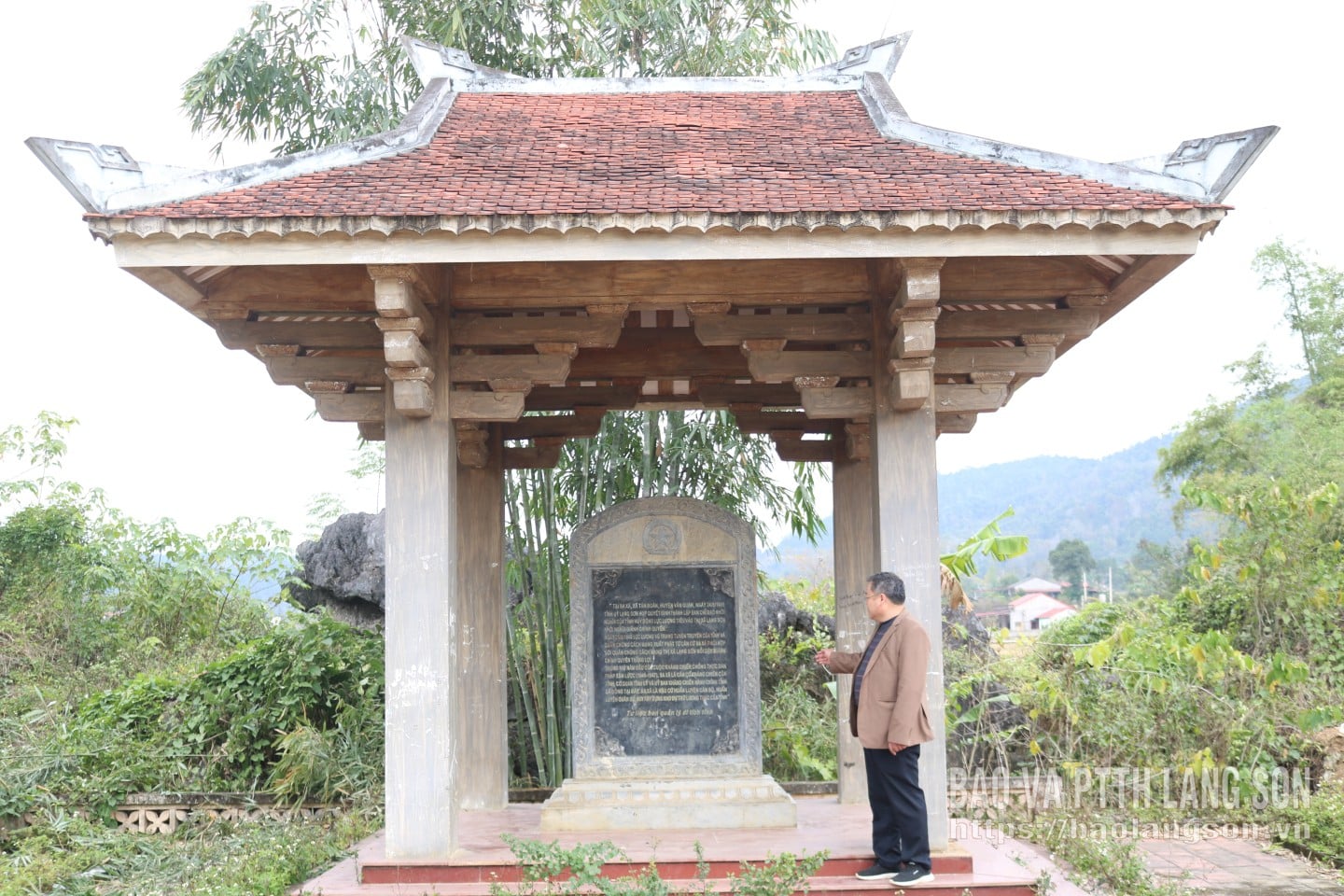
The Ba Xã safe zone encompassed the Ba Xã market town (now Ba Xã village) and several communes such as Vân Nham, Quy Hậu, and Kim Quan (until 1947, they were merged into Tân Đoàn commune) in the former Điềm He district. The Ba Xã market town, along with neighboring villages like Phai Rọ and Lùng Mán (now merged into Phai Rọ - Lùng Mán), was nestled amidst towering mountain ranges. Its terrain was secluded and rugged, yet it benefited from convenient transportation links to the old National Highway 1A and National Highway 1B.
The cornerstone of the revolution
Before the revolution, Diem He district had been established as an important safe zone of the province, with the Ba Xa area as its center. It was in Ba Xa, on August 24, 1945, that the Provincial Viet Minh Committee met and decided to establish a steering committee for the uprising, mobilizing forces to liberate the town. From there, on August 25, 1945, the armed propaganda forces of the province and revolutionary masses advanced towards the town to coordinate with the revolutionary masses in the town to rise up and seize power.
After seizing power, Chiang Kai-shek's forces, and later the French army, successively occupied Lang Son . In November 1946, the French colonialists fired provocatively at Hang De Mountain. In response, the provincial authorities withdrew to Ba Xa to organize and direct the resistance.
During the years 1946-1947, Ba Xa was the operational base of the Provincial Party Committee and the Provincial Administrative Committee, a gathering and training center for the province's main army units, and also the headquarters of the leadership agencies of Cao Loc town and district.
Regarding the Ba Xã base, we were fortunate to meet Mr. Đàm Văn Yên (born in 1925), residing in Phai Rọ - Lùng Mán village, Tân Đoàn commune. He still clearly remembers and recounts that Phia Thình cave was where provincial officials held important meetings, each time guarded by soldiers and guerrillas in two layers. Pò Danh hill, a high point in the middle of the field, was often used by our troops to observe the situation, especially the transportation routes around the base. When provincial officials and soldiers came to operate there, the people in the villages all loved and protected them. Having been enlightened by the revolution early on, immediately after the revolution, he and six other young men from Tân Đoàn volunteered to join the army and actively participated in fighting to protect their homeland.
Moreover, the people of the ethnic groups in the three communes unanimously responded to the "rice jar for the resistance" movement, launched by President Ho Chi Minh. Mr. Lieu Van Duong, an official of the Fatherland Front Committee of Tan Doan commune, shared: "When I was young, my grandparents used to tell me that after the revolution, even though our family was still facing many difficulties, every time we measured out rice to cook, we would save a handful to put in a jar to donate to the revolution."
Alongside this, the Popular Education Movement in Ba Xa was also implemented effectively, and by 1950, more than 50% of the commune's population was literate.
Continuing the tradition
During the years of resistance against the French, Ba Xa served as a strong rear base for the revolutionary movement in the province, sheltering, protecting, and nurturing cadres and soldiers.
Continuing the revolutionary tradition, over the years, the Party Committee and government of Tan Doan commune have led and directed the successful completion of the political tasks set forth. Since 2019, Tan Doan commune has achieved the new rural standard. In Tan Doan, at the commune center – Ba Xa village, multi-story buildings have sprung up densely along Provincial Road 239. As the central village of the commune, and with Ba Xa market serving as a trading hub between neighboring communes, the socio-economic situation of the village is increasingly improving. It is known that Ba Xa village currently has only 4 out of 142 poor households, accounting for 2.8%.
In accordance with the policy of reorganizing administrative units and implementing a two-tiered local government model, Tan Doan commune and Trang Phai commune of the former Van Quan district, and Tan Thanh commune of the former Cao Loc district, were merged into the new Tan Doan commune. After the reorganization, the new administrative apparatus quickly stabilized its operations.
Speaking with us, Mr. Le Xuan Truong, Permanent Deputy Secretary of the Commune Party Committee, said: In the coming time, the Commune Party Committee will continue to direct the effective implementation of political and ideological education, arousing pride in the revolutionary traditions of the homeland in each cadre, Party member and citizen, while leading and directing the comprehensive implementation of tasks to promote socio-economic development, closely monitoring the grassroots, understanding the situation of the people, and creating consensus to successfully achieve the goals and targets set forth in the resolutions of the Party congresses at all levels.
Recently, according to Decision No. 2549 dated November 27, 2025, of the Provincial People's Committee on recognizing safe zone communes in the province after the reorganization of commune-level administrative units, Tan Doan commune is one of the 24 safe zone communes in the province. The Party Committee, government, and people of all ethnic groups in the commune are excited and happy, seeing this as a driving force to continue to unite and work together to build a more prosperous, beautiful, and culturally rich homeland.
Source: https://baolangson.vn/ve-an-toan-khu-ba-xa-5068676.html


![[Photo] General Secretary To Lam visits the exhibition space showcasing books, photo exhibitions, and achievements of digital transformation in journalism.](/_next/image?url=https%3A%2F%2Fvphoto.vietnam.vn%2Fthumb%2F1200x675%2Fvietnam%2Fresource%2FIMAGE%2F2025%2F12%2F19%2F1766110879215_1766110240024-jpg.webp&w=3840&q=75)
![[Photo] Enchanting ancient rose garden on the mountainside in Nghe An](/_next/image?url=https%3A%2F%2Fvphoto.vietnam.vn%2Fthumb%2F1200x675%2Fvietnam%2Fresource%2FIMAGE%2F2025%2F12%2F19%2F1766109900916_vuon-hong-chin-do-thu-hut-du-khach-toi-check-in-o-ha-noi-3-20162778-1671624890024-1671624890104198100259.jpeg&w=3840&q=75)

















































































Comment (0)