Amidst the smoke of incense, memories come flooding back.
It was the 1980s. During those years, the whole country was facing hardship and shortages under the centrally planned economy. Although it was considered a purely agricultural region, the people of Luong village lacked everything from rice to vegetables and fish. To overcome these difficulties, the people in the hilly areas tried growing various crops and applying different economic models to escape poverty. Soybeans, sugarcane, tea, bananas… were all grown in this area, but they only partially improved the lives of the people. The poverty rate remained above two-thirds, and the remaining families barely had enough to eat, let alone become wealthy.
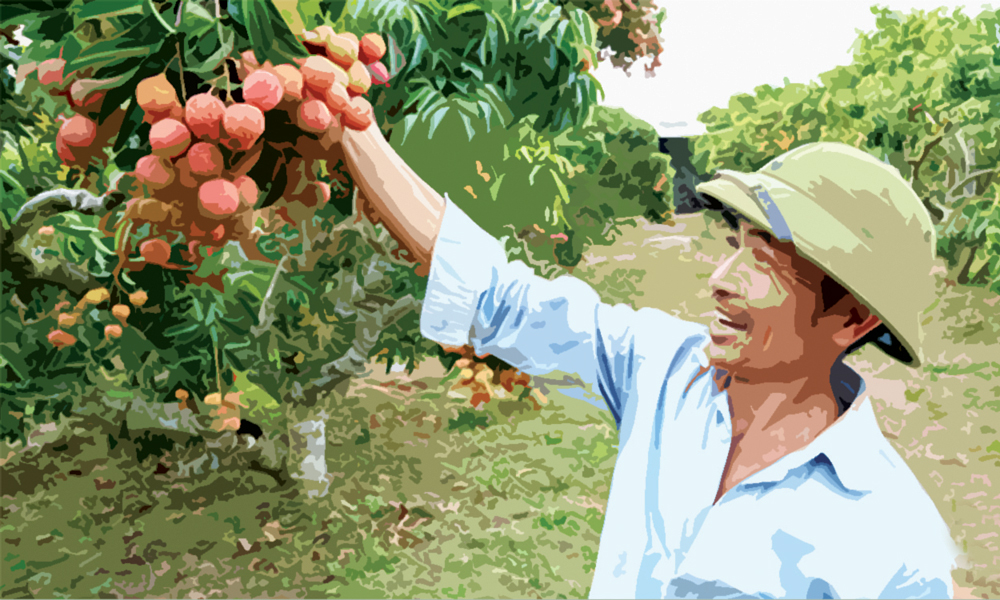
|
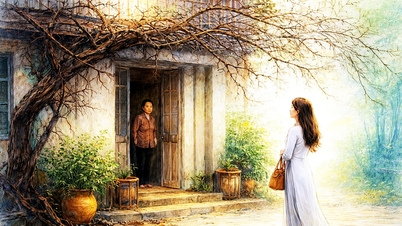
Illustration: China. |
Luong's parents were not originally from the area. They moved to the hilly region to start a new life as part of the New Economic Development movement. Like many other farmers leaving their village, the young couple's belongings included a lychee tree, a Thanh Ha variety from Hai Duong. When his grandfather handed the tree, a graft from an old tree in the garden, to Luong's father, he advised: "Take it and plant it; it will be a memento of your ancestral homeland."
Initially, no one thought that the Thanh Ha lychee variety would become a source of prosperity for the people in the hilly region. Many families from their old hometown of Thanh Ha came to build a new life, planting it only in their gardens and around their houses, along with a few other fruit trees such as pomelo, persimmon, and custard apple. Gradually, seeing that the tree was well-suited to the soil, producing high-quality fruit with high yields and a taste comparable to Thanh Ha lychees, some families boldly planted a few dozen trees, and after ten years, they had a stable fruit yield. Luc Ngan lychees gradually appeared on the market. From the 1980s, canning factories in Hanoi , Vinh Phuc, and Son Tay came to Luc Ngan to buy lychees for canning and export. Fresh Luc Ngan lychees are also popular in localities such as Hanoi, Ho Chi Minh City, and many southern provinces.
As the lychee trees gradually took root in Luc Ngan, Luong was accepted into the Journalism Department at Hanoi University, a school he had long dreamed of attending. Holding the acceptance letter in his hand, Luong couldn't help but feel conflicted. As the eldest of eight siblings, Luong knew that his going to university would place a significant burden on his parents. No one would help them care for the more than one hundred lychee trees they had planted years earlier, which were about to bear fruit and required meticulous, technical care. Normally, at home, Luong helped his parents with researching cultivation techniques, watering, and fertilizing. Gradually, he grew to love the work, the lychee trees, and felt a strong attachment to the hilly area where he was born and raised. And there was also a secret reason that Luong didn't reveal: he had developed feelings for his neighbor, with whom he had attended training courses organized by the Youth Union on lychee tree care techniques…
Knowing Luong's concerns and understanding his dream of becoming a journalist, his father encouraged him: "Don't worry, just focus on your studies. It's not that far from here to Hanoi. You can still come back to help your parents during the harvest season. When the lychee harvest is ready, our family will have an easier time. Besides, your younger siblings are grown up now."
Encouraged by his father and reassured by his girlfriend's promise to help his parents, Luong confidently went to school to enroll, taking his first steps on the path to fulfilling his long-cherished dream of becoming a journalist. From a young age, the image of reporters with their notebooks, pens, and cameras had inspired admiration in the boy from the hilly region.
Despite pursuing a career in journalism, Luong still has a deep affection for lychee trees. Throughout his career, he can't remember how many news articles he's written about his hometown's fruit-growing region, but most of them have focused on lychees and the transformation of the lives of lychee growers. |
Decades have passed in the blink of an eye. From the first lychee orchards, Luc Ngan has now become the capital of lychee cultivation, fulfilling the dreams of the people in the hilly region. The bountiful lychee harvests have transformed the land of Luc Ngan. Luong has also gradually matured. He has faced many challenges and setbacks, but his life as a journalist has given him wonderful experiences, journeys, and insights that he would never have gained without pursuing this profession. And every year, during lychee season, Luong makes time to return home, sharing in the joy of his family and fellow villagers during the bountiful harvest, witnessing his hometown bathed in the red color of lychees, and seeing the bustling trucks carrying these sweet, fragrant fruits to all corners of the country, from the South to the North, and even abroad. Journalism has taken Luong everywhere. He still remembers the exhilarating feeling of seeing fresh Luc Ngan lychees on the shelves of a supermarket in central Tokyo, Japan. That time, he stayed up all night to finish his essay, filled with fresh emotions and pride about his hometown's lychee fruit, hoping that after Japan, Luc Ngan lychees would be available in many places around the world . And Luong's wish came true. Just last lychee season, with a production of hundreds of tons, Luc Ngan lychees were available in China, the EU, Japan, Australia, the United States, Dubai, Canada…
Despite pursuing a career in journalism, Luong still has a deep affection for lychee trees. Throughout his career, he can't remember how many news articles he's written about his hometown's fruit-growing region, but most of them are about lychees and the transformation of lychee growers' lives. Furthermore, continuing his family tradition, Luong and his wife, his former neighbor, have continuously expanded their lychee orchards and introduced early-ripening varieties. His parents have passed away, but the lychee orchard they cultivated is still carefully tended and developed by him and his siblings, becoming one of the most renowned lychee farms in the hilly region. The old thatched-roof, mud-walled house has been replaced by a spacious, airy two-story villa.
From a reporter, Luong rose to become the leader of a sectoral newspaper after decades of dedication and hard work. And after all those years, he now faces a choice. Implementing a streamlining revolution, Luong's newspaper merged with several other units to form a unified press agency under the governing body. The merger inevitably led to personnel changes, including some who would be transferred to other positions, and others who would retire early despite still being capable of contributing. After much deliberation, Luong decided to request early retirement, even though he still had more than two years of service left and was still trusted by the organization. His proactive decision facilitated the governing body's arrangement of key leadership personnel for the new press agency and also created opportunities for younger generations to develop. Luong felt this way and found peace in his decision…
He lit another incense stick at his parents' altar. In the hazy smoke, he seemed to catch a glimpse of a smile in his father's eyes. He silently prayed: Father, now is the time for me to return to the hills, to wholeheartedly dedicate myself to caring for the lychee orchard that you and Father built years ago, along with my wife, children, and siblings. In the afterlife, you must be pleased with my decision, just as you encouraged me to focus on my studies and pursue my beloved journalism, a profession I will dedicate my life to, and even if I return to the hills, I will never give it up…
Short stories by Le Ngoc Minh Anh
Source: https://baobacgiang.vn/ve-lai-vung-doi-postid420451.bbg




![[Video] Sunset at Lap An Lagoon – Where the sun sets over the fishing nets](https://vphoto.vietnam.vn/thumb/1200x675/vietnam/resource/IMAGE/2026/05/31/1780192137701_beach-landscape-sea-water-nature-grass-745871-pxhere-com.jpeg)


















![[Video] Sunset at Lap An Lagoon – Where the sun sets over the fishing nets](https://vphoto.vietnam.vn/thumb/800x450/vietnam/resource/IMAGE/2026/05/31/1780192137701_beach-landscape-sea-water-nature-grass-745871-pxhere-com.jpeg)











































![[Video] Sunset at Lap An Lagoon – Where the sun sets over the fishing nets](https://vphoto.vietnam.vn/thumb/402x226/vietnam/resource/IMAGE/2026/05/31/1780192137701_beach-landscape-sea-water-nature-grass-745871-pxhere-com.jpeg)





























Comment (0)