

Mr. Le Hoan Nhan, a tourist from Can Tho visiting Tinh Bien market, said, "I really like this place."
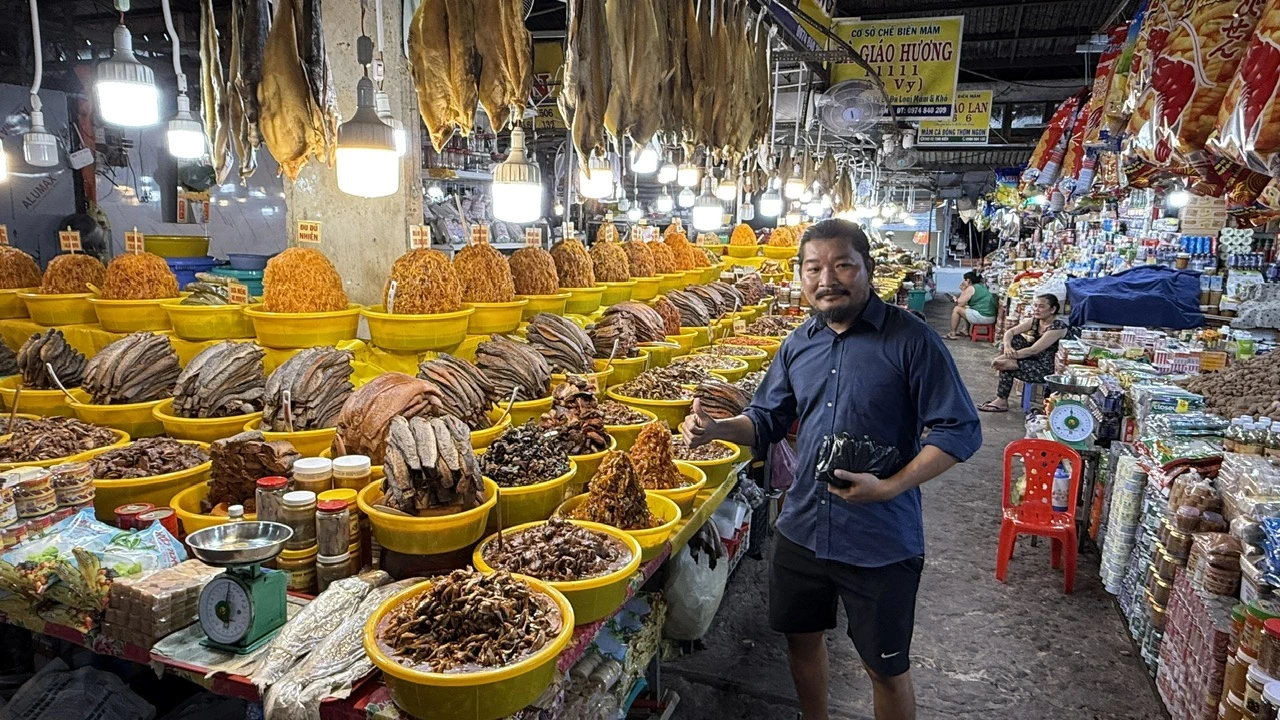
The imprint of Tinh Bien market
"Well, sales aren't very good," a salesperson, about 17-18 years old, with a friendly smile, answered a customer's question softly and politely.
Tịnh Biên Market has approximately 210 business households with over 540 stalls. It is said that in the first six months of 2024, the town welcomed over 2 million visitors for sightseeing and shopping, generating revenue exceeding 204 billion VND. The Tịnh Biên - An Giang International Trade Fair 2024 alone generated over 10 billion VND in sales and attracted more than 170,000 visitors – more than the entire population of Tịnh Biên.
Leaving the bustling Tinh Bien market, let's not even talk about domestic versus imported goods; there's a clear concentration, abundance, and diversity. The vendors are open, friendly, and enthusiastic, even though purchasing power isn't particularly strong. Imported goods make up the majority, but domestic goods are also quite plentiful, especially local products. This is the solid three-pillar structure that has been forming the market since the beginning of the 19th century.
Tịnh Biên – initially known as the "Nghê Thường" and later as the "Lục Yêu" – is associated with the period when King Ang Chan II gifted three regions, Chân Sum, Mật Luật, and Lợi Kha Bát, to the Nguyễn dynasty through Ngọc Hầu Nguyễn Văn Thoại. The Nguyễn dynasty only received Chân Sum and Mật Luật, then divided Chân Sum into Hà Âm and Hà Dương, belonging to the Tĩnh Biên (Tịnh Biên) prefecture, part of Hà Tiên province. The place name Tịnh Biên appeared in 1832, when King Minh Mạng divided the five provinces into six, with the Tĩnh Biên prefecture belonging to Hà Tiên province.
In the second year of the reign of Emperor Thieu Tri (1842), Tinh Bien prefecture and Ha Duong district of Ha Tien were merged into Ha Tien province. In the third year of the reign of Emperor Tu Duc (1850), Tinh Bien prefecture was dissolved, and the two districts of Ha Am and Ha Duong were merged into Tuy Bien prefecture. "Did the ancients really separate and merge so much?" - many tourists from afar are delighted to hear these old stories. They also appreciate the current situation where imported goods are cheap. People from across the border, hundreds of kilometers from Phnom Penh, love the market because they can buy everything from Vietnam. That's the characteristic feature of border markets: a mix of domestic and imported goods.
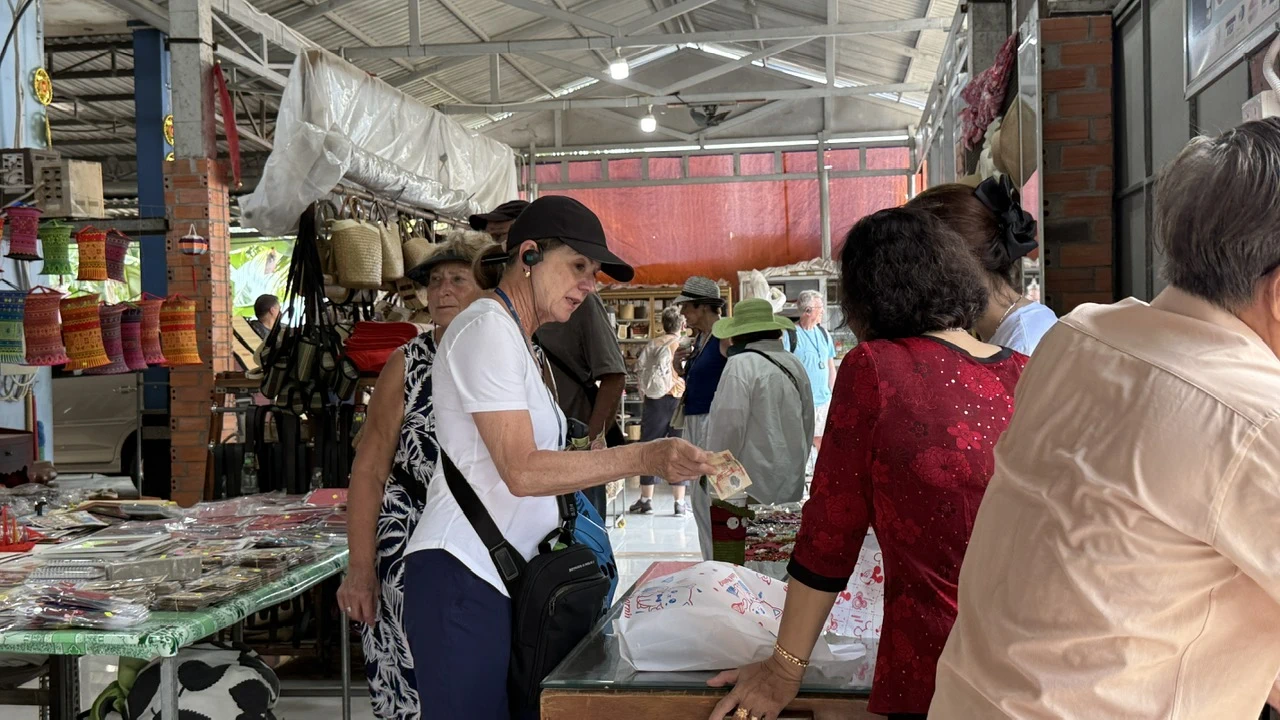
Mr. Le Van Tho's tourist reception point, "Tan Chau Long".
The brightly lit fish sauce section of the market is the backbone of this market. The vendors here are great because even if you don't buy anything from them, if you need something, they'll immediately point you to the stall you're looking for – very cheerful and friendly. One vendor said that the Tinh Bien border economic zone used to be vibrant when there was a duty-free shop in the duty-free zone. Frankly, at that time, the traditional Tinh Bien market was overshadowed by the duty-free supermarket. Yet, when the duty-free shop closed, the vendors weren't happy because the "border zone light effect" for a new game had quickly faded.
An Giang province has proposed developing the Tinh Bien International Border Gate Logistics Center with an investment of 239 billion VND to attract investment into the border economic zone and boost growth. The strategy includes persistently defending the proposal submitted to UNESCO for the Ba Chua Xu Festival to be recognized as an Intangible Cultural Heritage of Humanity, alongside efforts to transform natural and man-made landscapes into magnets attracting entrepreneurs and residents on both sides of the border, creating a vibrant highlight in the border trade economic zone.
"We hope to have a thematic workshop on border trade economics, not only for An Giang but also for all localities sharing a border with Cambodia in the Southwest region," said Ho Van Mung, Chairman of the People's Committee of An Giang province, at the Mekong Connect 2024 Forum.
Tan Chau Gateway
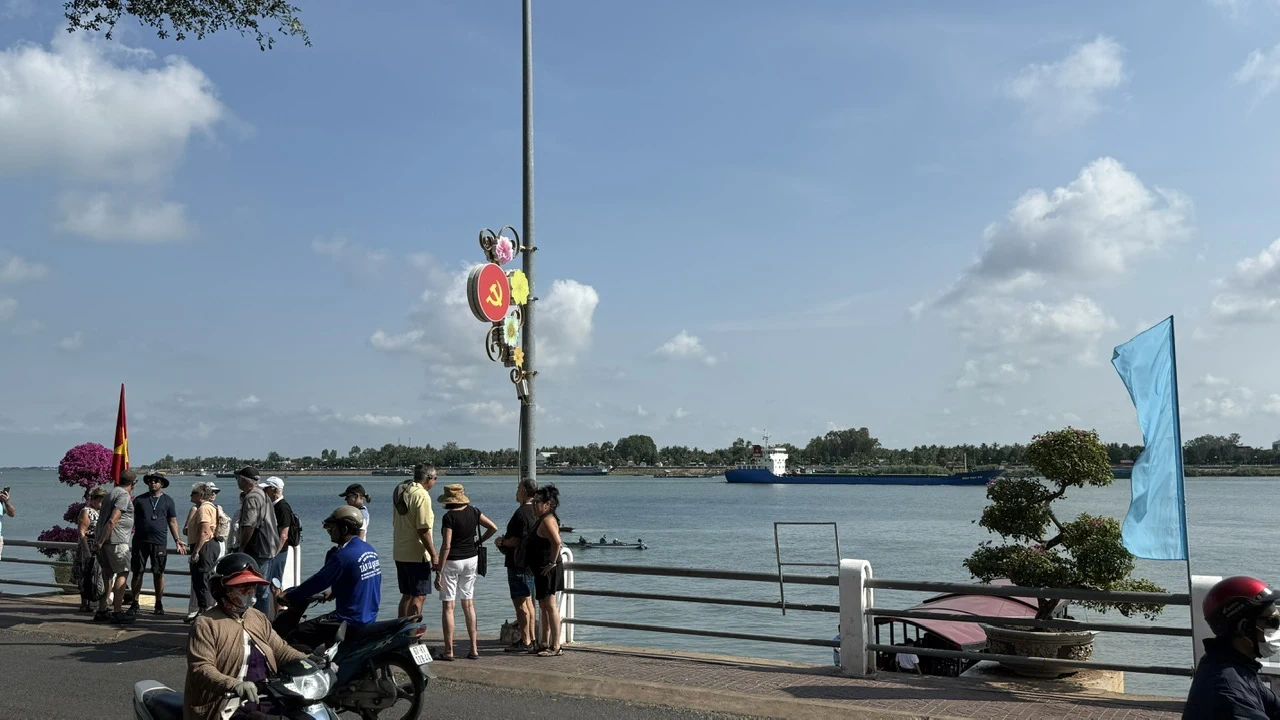
As the sun rose, I enjoyed the gentle breeze blowing from the Tien River. I glanced around the panoramic view from Tan Chau towards Hong Ngu – a picture emerged of bustling towns and cities along the riverbanks; boats and ships traversed the waterway connecting to the Kingdom of Cambodia.
The connectivity is becoming more detailed. Hong Ngu is receiving investment and upgrading the provincial road 841 connecting the center of Hong Ngu city with the Thuong Phuoc International Border Gate Economic Zone; the Hong Ngu - Tan Chau ferry terminal is being expanded and upgraded; and investment is being sought for projects such as the Cai Vung bridge, the Muong Lon ferry terminal, the Long Khanh B ferry terminal via An Thanh ward, and the Muong Mieu ferry terminal via Tan Chau (An Giang province).
Gazing out at the vast river from BOKE Coffee, a chain of cafes and beverage shops along the embankment from Chau Doc to Tan Chau, Mr. Le Van Tho, in his seventies, owner of Tan Chau Long, a tourist attraction showcasing woven mats and handicrafts made from uzu, sedge, and reeds, says he finds joy in his twilight years seeing tourists from all over come to his homeland, visit the weaving village, and shop at the market. He particularly enjoys seeing foreign tourists – mostly elderly – seeking cultural similarities and differences, and expressing their amazement at the unexpected creativity in exploiting plant and fruit resources to create unique silk fabrics like My A silk, and exquisite mats, bags, and tableware made from uzu and sedge.
The Tien River stretches endlessly.
Tan Chau town has shifted its economic structure towards a strong trade and service sector (accounting for 60.74% of the economic structure). Tan Chau Market has a total retail sales of goods and revenue from food, accommodation, and other services estimated at over 7,800 billion VND. Retail sales and social consumption in Tan Chau town have increased by an average of 11.42% annually, and the average per capita income (household) in 2023 reached over 68 million VND/person/year. In 2021, Tan Chau Market alone contributed over 3.1 billion VND to the budget.
In 2022, the People's Committee of Tan Chau town set several targets: Total retail sales of goods and consumer service revenue in the area reaching over 11,000 billion VND; average per capita income exceeding 65 million VND/year; total state budget revenue from the local economy reaching nearly 600 billion VND…
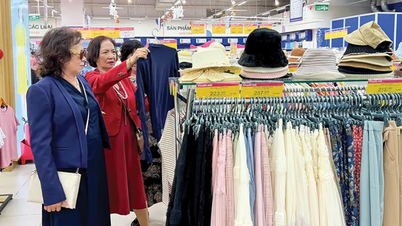
At the edge of the market was a jewelry shop – gleaming gold in the midday sun – everyone understood that buying and selling was much more difficult now than before because markets, shopping malls, and modern distribution channels were everywhere… a densely stretched network covering the market. “Without something different, it’s very hard to sell,” the small traders said. Ms. Tư Du, a fish sauce vendor and friend from Châu Phong, advised me to find this particular stall to buy fermented catfish sauce with rice wine and palm sugar – a unique product that has been maintained for three generations.
Opposite Tư Du's stall, famous for its fermented fish sauce made from Vinh carp, is the "Chấm - Trinh" dried seafood stall. This young couple had just welcomed their youngest child, who was sleeping soundly in his mother's arms. Trinh, busy with her dried seafood and fermented fish sauce stall, chuckled and said, "Buying and selling at the market is so complicated."
Many famous salted catfish from Phnom Penh, weighing 5-7kg, golden-brown dried catfish from Tonle Sap Lake, and various types of dried white meat prepared to Vietnamese tastes – these are the items Chấm helps his wife with, simultaneously answering phone calls and arranging daily shipments via cargo carriers. Local buyers are usually tourists; online orders and shipments via cargo carriers are the only way to make ends meet. Regardless of the online business model, delivery remains the most important factor. Fortunately, Tân Châu has a delivery service that goes all the way to the Eastern region, Chấm says.
Then there's the rice vendor selling Rum Duol, Khakanhay, Soc rice mixed with ruby red rice, bird's claw rice, Thai sticky rice, Nang Hoa rice, "Vietnamese" blood rice, Thai blood rice... you can buy 1kg or more, many varieties enough for a family to eat for a month, and delivery is available; for those far away, they send it via freight forwarding. That's a difference compared to the old days.
The Vinh Xuong border gate was designated as an international river border gate in 1995, and officially became a unified international border gate from both river and land border gates in 2023. From here, it connects to Kaorm Samnor in the Kingdom of Cambodia via the river. In 2010, the import and export turnover through this border gate was approximately 500 million USD. After the pandemic, the import and export turnover reached nearly 700 million USD.
An Giang province has a border nearly 100km long, bordering the two provinces of Kandal and Takeo of the Kingdom of Cambodia; including two international border gates, Tinh Bien and Vinh Xuong; two main border gates, Khanh Binh and Vinh Hoi Dong, and one secondary border gate, Bac Dai.
In 2024, An Giang province is expected to receive approximately 9.1 million tourists, generating a total tourism revenue of around 10,250 billion VND, a 73.73% increase compared to the same period. According to the plan, the merger of Kien Giang and An Giang provinces will create a new province with a natural area of 9,888.9 km2 and a population of 3,679,200 people. The merger of An Giang, Kien Giang, Dong Thap, Tien Giang, and Tay Ninh into Long An will expand the border trade economic space from the Mekong Delta to the Eastern region.
The tourism industry of An Giang and Kien Giang, with its unprecedented advantages and boundless potential for innovation from the plains, mountains, and islands, is opening up, although it still faces challenges in terms of algorithms and complaints about placing toll booths in the Mount Sam National Tourist Area.
The new direction will be a beautiful melody; the people living along the border believe so.
Text and photos: CHAU LAN
Source: https://baocantho.com.vn/ve-vung-bien--a186370.html











































































Comment (0)