

The situation became increasingly unstable after the election.
According to allegations from the Venezuelan Attorney General's Office, Edmundo Gonzalez is accused of numerous crimes against the state, including charges related to the announcement of the results of the recent presidential election in the country.
Previously, the Venezuelan Attorney General's Office had issued three subpoenas to Mr. Gonzalez because his team posted online what were deemed "false" results of the presidential election, causing public confusion about the victory of President Nicolas Maduro, leader of the United Socialist Party of Venezuela (PSUV). National Assembly President Jorge Rodriguez Gomez subsequently pointed to signs of the opposition manipulating polling station protocols.
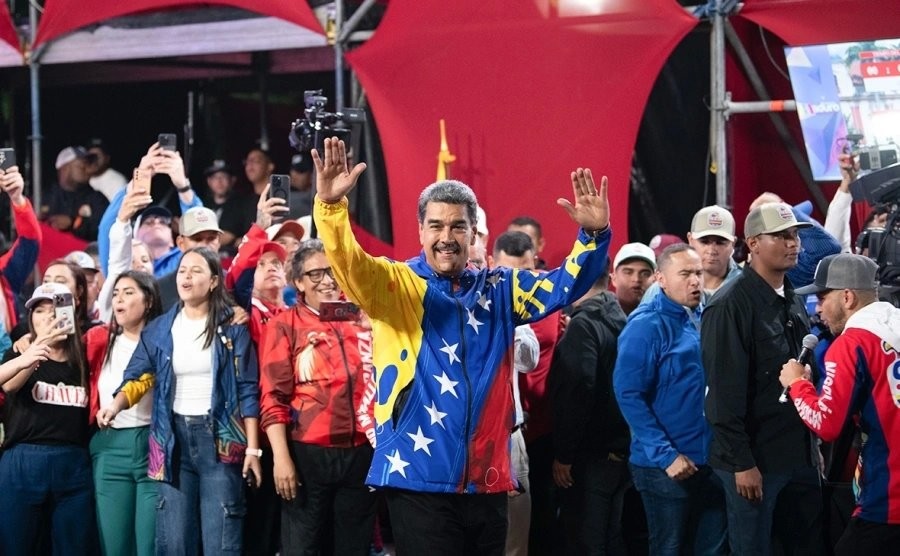
Venezuelan President Nicolas Maduro. Photo: Reuters
The Venezuelan government's harsh measures against the opposition in general, and Edmundo Gonzalez in particular, have been strongly opposed by Maria Corina Machado, a key figure in the Venezuelan opposition, who is also under criminal investigation by the country's Attorney General's Office because Machado had previously called for the recognition of Edmundo Gonzalez as the winner of the recent presidential election.
On July 29, incumbent President Nicolas Maduro was officially declared the winner of the July 28 election by Venezuela's electoral commission. Maduro called the victory "irreversible," although the opposition did not recognize it, and opposing forces abroad raised doubts about the authenticity of the declaration.
Shortly afterward, the opposition refuted Maduro's claim of victory. Gonzalez and Machado stated they could prove their win after securing 73.2% of the votes cast at polling stations.
The opposition accused President Nicolas Maduro of plunging Venezuela into an economic and humanitarian crisis, forcing millions to flee the country. Simultaneously, the opposition called on its supporters to take to the streets to protest the officially announced election results. Following a day of massive demonstrations, violent clashes occurred with security forces.
Will the opposition organize a new wave of protests?
Venezuela faced a political crisis after Maduro was re-elected for a second term in 2018. The country was then engulfed in thousands of protests, and the opposition declared the President of the National Assembly, Juan Guaido, as the country's leader.
Guaido enjoyed support from several Western countries, including the United States, Israel, and even the Latin American association "Lima Group." Two structures simultaneously called themselves parliaments – the Venezuelan National Assembly, officially recognized and largely controlled by President Nicolas Maduro's party, and the "Alternative Legislative Assembly" led by opposition leader Guaido. However, international support for Guaido gradually waned, and divisions emerged within the opposition.
World leaders were divided in their assessment of the results of the Venezuelan elections on July 28. On July 29, Russia and China congratulated Maduro on his victory. Meanwhile, several countries in the region, including Argentina, Peru, and Costa Rica, almost immediately declared they would not recognize Maduro's victory.
Western countries initially issued cautious statements expressing concern about the situation in Venezuela. However, on August 1st, US Secretary of State Antony Blinken officially congratulated Edmundo Gonzalez on his election victory, stating that it was time for Venezuela to carry out a “peaceful and respectful transfer of power.”
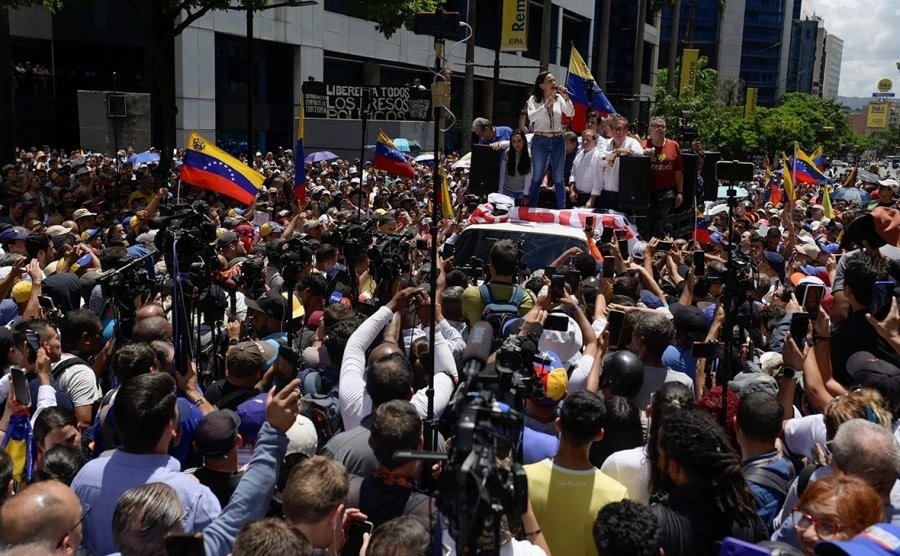
A protest movement by the Venezuelan opposition. Photo: Reuters
On August 3rd, the heads of the foreign affairs committees of both houses of the US Congress, as well as the chairmen of the foreign affairs committees of several European countries, issued a joint statement demanding Maduro's resignation. At the end of August, the head of European diplomacy, Josep Borrell, stated that the European Union (EU) had also decided not to recognize Maduro's victory in the election.
On September 3rd, Bloomberg, citing sources, reported that the US Department of Justice is preparing to impose sanctions on 15 Venezuelan officials. According to the draft document proposed by the agency, the restrictions would directly target members of the Venezuelan Electoral Council, the Supreme Court, and SEBIN (Bolivar National Intelligence Agency).
The U.S. also seized an aircraft believed to be President Nicolas Maduro's private jet, estimated to be worth around $13 million, on the grounds that it violated Washington's sanctions against Caracas. The Venezuelan government condemned the seizure of the presidential plane in a statement on September 2 and accused Washington of escalating its interference in Venezuela's internal affairs.
According to RBC, Andrei Pyatkov, a leading researcher at the Center for Political Studies, Institute of Latin America of the Russian Academy of Sciences, believes that the international community is now far less inclined to support the Venezuelan opposition than in 2018. Pyatkov notes that the US is awaiting the reaction of the Latin American community and remains extremely cautious about placing bets on opposition leader Edmundo Gonzalez, considering him a figure lacking the credibility to reverse the current political situation in Venezuela.
“The current crisis is fundamentally different from the situation in 2018, because Guaido then had a clearer political base as Speaker of Parliament than Gonzalez, who, although he had become the official leader of the opposition, still had a relatively modest political career, even considered second only to Machado, who had a better ability to mobilize society,” Pyatkov emphasized.
According to the Russian expert, Gonzalez's arrest could become a trigger for the opposition and lead to "radicalization" of their actions under Machado's leadership. Machado may be a figure of particular interest to President Nicolas Maduro's government; because she and the Vente Venezuela political movement have attracted a large number of supporters at polling stations, around 600,000 people, and this could provoke strong resistance from the Venezuelan opposition in the coming period.
Ha Anh
Source: https://www.congluan.vn/venezuela-lieu-co-the-tranh-duoc-vong-xoay-bat-on-moi-post310657.html





















































Comment (0)