

Baoquocte.vn. The Hanoi Capital City Planning for the period 2021-2030, with a vision to 2050, is a comprehensive plan that integrates relevant specialized and sectoral plans across the entire city, linked to national plans, national sectoral plans, and regional plans.
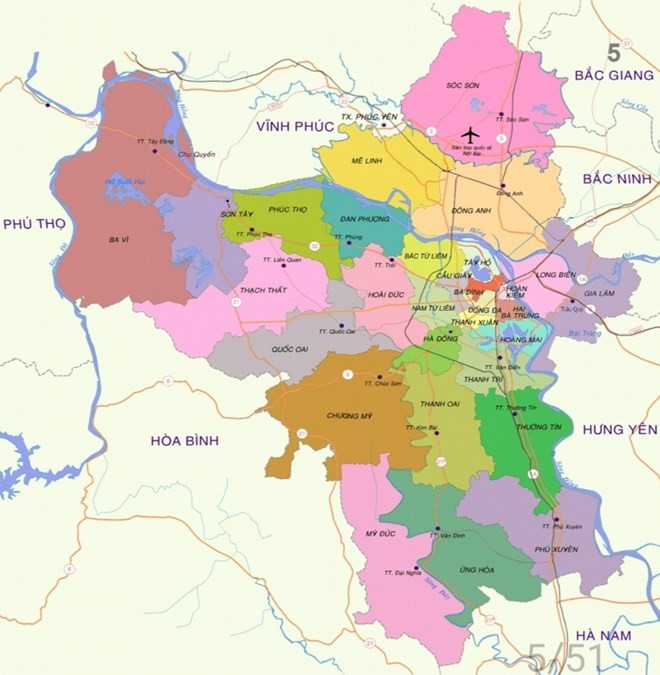 |
| The Hanoi People's Committee is soliciting feedback on the draft Hanoi Capital City Planning for the period 2021-2030, with a vision to 2050. (Source: Hanoi People's Committee) |
Adjustments are needed to ensure the capital city develops to its full potential.
Resolution 15-NQ/TW of the Politburo, issued on May 5, 2022, sets the goal: By 2030, Hanoi will be a "Cultural - Civilized - Modern" city, becoming the center and driving force for development in the Red River Delta region, the key economic region of Northern Vietnam, and the whole country, deeply integrated into the international community, highly competitive with the region and the world, striving to develop to the level of capitals of developed countries in the region; by 2045, Hanoi will be a globally connected city with a high standard of living and quality of life; its economy, culture, and society will develop comprehensively, uniquely, and harmoniously; it will be a model for the whole country; and its level of development will be on par with capitals of developed countries... To achieve this goal, adjusting the overall planning of the Capital City is essential.
After 10 years of implementing the 1998 Capital City Planning, Hanoi once again became overcrowded. To open up development opportunities and resolve existing problems, on May 29, 2008, the 12th National Assembly passed a resolution expanding Hanoi's administrative boundaries, specifically by merging the entire province of Ha Tay, four communes of Luong Son district (Hoa Binh province), and Me Linh district (Vinh Phuc province) into Hanoi city, increasing the capital's area to 3,344 km² . This necessitated a new planning scheme.
On July 26, 2011, the Prime Minister approved the "General Planning Project for the Construction of Hanoi Capital City until 2030, with a vision to 2050". The purpose of the plan is to build Hanoi into a "Green - Culturally Rich - Civilized - Modern and Sustainable" city. Experts have assessed that "the plan has breakthroughs, namely the development of satellite cities".
Hanoi today is modern yet still preserves many traditional values. The old quarter, the old streets, and the new streets blend together, with the emergence of many modern architectural buildings. The Noi Bai - Nhat Tan Bridge axis connects the capital's center with the northern gateway. The eastern area (left bank of the Red River) has undergone rapid urbanization on a scale and with a landscape similar to developed countries. However, during implementation, the planning project approved in 2011 still revealed shortcomings and limitations. Many of the capital's potentials and advantages have not been fully exploited and utilized. Urban development is not comprehensive and lacks synchronization; many large projects are slow to be implemented, causing a waste of resources. The planning and construction of satellite cities did not meet the targets... To address these limitations, on May 25, 2021, the Hanoi People's Committee issued Plan 129/KH-UBND to implement the overall adjustment of the "General Planning Project for the Construction of Hanoi Capital City until 2030, with a vision to 2050".
Hanoi Party Secretary Dinh Tien Dung stated: "The comprehensive study and adjustment of the master plan for the construction of the capital city to suit the practical situation and the socio-economic development orientation of the city in the short and long term is very necessary."
Meeting the goals of sustainable urban development.
According to Vice Chairman of the Hanoi People's Committee Duong Duc Tuan, the City People's Committee will urgently implement the next steps, such as selecting consultants; establishing a group of experts and scientists to review and conduct in-depth research on the driving forces for the capital's development; investigating, analyzing, and evaluating the current situation; collecting and standardizing data… In particular, the process of researching and adjusting the planning will be carried out in parallel and integrated with the Hanoi Capital Planning for the period 2021-2030, with a vision to 2050, and other national and regional planning.
Sharing his perspective, Chairman of the Vietnam Urban Planning and Development Association Tran Ngoc Chinh stated that reviewing and re-evaluating the General Planning is absolutely necessary for Hanoi. This will allow for strategic forecasting of sectors, socio-economic development, and will serve as a guideline for urban planning and development, as well as a foundation for integration into the Capital City Planning for the period 2021-2030, with a vision to 2050.
However, in addition to orientation and target programs, good consultation is needed to ensure high-quality planning, develop planning ideas, and fully exploit natural resources, human resources, and other resources to build and develop the capital city to its full potential. This planning task also particularly emphasizes the need to guide population growth because in recent years, managing and controlling population in the central urban area and relocating people from the inner city has faced many difficulties, leading to overloaded urban infrastructure, frequent traffic congestion, smog, and air pollution. With a rapid and unpredictable increase in population, guiding population growth in the future will also be a difficult task, requiring the city to have strict management.
Mr. Tran Ngoc Chinh assessed that the Hanoi People's Committee's Hanoi Capital City Planning for the period 2021-2030, with a vision to 2050, is a comprehensive plan that integrates relevant specialized and sectoral plans across the entire city, linked with national plans, national sectoral plans, and regional plans.
"Therefore, the adjustment of the General Planning for the Construction of Hanoi Capital City must ensure synchronicity, consistency, and uniformity with the National Master Plan for the period 2021-2030, with a vision to 2050, as well as national sectoral plans, the Red River Delta Regional Plan for the period 2021-2030, with a vision to 2050, and the Capital City Plan currently under study," emphasized the Chairman of the Vietnam Urban Planning and Development Association.
Given the aforementioned practical requirements, the assignment by the Hanoi People's Committee to the Hanoi Institute of Construction Planning to develop a revised master plan for the construction of Hanoi Capital City until 2045, with a vision to 2065, is necessary and urgent.
Expressing his views, Mr. Dao Ngoc Nghiem, Vice President of the Vietnam Urban Planning and Development Association, stated that new aspects such as the planning vision, population targets, and the model of a city within the capital are major and complex orientations that significantly impact this planning adjustment. Therefore, the city needs to gather leading scientists and experts to provide forecasts and ensure that the adjusted planning project is of high quality and feasibility.
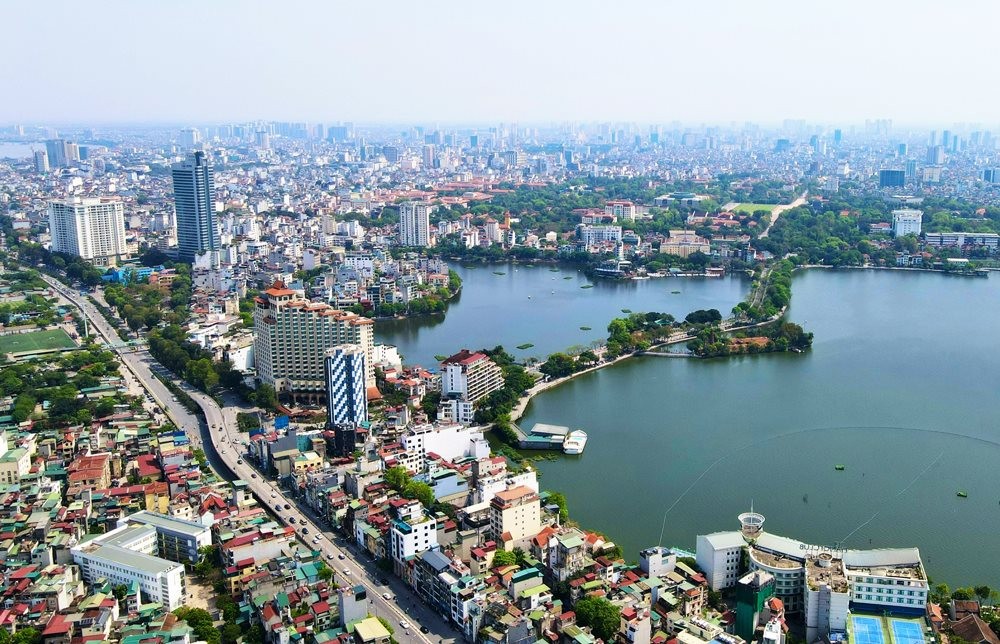 |
| Hanoi, the capital city, is envisioned to become a "Green - Culturally Rich - Civilized - Modern" city. (Source: Hanoimoi) |
Great opportunities and challenges for Hanoi.
Hanoi, as the national political and administrative center, and a major hub for economy, culture, education and training, science and technology, is a significant milestone in the development of the capital city, especially with its role and position as the political and administrative nerve center. Adjusting the master plan for Hanoi, with its many new requirements, presents both significant opportunities and challenges.
In practice, from 2011 to the present, several legal regulations related to construction planning and urban planning have been amended, supplemented, or newly enacted, such as the 2014 Construction Law and the 2017 Planning Law. These adjustments, along with national and regional socio-economic development strategies and urban and rural development plans, have affected the nature, function, and development orientation of the capital city. In particular, a series of recent resolutions issued by the Politburo, along with national sectoral plans, have placed many new demands on the planning and development of Hanoi, requiring review and adjustment to ensure suitability.
Adhering closely to and concretizing the resolutions of the Politburo related to the direction and tasks of developing Hanoi Capital; the laws, decrees, and circulars related to construction planning and urban planning; and the relevant decisions approving planning at higher levels, Hanoi has a full practical and legal basis to carry out the task of comprehensively adjusting the General Planning for the Construction of Hanoi Capital until 2030 and with a vision to 2050 (Plan 1259).
Hanoi, the capital city, is envisioned to become a "Green - Culturally Rich - Civilized - Modern" city, a dynamic and efficient urban center with high competitiveness domestically, regionally, and internationally; offering a good living and working environment, high-quality recreational activities, and favorable investment opportunities. The proposed urban cluster development model includes one central city, five satellite cities, ecological cities, towns, and rural areas; connected by a system of ring roads combined with radial axes, linking to the transportation network of the Capital Region and the nation.
In particular, Hanoi has a legal basis for adjusting its planning when the Politburo issued Resolution No. 30-NQ/TƯ on socio-economic development and ensuring national defense and security in the Red River Delta region until 2030, with a vision to 2045.
The master plan for the construction of Hanoi Capital City until 2030 and with a vision to 2050 sets out the goal of building Hanoi into a sustainably developed capital city with a synchronous and modern social and technical infrastructure system, harmoniously developing culture, preserving heritage and historical relics, and developing the economy, with a focus on the knowledge economy and environmental protection, ensuring national defense and security in the direction of regional, national and international linkages.
Offering recommendations, the Director of the Hanoi Institute of Construction Planning, Luu Quang Huy, stated: “Based on the identified limitations, in this comprehensive adjustment of the Hanoi Capital City Master Plan, in addition to considering new factors arising during the planning process, research into the feasibility of the plan, its suitability to the general development trend, and its close connection with urban economic development are also necessary. Mechanisms and procedures need to be developed and improved by all levels and sectors to avoid obstacles right from the planning stage.”
Source
![[Photo] Ba Lang An Lighthouse - the "eye of the sea" amidst the "rock museum" of Quang Ngai province.](https://vphoto.vietnam.vn/thumb/1200x675/vietnam/resource/IMAGE/2026/05/29/1780038698840_anh-man-hinh-2026-05-29-luc-14-10-42.png)


![[Image] Pleasant weather helps students enter the 10th grade entrance exam with confidence.](https://vphoto.vietnam.vn/thumb/1200x675/vietnam/resource/IMAGE/2026/05/29/1780034401612_ngay-1-thi-lop-10-minh-duy-8-5009-jpg.webp)













































































Comment (0)