

Vietnam has been operating a competitive electricity market with three levels, including the competitive electricity generation market which has been operational since July 1, 2012. Therefore, according to market principles, EVN will purchase electricity from sources with the lowest prices first, then the highest prices. Thus, all sources from hydropower, coal, gas, oil, and renewable energy are sold to EVN.
Buy at market price, sell at regulated price.
“If EVN is not the sole buyer, then customers will have to bear the high electricity prices from the producers. For example, if we operate a competitive retail electricity market as designed, then power plants are selected to sell directly to customers. Therefore, if customers buy electricity from oil and gas-fired power plants, they have to pay for it themselves; no one buys it for them. That is the principle of a competitive retail market. As EVN remains the sole buyer, the high purchase costs are all borne by EVN, while the selling price of electricity is regulated by the State,” said Deputy Minister of Industry and Trade Dang Hoang An.
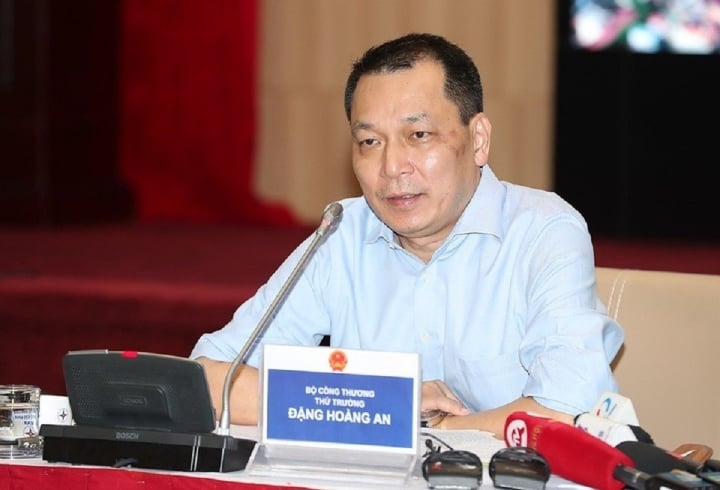
Deputy Minister of Industry and Trade Dang Hoang An answers questions from the press regarding EVN's losses.
According to Mr. An, EVN buys electricity at market prices (high prices) and sells it at government -regulated prices (lower than the purchase price in the competitive electricity generation market). This is not to mention that at this time, hydropower (cheap) lacks water, resulting in very low electricity generation output. Currently, the power system is mobilizing electricity sources with high production costs to meet societal needs.
Mr. An also added that, when operating a competitive retail market, power plants will be selected to sell directly to customers. Therefore, if customers purchase electricity from oil or gas-fired power plants, they will have to pay for it themselves. That is the principle of a competitive retail market.
Regarding the information that EVN might propose increasing electricity prices when input costs are high, Mr. An stated that EVN's responsibility is to ensure electricity supply. Therefore, the corporation does not operate for economic efficiency by cutting off electricity, even though the cost of purchasing electricity increases during the dry season.
"No matter how high the production costs are, we must mobilize all resources to ensure electricity supply," Mr. An affirmed, but said he was not yet aware of information regarding EVN's intention to further increase electricity prices.
Members of parliament requested clarification on the 26,000 billion VND loss.
Earlier, during the National Assembly's discussion on socio-economic issues, delegate Ta Thi Yen (Phu Yen) raised concerns about the business performance of EVN, given its reported loss of 26,000 billion VND in 2022.
According to Ms. Yen, from 2010 to the present, EVN has adjusted electricity prices eight times, raising the average price from 1,058 VND/kWh to 1,864.44 VND/kWh (in 2019), and continues to report losses and request further price increases.
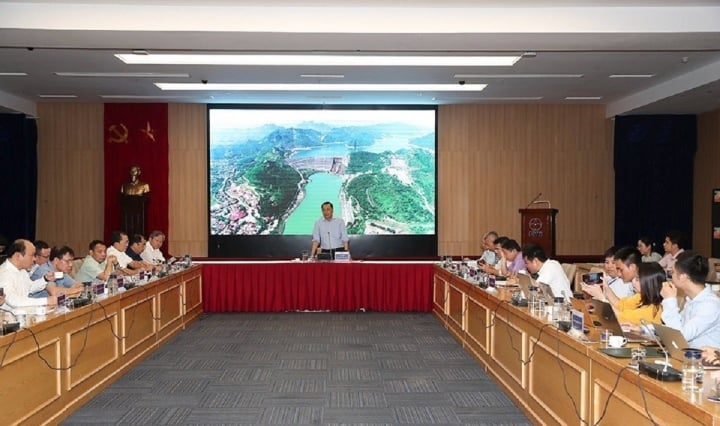
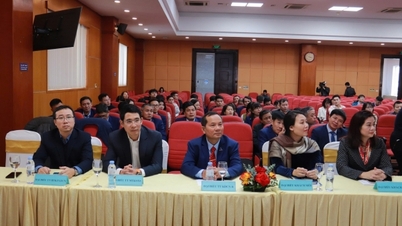
Reporters asked questions at the press conference.
Notably, within the same ecosystem, the parent company reported losses while its subsidiaries still announced high profits in 2022. For example, two companies under EVN, Power Generation Corporation 3 and Power Generation Corporation 2, both recorded after-tax profits of VND 2,550 billion and VND 3,668 billion respectively in 2022…
"So what is the main cause of this loss? If it's due to high input costs, including fuel, interest rates, or exchange rate losses, then the subsidiaries are also facing similar difficulties. Why are the results different? Is this a problem of management capacity?", Ms. Yen asked.
Regarding the recent issue raised by National Assembly deputies concerning the need for transparency in EVN's losses (reported at approximately 26 trillion VND in 2022), Mr. Dang Hoang An stated that there is a paradox: EVN only accounts for about 38.4% of the total capacity of Vietnam's electricity system, yet it bears all the losses. Meanwhile, many power generation companies, including EVN's subsidiaries, power generation corporations, and joint-stock companies, are still profitable.
Pham Duy
Beneficial
Emotion
Creative
Unique
Source

















































































Comment (0)